

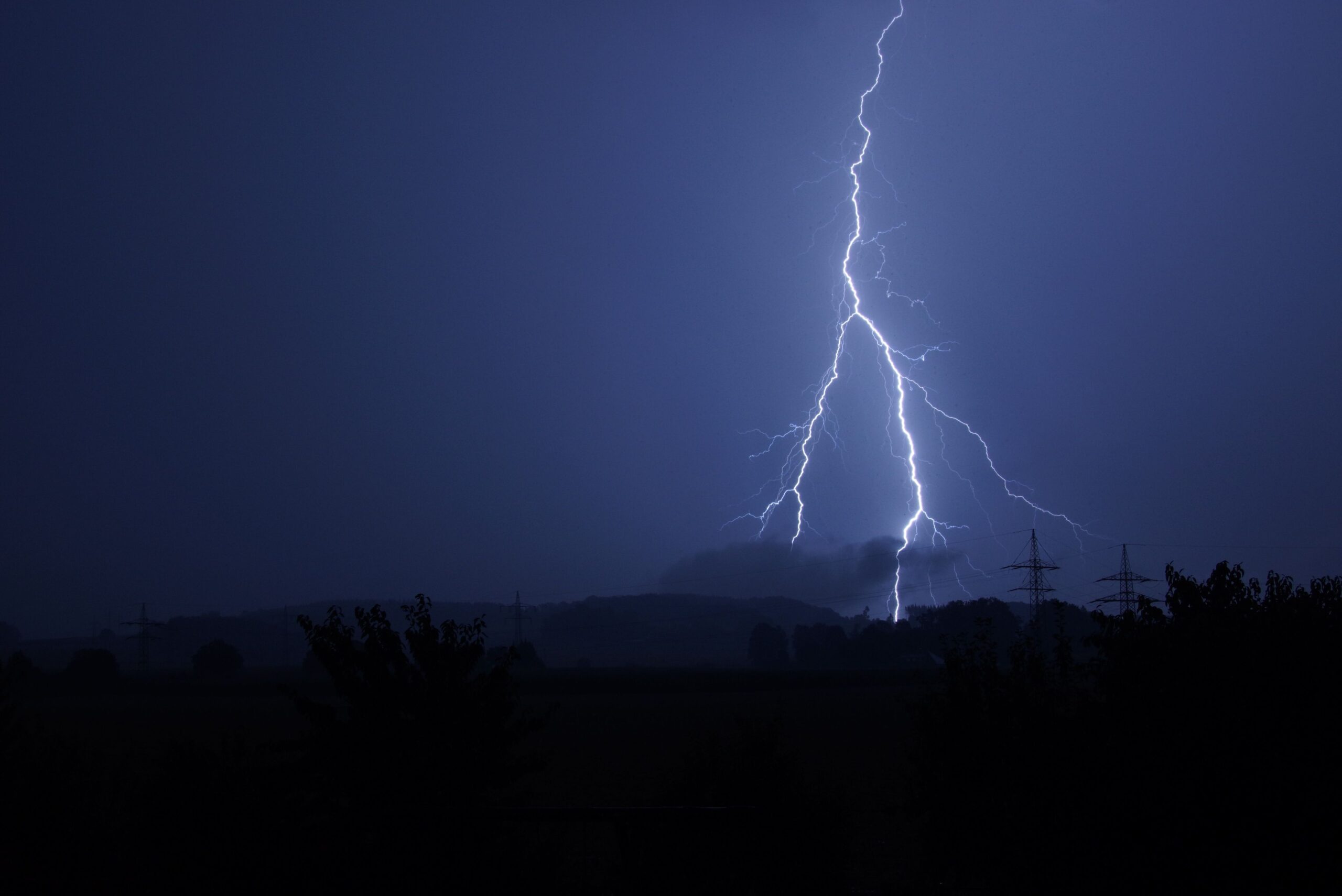
On many nights in northwestern Venezuela, darkness does not stay dark for long. Thunderstorms repeatedly assemble over the southern reaches of Lake Maracaibo, and their clouds can flicker with lightning for hours. The display is known as Catatumbo lightning, after the river that enters the lake near its most active zone.
The headline numbers sound almost unreal: thunderstorms on roughly 300 nights a year and, during the most intense episodes, about 28 flashes in a minute. Both are grounded in published accounts, but they describe different aspects of the phenomenon. The 28-per-minute figure is a peak burst rate, not a steady average through every storm. The 2016 satellite result that made Lake Maracaibo famous used another measure entirely: long-term lightning flashes per square kilometre.
That distinction makes the place no less extraordinary. It simply explains what scientists measured, what they understand about the nightly storm machine, and what remains difficult to pin down.
A lake nearly as large as Connecticut
Lake Maracaibo covers about 13,000 square kilometres, according to the World Lake Database. Connecticut, by comparison, has about 4,842 square miles of land and another 701 square miles of water, according to the US Census Bureau. That works out to roughly 14,360 square kilometres in total. The two are not identical, but saying the lake is roughly Connecticut-sized gives a fair sense of its scale.
Maracaibo is also an unusual lake. A narrow connection runs north to the Gulf of Venezuela and the Caribbean Sea, so its water is brackish and partly tidal. It is sometimes described more precisely as a tidal bay or estuary. For the storms, however, the important fact is that a huge expanse of warm water sits inside a basin bordered by high terrain.
The Perijá Mountains rise to the west. Branches of the Andes, including the Mérida range, wrap around the south and east. The lake remains open toward the Caribbean in the north. It is a natural bowl with a humid entrance, a warm floor and steep walls, an arrangement that repeatedly steers air into the same region.
What the 2016 satellite study measured
The global ranking came from the Lightning Imaging Sensor, or LIS, aboard NASA’s Tropical Rainfall Measuring Mission. Researchers reprocessed 16 years of observations and built a lightning climatology at a resolution of 0.1 degrees, much finer than the half-degree maps used in earlier work.
In the resulting 2016 study in the Bulletin of the American Meteorological Society, Earth’s top grid cell was directly over Lake Maracaibo, near 9.75 degrees north and 71.65 degrees west. It averaged about 233 flashes per square kilometre per year. A hotspot in the Congo Basin, previously ranked first at coarser resolution, moved to second place.
The instrument was not counting only the bolts that struck water or land. LIS watched for brief changes in optical output near the tops of clouds and recorded total lightning, including intracloud flashes and cloud-to-ground flashes. As NASA explained when announcing the result, the sensor observed a narrow wavelength near 777 nanometres, allowing it to find lightning even against bright daytime clouds.
Nor is a flash always identical to a single visible channel or electrical stroke. One lightning flash may contain multiple pulses and branches. The satellite’s flash-density metric, the number of thunderstorm nights and the momentary rate visible to an observer are therefore related, but they are not interchangeable.
Why the nightly clock is so reliable
The broad sequence begins with water and sunlight. Tropical heating warms Lake Maracaibo, encouraging evaporation and leaving a reservoir of humid air close to the surface. Air also arrives through the northern opening from the Caribbean. During daylight, the surrounding land and mountain slopes respond to solar heating differently from the water.
After sunset, the pattern changes. Higher slopes cool quickly, and denser air begins draining down the mountains. These mountain breezes meet the lake’s warm, moist air. Near the southern basin, opposing flows converge, leaving the air with nowhere to go but upward. Rising air expands and cools; water vapour condenses; and, when instability is sufficient, deep cumulonimbus clouds grow.
A recurring current called the Maracaibo Basin Nocturnal Low-Level Jet adds another part to the machinery. This relatively fast ribbon of air, generally below about one kilometre, carries moisture southward and helps establish convergence near the mountains. A NASA Earth science account of fieldwork in the basin described the lightning striking about 28 times a minute for up to nine hours during particularly active episodes.
That sentence is easy to turn into something stronger than the evidence supports. It does not mean 28 flashes arrive every minute of every storm. It is best understood as a vivid peak rate within a phenomenon whose intensity rises and falls through a night.
The recipe is known, but the timing is complicated
Scientists are not starting from mystery. Warm water, abundant moisture, unstable air, mountain topography and converging nighttime winds make the region highly favourable for deep convection. Inside the resulting clouds, collisions involving ice crystals, graupel and supercooled water help separate electrical charge. When the electric field becomes strong enough, a discharge occurs. The basic physics is the same physics behind thunderstorms elsewhere.
What makes Maracaibo special is the consistency with which its geography reconstructs the setup. The 2016 paper reported an average of 297 nocturnal thunderstorms per year, with the annual maximum in September. It also found a strong night-time concentration of flashes across the lake and southern valley.
Even so, “297 nights” should not be read as a promise that lightning appears every night apart from exactly 68 quiet ones. It is a climatological average associated with the long observation record. Activity varies by hour, month, location and year. Some storms form over the water, while others favour the southwestern valley and nearby terrain.
A 2017 analysis of lightning over large tropical lakes found that Lake Maracaibo’s evening low-level flow establishes convergence along terrain southwest of the lake. It also showed that nearby land and water have different daily lightning cycles. The storm engine is repeatable, but not mechanically identical from one night to the next.
Why persistence remains an active research problem
Understanding the ingredients is different from calculating how much each ingredient matters on a given night. Lake temperature, surface evaporation, humidity, lake breezes, mountain drainage, the low-level jet and the depth of the unstable layer all change. Larger weather systems can strengthen, weaken or redirect the local winds. Small changes in where air converges may determine whether a growing cloud becomes electrically vigorous.
The annual cycle adds another layer. Research on seasonal lightning prediction in northwestern Venezuela has connected Maracaibo’s activity with both local conditions and much larger patterns, including the migration of the Intertropical Convergence Zone, the Caribbean Low-Level Jet, tropical cyclone activity and sea-surface temperature patterns associated with El Niño.
Those influences do not all push in the same direction. A stronger regional jet may deliver moisture in one configuration but introduce wind shear that suppresses convection in another season. Dry periods can interrupt the display. This is why researchers can explain the basin’s general advantage while still studying the exact causes of its exceptional persistence, seasonal peaks and occasional pauses.
New observations continue to refine the picture. A study covering 2014 through 2024 found that the daily and monthly patterns of Catatumbo lightning had not changed substantially from patterns reported for 2005 through 2010. Its results also supported the idea that Lake Maracaibo itself supplies water vapour to storm systems forming in the region. Persistence is therefore a measurable feature, not merely a traveller’s impression, even if its night-by-night controls remain complex.
What “Earth’s hotspot” does and does not mean
Lake Maracaibo’s title comes with scientific boundaries. It was the highest flash-density grid cell in a 16-year TRMM-LIS climatology covering the tropics and subtropics. It does not mean the lake always produces the greatest total number of flashes across a whole country-sized region. It does not guarantee first place in every single year. Rankings may also shift when researchers change the instrument, time period, coverage or grid size.
The later record nevertheless reinforces the central conclusion: this is one of the most reliably lightning-rich places on Earth. The geography repeatedly brings moisture, lift and instability together after dark, while larger atmospheric patterns modulate the strength of the result.
Lightning there is not only a spectacle. It is a hazard for communities and people working on the water. Electrical storms can also shape living systems in quieter ways; research elsewhere has shown how lightning can alter forests by killing large trees and changing carbon storage.
Lake Maracaibo’s storm is compelling precisely because it sits between explanation and open inquiry. There is no need for a mysterious energy source or a unique kind of lightning. Familiar atmospheric processes, amplified by an unusually favourable landscape, are enough to build the broad pattern. The harder task is understanding how a changing atmosphere keeps reproducing that pattern with such extraordinary regularity.