

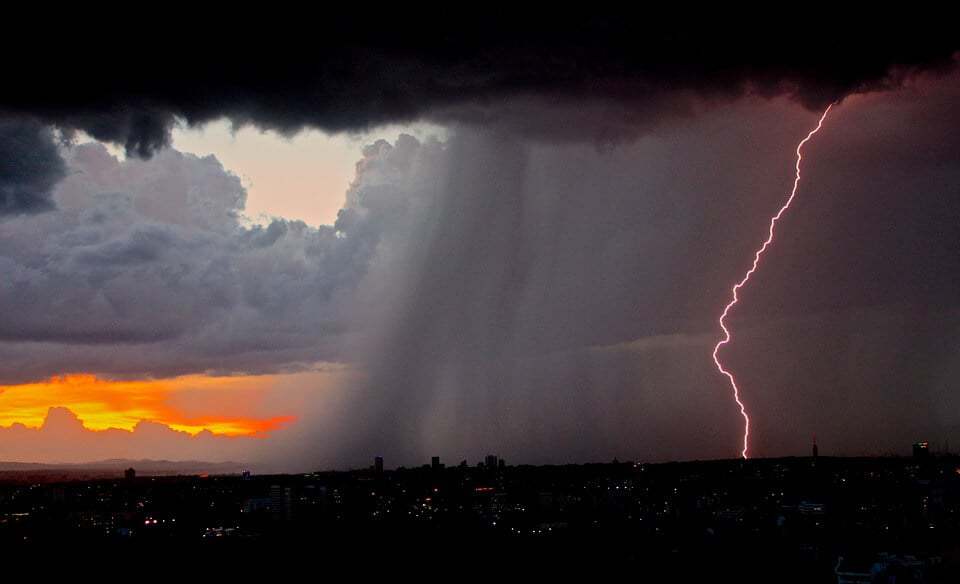
Lightning may strike in an instant, but its ecological toll lingers for years.
According to a new global study published in Global Change Biology, lightning directly kills approximately 320 million trees each year — a number that rivals other major causes of forest disturbance but has gone largely unrecognized. These deaths release an estimated 0.21–0.30 gigatons of carbon annually, underscoring lightning’s surprising role in shaping forest structure and the global carbon cycle.
Modeling a Hidden Killer
While lightning has long been associated with wildfires, its direct impact on tree mortality has rarely been quantified. To address this gap, researchers led by Andreas Krause at the Technical University of Munich integrated lightning mortality into a dynamic global vegetation model known as LPJ-GUESS.
Their approach used detailed field data from Barro Colorado Island in Panama, where each lightning strike was found to kill about 3.2 trees, often through lethal flashovers that affect neighboring trees up to 45 meters away. By scaling these observations with global lightning density maps from satellite and ground-based sensors, the model simulated lightning’s effects across tropical and temperate forests worldwide.
Not Just a Tropical Problem
Simulations revealed that:
- 301–340 million trees (>10 cm diameter) are killed annually by lightning
- 24–36 million of these are large trees (>60 cm diameter)
- Lightning causes 0.21–0.30 GtC of dead biomass annually
- In a world without lightning, global forest biomass would be 1.3%–1.7% higher
Most of this mortality occurs in tropical Africa, where both lightning density and the prevalence of tall, vulnerable trees are high. However, the study also found that as climate change intensifies thunderstorms, lightning-induced tree deaths could increase in temperate and boreal forests.
A Missing Piece in Ecosystem Models
“Most climate models project an increase in lightning frequency in the coming decades, so it’s worth paying closer attention to this largely overlooked disturbance,” Krause noted in the press release.
Until now, ecosystem models have accounted for lightning only as a fire ignition source — not as a direct cause of tree death. That omission, the researchers argue, likely underestimates forest turnover and distorts projections of carbon storage under future climate scenarios.
Some Strikes Hit Harder Than Others
Interestingly, LPJ-GUESS underestimated lightning mortality in some sites like the Amazon and U.S. pine forests but performed well in Panama, thanks in part to the model’s design: lightning was assumed to strike the tallest tree cohorts, mimicking real-world behavior. Deviations in other forests may reflect undercounted secondary effects like beetle infestation or long-delayed tree death, both common after lightning strikes.
What Comes Next?
To improve accuracy, the authors call for more real-time data from forest lightning detection systems—particularly outside the tropics—and closer attention to species-specific vulnerability. Trees with denser wood or lower electrical resistance, for instance, may better withstand strikes, a factor not yet fully integrated into global models.
Reference
Published in Global Change Biology on June 24, 2025. DOI: 10.1111/gcb.70312