

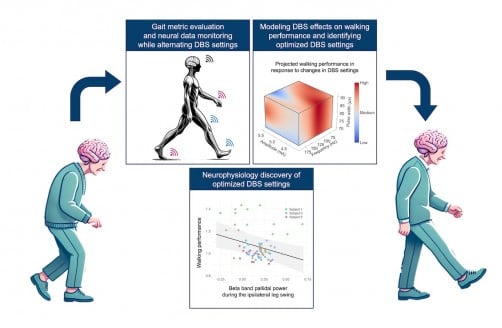
For people with Parkinson’s disease, walking can become an unpredictable and exhausting task. Now, scientists at UCSF have developed a way to fine-tune deep brain stimulation (DBS) to each patient’s unique neural signature—resulting in steadier strides, better balance, and a new level of precision in gait treatment.
The study, published in npj Parkinson’s Disease, marks a shift from one-size-fits-all DBS to a personalized, data-driven approach. By recording brain signals while patients walked, the team created a “Walking Performance Index” (WPI) that allowed them to optimize electrical stimulation settings in real time.
Tracking Gait with Brain and Body Sensors
Three individuals with Parkinson’s were implanted with neural devices that not only stimulated the brain’s globus pallidus but also streamed brain activity continuously. During clinic visits, researchers varied DBS settings within safe limits while patients walked six-meter loops. Sensors tracked step length, arm swing, stride speed, and timing consistency.
These data were used to build the WPI, a composite score designed to reflect meaningful changes in walking function. Using machine learning, the team identified the best combination of amplitude, frequency, and pulse width for each patient.
Personalized Settings Yield Real Gains
Compared to their standard clinical DBS settings, patients showed:
- Up to 21% increase in stride velocity
- Nearly 47% reduction in step time variability
- Improved arm swing amplitude
- Better alignment between patient-reported and measured performance
Critically, these gait-specific DBS settings did not worsen other Parkinson’s symptoms, and one patient voluntarily used the optimized setting for hours each day at home.
Cracking the Neural Code of Better Walking
The researchers didn’t just find better settings—they discovered how the brain behaves during good walking. Improved gait was associated with reduced beta-band activity in the globus pallidus during key phases of the stride cycle, particularly during the stance phase of the opposite leg.
“We approached the problem of optimizing DBS settings as an engineering challenge, aiming to model the relationship between stimulation parameters, brain activity, and walking performance,” said first author Hamid Fekri Azgomi, PhD.
Each participant had unique neural “biomarkers” linked to better walking, highlighting the need for individualized therapy. Still, the shared brain signature—lower pallidal beta power during contralateral stance—points to a possible common target for future smart DBS systems.
Toward Real-Time, Adaptive Therapies
Senior author Doris Wang, MD, PhD, emphasized the broader implications: “This work not only deepens our understanding of how DBS affects movement but also highlights the promise of personalized neuromodulation for Parkinson’s and other neurological disorders.”
The team hopes to integrate the WPI into real-time DBS systems using wearable sensors and motion capture—laying the groundwork for fully adaptive neuromodulation therapies.
Journal: npj Parkinson’s Disease
DOI: 10.1038/s41531-025-00510-0