

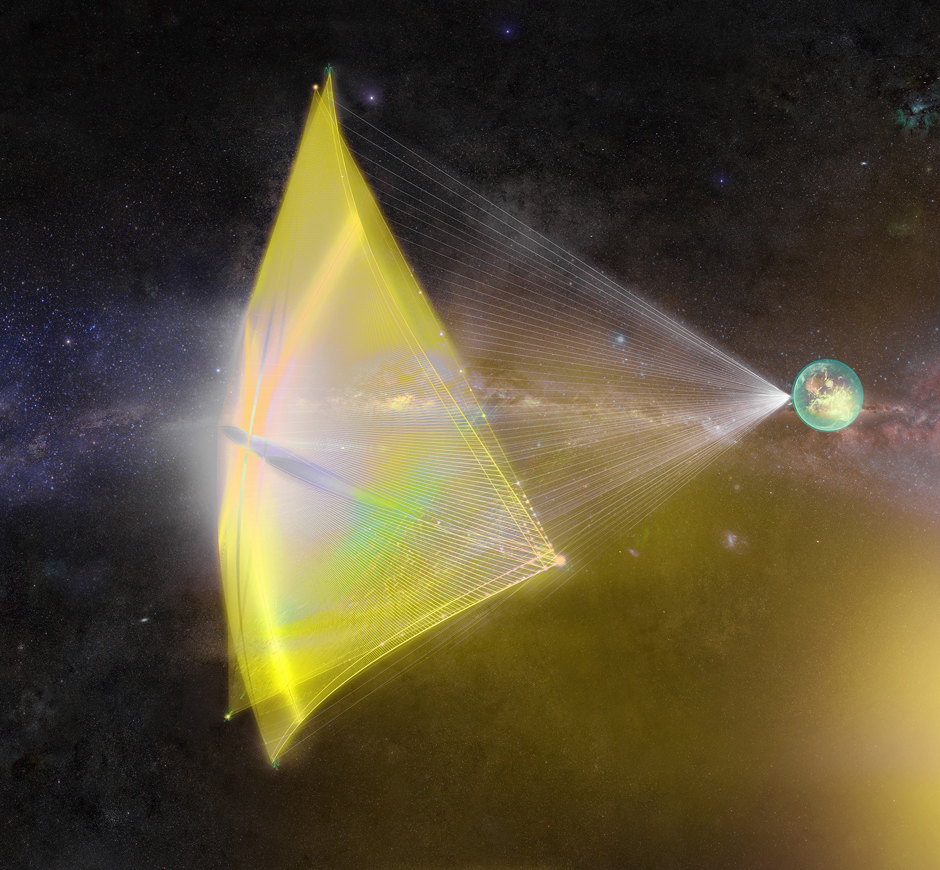
A beam of light can push. Photons have no rest mass, but they carry momentum, and a reflecting surface changes that momentum as the photons bounce away. For an ordinary object the resulting pressure is almost imperceptible. For a mirror-like sail weighing grams, illuminated by a laser system delivering tens of gigawatts, it becomes a possible propulsion system.
The most ambitious version leaves nearly everything heavy on Earth. A ground-based array supplies the energy. A meter-scale lightsail carries a wafer-like spacecraft with cameras, sensors, computing and communications. The beam acts for minutes, the sail is released, and the probe coasts through space without carrying propellant for its main acceleration.
The target often attached to this architecture is 20 percent of light speed, or about 59,958 kilometers per second. That is a calculated goal, not a speed reached by any spacecraft or laboratory sail. It depends on an unbuilt laser array, sail materials still being developed and a flight system whose hardest components have never operated together.
A propulsion system whose engine never leaves Earth
Conventional rockets must accelerate their tanks, engines and remaining propellant along with the payload. Adding fuel adds mass, which demands more fuel. Beamed-energy propulsion avoids part of that loop by putting the power source somewhere other than the spacecraft.
For a perfectly reflecting sail, the ideal force is approximately twice the laser power divided by the speed of light. A 100-gigawatt beam that was completely intercepted and perfectly reflected would produce about 667 newtons of force. That is small beside the thrust of a launch rocket, but a few-gram sail and probe could experience acceleration thousands or tens of thousands of times stronger than Earth’s gravity.
The Breakthrough Starshot concept envisages many separate lasers phased so their light acts like a single, kilometer-scale aperture. The proposed “light beamer” would be built at a dry, high-altitude site, use adaptive optics to compensate for the atmosphere and deliver as much as 100 gigawatts to a sail in space. The organization estimates that a launch would require a few gigawatt-hours of stored energy.
This is different from a solar sail. Both use radiation pressure, but a solar sail takes its relatively gentle push from sunlight. A laser sail substitutes a much more intense, deliberately aimed source whose power and direction can be controlled from the ground.
The 1962 origin needs one important qualification
Physicist Robert L. Forward published “Pluto, the Gateway to the Stars” in Missiles and Rockets in April 1962, only two years after Theodore Maiman demonstrated the first working laser. Forward suggested extending the solar-sail concept by using large lasers to illuminate sails far from the Sun.
The historical record is more precise than the shorthand “an Earth laser array was proposed in 1962.” A 1975 Jet Propulsion Laboratory review says Forward placed those lasers in close solar orbit and initially judged the scheme impractical. In 1966, Hungarian physicist György Marx independently described a terrestrial laser pushing an interstellar vehicle and attempted an early relativistic model.
Modern researchers still cite Forward’s 1962 article as the first proposal for laser-driven directed-energy propulsion. A later peer-reviewed history and analysis in Physical Review Research uses exactly that lineage. The particular Starshot architecture, however, is a much newer synthesis of phased-array optics, nanophotonic materials and microelectronics. The core idea is six decades old; the Earth-based array now associated with it is not a frozen 1962 blueprint.
Where the 20 percent figure comes from
Breakthrough Starshot was announced in 2016 as a US$100 million research and engineering effort to test whether ultralight nanocraft could be accelerated to a substantial fraction of light speed. Its public mission description pairs a gram-scale “StarChip” with a meter-scale lightsail only a few hundred atoms thick.
The beam would remain on the sail only during the acceleration phase. Depending on the assumed mass, beam power and optical response, modelled accelerations range from thousands to tens of thousands of g. There is no crew to protect, but the sail, its attachment and every electronic component must survive those forces.
At 0.2 times light speed, a probe would cover one light-year in five years. Alpha Centauri is about 4.37 light-years away, so the simplest calculation gives a crossing time just under 22 years. The baseline design is a flyby rather than an orbiter. With no equivalent beamer waiting at the destination, the probe cannot simply discard its speed and stop.
Nor would arrival end the wait. A signal sent from Alpha Centauri would take another 4.37 years to reach Earth. Useful data could therefore return roughly 26 years after launch, even before allowing for the time needed to transmit a complete dataset. The spacecraft would pass its target region at nearly 60,000 kilometers per second, compressing its closest observations into hours.
The beam must remain one beam through moving air
A single 100-gigawatt laser is not the proposed machine. The array would combine a vast number of lower-power emitters whose waves must arrive in phase. Tiny phase errors blur the spot and waste energy. Earth’s turbulent atmosphere continually changes the optical path, so the system would need rapid sensing and adaptive correction while tracking a sail that is accelerating away.
The focusing problem becomes harsher with distance. Starshot’s engineering material describes keeping light on a sail across an acceleration distance of roughly two million kilometers. Diffraction sets a fundamental limit on how tightly any aperture can focus, which is why the design grows toward kilometer scale.
Pointing is not merely about hitting the sail during launch. A published calculation found that a one-arcsecond initial misalignment in a 0.2-light-speed case could lead to a displacement of about 80 astronomical units by the time the probe reached Alpha Centauri. Navigation corrections are possible in principle, but every actuator, sensor and power source must fit within a gram-scale mass budget.
A sail that reflects almost everything and steers itself
The laser cannot simply shine on thin aluminum foil. The sail must be exceptionally light, strongly reflective at the chosen wavelength, mechanically robust and able to radiate the heat it does absorb. Those requirements can conflict. Adding layers may improve reflectivity or stability while increasing mass.
Thermal tolerance is especially unforgiving. In one model of a relativistic lightsail, keeping the sail below 573 kelvin during a firing lasting a few minutes required it to absorb fewer than one photon in 260,000. That result depends on the assumed material and geometry, but it shows why “mostly reflective” is nowhere near enough.
The sail must also ride the beam. A small tilt changes the direction of radiation pressure and can create torque. A simple flat sail is not automatically stable, so researchers study curved sails, patterned optical surfaces and beam shapes that generate restoring forces. The desired material is not only a mirror. It is also an ultralight optical control surface.
What researchers have actually demonstrated
The scale of the experiments is still far removed from the headline speed. In 2025, a Caltech-led group reported direct radiation-pressure measurements on a 50-nanometer silicon nitride membrane. The team measured forces around 70 femtonewtons and developed a method for separating the effects of optical force, heating, beam angle, spot size and edge scattering. The membrane was tethered in a laboratory. It did not fly, and it did not approach relativistic speed.
That small result answers a large engineering need: designers must be able to measure how a real ultrathin sail responds, not merely calculate the behavior of an ideal reflector. It also shows how early the technology remains. For comparison, ScienceBlog recently explained how Parker Solar Probe reached 692,000 kilometers per hour, the record for a human-made object. A probe at 0.2 times light speed would move more than 300 times faster.
Research has continued beyond the original concept studies. A NASA-supported University of Minnesota project, updated in June 2026, is combining simulations with the fabrication and testing of metasurface lightsails. A separate 2026 high-power photonic-crystal experiment reported beam-driven motion in ultrathin sail material and studied the limits imposed by optical loading.
Those efforts justify saying that researchers are actively pursuing directed-energy propulsion. Breakthrough Starshot is not a funded flight mission with a launch date. The work is active at the level of materials, dynamics, laboratory prototypes and system studies.
Acceleration is only the first impossible-looking problem
Once released, the probe must survive for more than two decades. At 0.2 times light speed, impacts with dust grains become violent, and even gas atoms can damage exposed surfaces over a long crossing. Shielding adds mass, while redundancy is difficult when the whole vehicle is measured in grams. Starshot’s answer has partly been numerical: launch many inexpensive probes and accept that some may fail.
The surviving craft must then identify its target, orient its instruments and collect useful data during a high-speed pass. Finally it must point a laser or radio transmitter back at the Solar System and make a signal detectable across more than four light-years with very little onboard energy. The ground receiving system may need to be enormous, and the data rate would be limited.
None of these obstacles violates known physics. Together, however, they explain the large distance between a plausible equation and a working spacecraft. Laser-driven directed-energy propulsion has lasted since 1962 because the physical bargain remains enticing: leave the engine at home, reduce the vehicle to almost nothing and let light supply the momentum. More than six decades later, researchers are still learning how to build the first pieces of that bargain.