

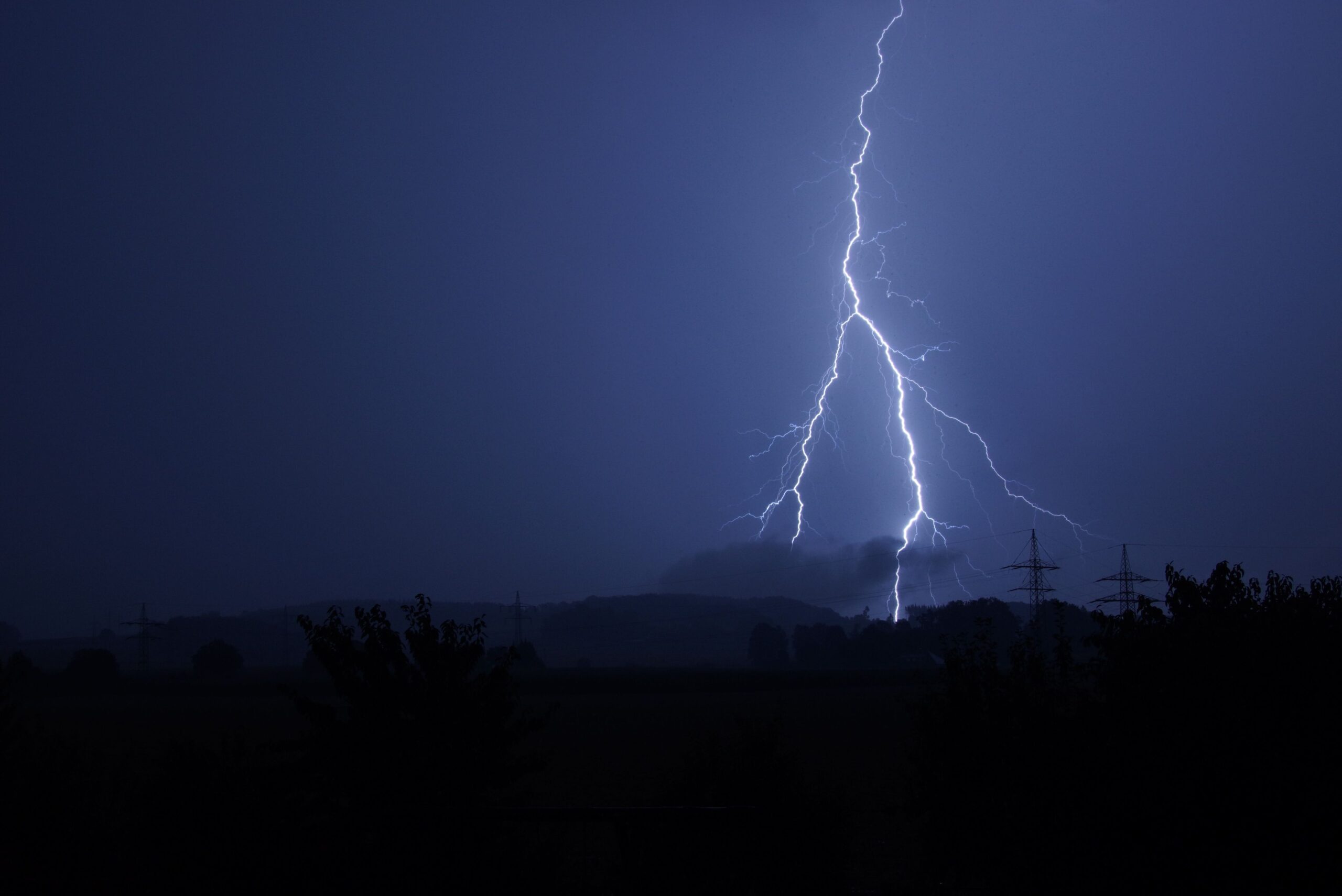
The flash and the sound of a thunderstorm are two outputs of the same event. Electrical current creates a luminous plasma channel. The channel heats the surrounding air so abruptly that the air cannot expand gently, and the resulting pressure pulse begins as a shock wave.
That sequence supports the headline’s central claim, but the language needs precision. Electricity supplies the energy. Rapid heating and expansion are the immediate physical steps that turn the discharge into thunder.
The “five times hotter” comparison uses the Sun’s visible surface
A lightning return stroke can drive the air in its narrow channel to roughly 30,000 kelvin, or about 53,500 degrees Fahrenheit. NASA gives the Sun’s photosphere a temperature near 5,500 degrees Celsius, equivalent to about 5,800 K. On an absolute temperature scale, the lightning channel’s peak is a little more than five times higher.
The comparison is with the photosphere, the layer we ordinarily call the Sun’s surface. It is not a comparison with the Sun’s core, at roughly 15 million degrees Celsius, or its million-degree corona.
There is another distinction hidden in the wording. The National Weather Service notes that electrical charge does not itself have a temperature. Resistance to the current heats the material through which it moves. In a lightning stroke, that material is air that has been converted into a conducting plasma.
The hottest phase is narrower and shorter than the visible flash
The extreme temperature occupies a channel measured in centimeters across, not the whole sky around a bolt. Temperature measures the average energy of particles in that channel; it does not measure the total thermal energy of the event. A tiny, short-lived volume can be hotter than a star’s visible surface without containing remotely comparable heat.
The phrase “a few millionths of a second” also refers to the rise toward peak return-stroke conditions, not the entire lightning flash. A review used by the World Meteorological Organization notes that a first return-stroke current typically rises to its initial peak in several microseconds and falls to half that peak over tens of microseconds. A flash can contain several strokes separated by about 40 milliseconds.
Modern measurements reveal more detail. A 2021 study in the Journal of Geophysical Research: Atmospheres used a high-speed spectrograph to derive temperatures along two natural return strokes for several hundred microseconds. The hottest ionized emissions belong to the earliest phase, while cooler neutral emissions persist longer. The headline’s timing is best read as the violent peak, not a stopwatch for every hot or glowing part of the channel.
Current turns air into a high-pressure plasma channel
Before a cloud-to-ground return stroke, a branching leader establishes an ionized path between cloud and ground. When connection occurs, a high-current wave travels upward through that path. Tens of thousands of amperes can pass through air that, under ordinary conditions, is an effective electrical insulator.
The current transfers energy to the channel faster than the gas can respond mechanically. A 2019 physical model in the Journal of Geophysical Research: Atmospheres describes how a typical return stroke rapidly reaches temperatures near 30,000 K and pressures of ten atmospheres or more. The channel also emits intense light, which is the flash seen by an observer.
This is why the wording “not the electricity itself” requires care. Thunder is not independent of the current. The electrical discharge deposits the energy. The part that launches the sound, however, is the atmosphere’s mechanical response to that concentrated energy.
Explosive expansion creates the wave we call thunder
Hot gas expands. In most everyday situations, it has enough time to do so without producing a violent pressure front. Lightning is different because the temperature and pressure rise within microseconds.
The channel pushes outward into much cooler air, compressing it into a cylindrical shock wave. The National Oceanic and Atmospheric Administration’s explanation of lightning and thunder describes this as explosive expansion. As the shock travels away from the channel, it weakens into an ordinary acoustic wave. By the time it reaches an observer, it is heard as thunder.
The process is comparable to a sonic boom in one limited sense: both begin with a pressure disturbance moving faster than the local speed of sound. Lightning does not “split” the atmosphere permanently. The sharp crack is the ear’s response to a rapidly arriving pressure change.
Why one flash becomes a crack, a boom and a rumble
A lightning channel is not a point source. It can be many kilometers long, crooked and branched. Every segment launches a pressure disturbance, but the sound from each segment travels a different distance to the listener.
The nearest part arrives first and can produce a high-frequency crack or tearing sound. More distant sections arrive later. Higher frequencies are absorbed more readily, so the tail becomes lower and softer. Multiple return strokes, reflections from the ground and clouds, and refraction through layers of air can extend the sound further.
NOAA’s severe-weather laboratory explains that the initial shock weakens rapidly and is perceived as sound after traveling only a short distance from the channel. Its account notes that thunder may be heard up to about 25 miles away, although local atmospheric conditions matter.
Lightning’s thermal effects continue after the sound begins
The rapid heating that makes thunder also drives chemical reactions, can vaporize moisture in trees and damages material at a strike point. ScienceBlog has reported on how repeated strikes can change the structure of tropical forests, an ecological consequence operating on a much longer timescale than the pressure wave.
The Sun comparison survives careful inspection because 30,000 K really is about five times 5,800 K. What makes thunder, though, is not the number alone. It is the concentration of electrical energy in a channel only centimeters wide and the speed with which that energy becomes heat.
For a few microseconds, the air is driven toward plasma temperatures and enormous pressure. The atmosphere responds by expanding outward violently. The light reaches us almost immediately; the pressure wave follows at the speed of sound, carrying the crack of that brief heating across the landscape.