

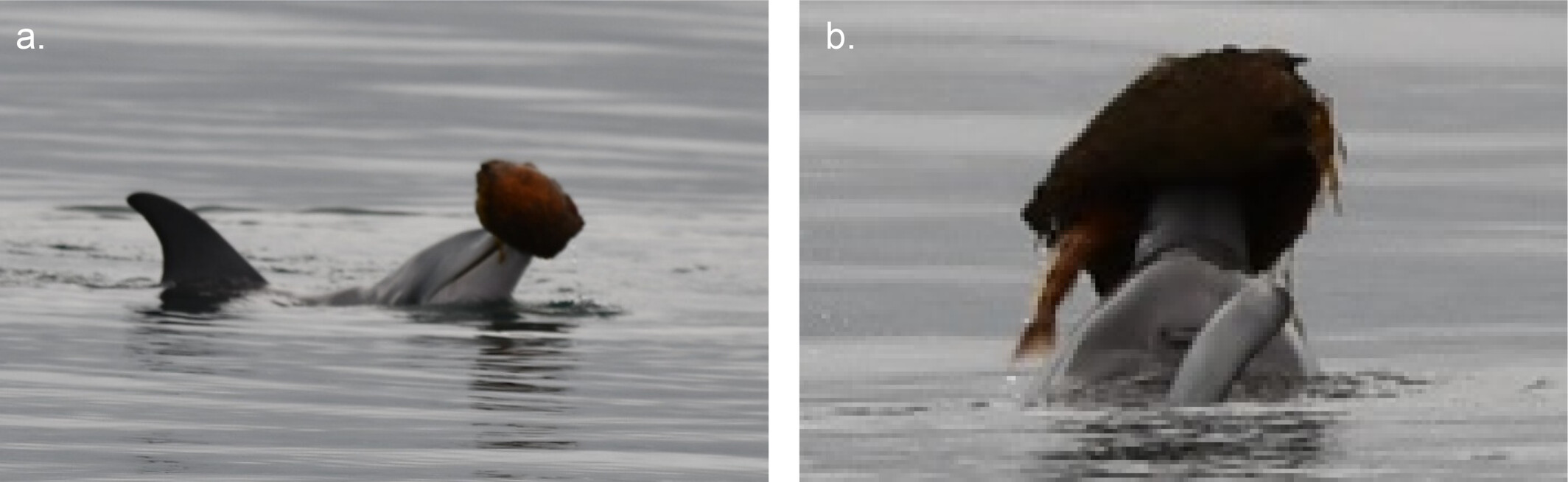
At 9:01 on the morning of 1 October 2025, an Indo-Pacific bottlenose dolphin called Maserati surfaced in the calm water north of Urangan, Queensland, with her snout inside a large bailer shell. A research drone recorded a fish escaping from the opening. Maserati dropped the shell and disappeared after the prey.
At 9:04, her calf Bentley surfaced in the same place with the same shell.
Bentley held it as Maserati had, with the rostrum inside the aperture, and slapped it against the water. After several surfacings the calf dropped the shell. Roughly 30 seconds later Bentley collected it again, carried it for another seven seconds, then swam away.
The sequence lasted only minutes, but its order made it scientifically useful. In a 2026 paper in Marine Mammal Science, Alexis Levengood and colleagues described it as the first potential evidence that this particular tool-using technique can pass vertically from a dolphin mother to her offspring.
Three minutes in Hervey Bay
The encounter took place about 4.15 kilometres north of Urangan in Hervey Bay, part of the Great Sandy Marine Park on Butchulla Country. The water was 5.4 metres deep, the sea was calm and visibility below the surface was poor. Maserati had been foraging when she raised the shell repeatedly while the drone flew overhead.
The footage shows an unidentified fish escaping from Maserati’s shell and her immediate pursuit. Researchers could not see whether she caught it. Maserati surfaced again without recovering the shell.
Three minutes later Bentley lifted that shell at the same location and handled it in a similar orientation. Drone footage did not show prey falling out, but still photographs appear to show the body or tail of a suspected lizardfish protruding from the opening. The research team could not confirm that Bentley caught or ate it.
The calf’s sex was not determined. More importantly, the researchers did not claim that Maserati intentionally gave Bentley a lesson. The observation documents a mother acting, followed closely by her calf using the same object in a similar way. Everything about the route from seeing to learning remains an inference.
Why a shell counts as a tool
The behaviour is called shelling. A dolphin pursues a fish into a large empty gastropod shell on the seabed, inserts its rostrum into the opening and carries the shell upward. At the surface it tilts, drains or shakes the container so the fish moves within reach.
The shell is not part of the dolphin’s body and is manipulated to obtain food, which is why researchers classify it as a tool. The earliest detailed scientific report from Shark Bay described dolphins lifting conch shells and emptying fish from them in photographic sequences. That 2011 study also recognized how easy the action is to miss because a successful draining can be over in seconds.
Shelling is opportunistic, but it is not automatic. A dolphin needs a suitable dead shell, prey willing to hide inside it and enough control to move a heavy, awkward object without losing the meal. The Hervey Bay paper argues that locating, orienting and emptying the shell together form a specialized skill.
Bentley did not simply nose an unfamiliar object once. The calf raised it repeatedly, put the rostrum into the aperture, struck it against the surface, dropped it and picked it up again. Those details make imitation plausible. They do not establish that the calf already understood the shell’s function.
Hervey Bay had left earlier clues
The Maserati and Bentley sequence was the second shelling encounter the team recorded in 2025. On 6 July, another adult female named Stevie Nicks surfaced three times while manoeuvring a bailer shell. Rain ended the follow after nine minutes, before observers could determine whether a fish was inside or a feeding attempt succeeded.
Researchers then learned that photographers aboard a local ecotour vessel had captured apparent shelling in 2013 and 2019 in the same general area. Those older images lacked precise locations and the continuous behavioural record of the drone footage, but they showed that the tactic had not appeared suddenly in 2025.
Together, the records became the first published evidence of dolphin shelling outside Shark Bay in Western Australia. The two sites lie on opposite sides of the continent in separate populations. That makes direct copying between them implausible and supports independent innovation, although undocumented shelling elsewhere around Australia cannot be ruled out.
The Hervey Bay sample is still tiny: two detailed encounters involving three dolphins, plus two older photographic records. It can establish that the behaviour occurs there. It cannot yet reveal how common it is, how many individuals can perform it or how long any dolphin retains the skill.
Shark Bay pointed toward learning between associates
Shelling was already rare in one of the world’s best-studied dolphin populations. A 2020 Current Biology analysis drew on 5,278 group encounters recorded in Shark Bay from 2007 to 2018. Researchers documented 42 shelling events by 19 individuals, almost certainly an underestimate for a behaviour that can last only seconds.
The team combined social associations, genetic relationships and habitat overlap in a network model. Dolphin relationships best predicted where shelling appeared. In other words, an animal was more likely to acquire the technique if it spent time with another sheller, even outside the usual mother-calf route.
That was notable because other dolphin foraging tools can travel down the maternal line. At Shark Bay, dolphins that protect their rostra with marine sponges belong predominantly to particular matrilines, a pattern used as evidence for cultural transmission of sponging. Shelling seemed more socially flexible.
The 2020 result did not demonstrate that every sheller learned from a peer. Its models also allowed room for independent invention, genetic influences and maternal association. What Maserati and Bentley add is a directly observed sequence consistent with the maternal route, not a contradiction that erases the social-network evidence.
Learning, teaching and culture are three different claims
Social learning means that observing or interacting with another animal changes how an individual acquires a behaviour. Bentley’s timing is consistent with that. It does not prove the calf would have ignored the shell without Maserati’s example, nor does it reveal whether Bentley had watched earlier attempts beyond the researchers’ view.
Teaching requires more. Under a common biological definition, an experienced individual alters its behaviour in a way that helps a novice learn, accepting some cost or receiving no immediate benefit. Maserati dropped the shell to pursue an escaping fish. Nothing in the observation shows that she placed it for Bentley, waited for the calf or modified her actions as instruction.
Culture is broader again. A convincing case would show that a behaviour is socially learned, shared within a group and persistent enough to form a local tradition. As ScienceBlog previously reported from southern Brazil, a dolphin foraging tradition can be supported by years of behavioural records, survival data and parallel knowledge passed among human fishers. The Hervey Bay shelling evidence is nowhere near that depth yet.
This is why the paper says “potential evidence” and warns that its sample is not conclusive of vertical transmission. A single mother-calf sequence can identify a plausible mechanism. It cannot measure how often that mechanism operates across a population or whether the behaviour endures across generations.
What would turn one sequence into an answer
The stronger test would follow identified dolphins over years. Researchers could ask whether calves whose mothers shell acquire the technique more often, sooner or more proficiently than calves whose mothers do not. Social networks would help separate maternal exposure from learning through other associates.
Ecology matters too. If shelling appears wherever empty Melo amphora shells and suitable fish are unusually abundant, independent discovery may explain part of the pattern. Genetic sampling could test whether shellers cluster within matrilines. Repeated video could show whether mothers change their behaviour in the presence of inexperienced calves.
The same work is needed at Shark Bay and Hervey Bay because the two populations may use more than one transmission route. A skill can begin as an individual innovation, pass laterally among associates and still move from a mother to a calf. Evolution does not require one learning pathway to exclude the others.
For now, the value of 1 October 2025 lies in how much happened within three minutes. A mother left a tool behind while chasing prey. Her calf recovered it and repeated distinctive parts of her handling. That is more than an isolated photograph, but less than proof of a tradition.
Bentley may have copied Maserati. Whether that brief imitation became learned technique is the story that longer observation must tell.