

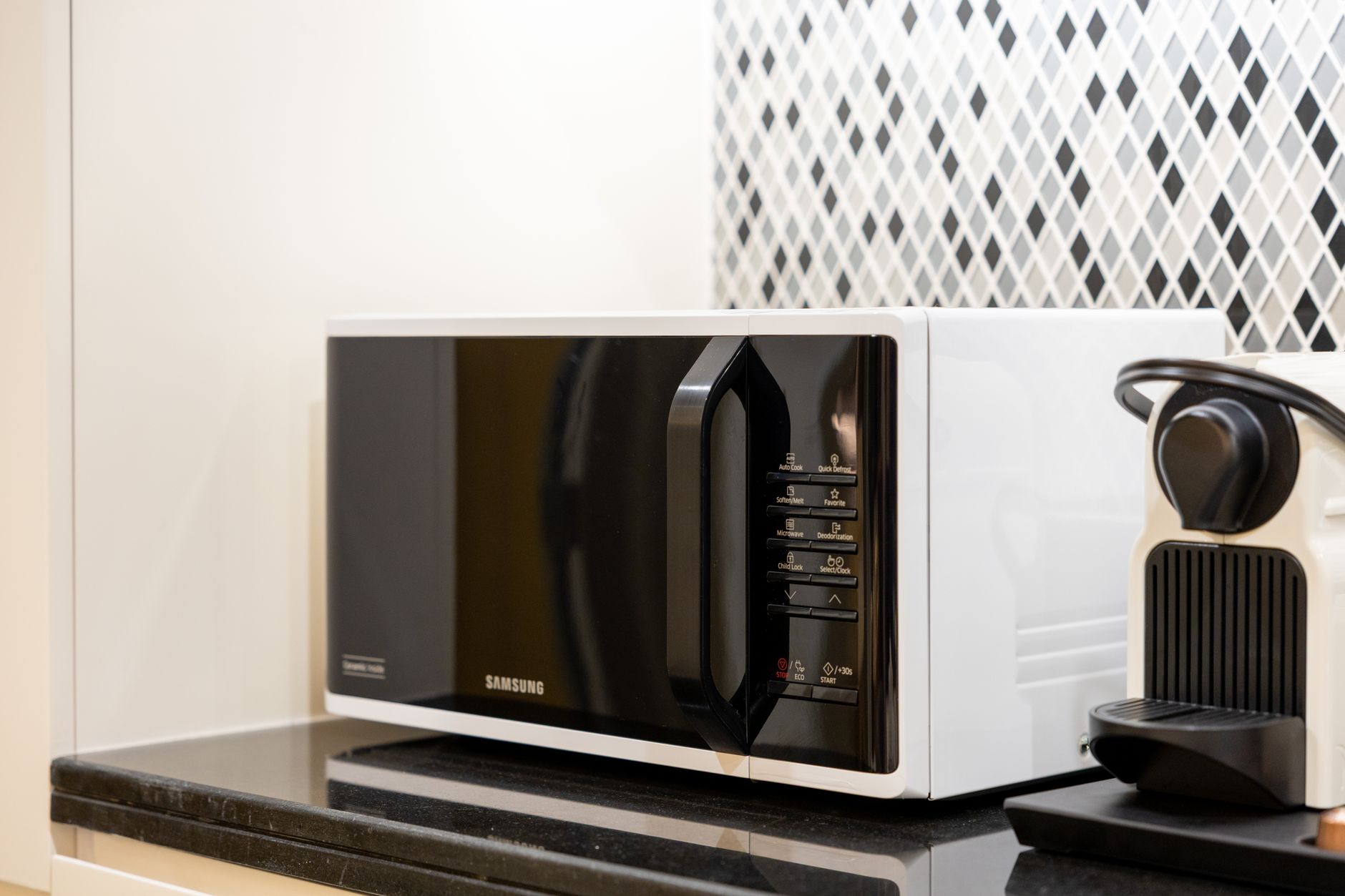
The microwave oven’s origin story begins with a small domestic mishap in an unlikely place. In 1945, Percy Spencer was working with radar equipment at Raytheon when a candy bar in his pocket softened near an operating magnetron. The heat was not coming from the room. Spencer suspected the invisible energy produced by the tube.
He did not stop at the melted snack. Institutional histories describe him bringing unpopped corn near the magnetron and watching kernels scatter across the laboratory. An egg tested soon afterwards burst over a sceptical colleague. Within months, Spencer had filed a patent for cooking food with microwave energy.
It is an appealing story because it gives a global technology a human-sized beginning. It is also often told too neatly. The broad sequence is well supported, but the exact candy, date and balance between one inventor’s insight and a team’s work are less certain than the polished legend implies.
The candy bar is documented, but the wrapper is not
The Library of Congress account says Spencer had a chocolate candy bar in his pocket while observing radar sets. The magnetron’s radiation heated it. Other retellings call the snack a peanut bar or peanut cluster. No reliable contemporary record names a brand.
That uncertainty has produced some confident but incompatible details. A popular version identifies a PayDay bar, sometimes even describing it as chocolate-covered. The original PayDay sold in the 1940s was caramel and peanuts, not a chocolate bar. The sensible conclusion is modest: food in Spencer’s pocket melted near a working magnetron; its exact identity cannot be recovered with confidence.
The year is slightly untidy too. Many institutional sources use 1945, while some later engineering histories place the observation in 1946. The strongest fixed date is 8 October 1945, when Spencer’s application for microwave cooking was filed. The patent makes a 1945 discovery entirely plausible, but it cannot reconstruct the day of the pocket incident.
This is common in invention history. A memorable anecdote survives because it explains a complicated transition in a few seconds. The paperwork records the resulting technology more precisely than it records the moment of recognition.
Spencer knew exactly what stood beside him
Percy LeBaron Spencer was not a passer-by who happened to wander near unfamiliar equipment. He was a senior Raytheon engineer with years of experience in radio and vacuum-tube technology. The Lemelson-MIT biography describes him leaving school at 12, working in a weaving mill and later teaching himself calculus and physics while serving as a US Navy radio operator.
During the Second World War, Raytheon manufactured cavity magnetrons for Allied radar. The device is a high-powered vacuum tube that turns electrical energy into microwave-frequency electromagnetic waves. Those short wavelengths allowed radar systems to resolve aircraft, ships and submarines more effectively than many earlier systems.
Spencer did not invent the cavity magnetron. John Randall and Harry Boot had developed a powerful version in Britain in 1940. Spencer’s wartime contribution included helping Raytheon manufacture magnetrons at industrial scale. By 1945, he understood both the component and the production system around it.
That background changes the meaning of the candy bar. The observation was accidental. Spencer’s ability to identify a plausible cause and design the next test was not.
Popcorn converted an accident into evidence
After noticing the melted food, Spencer reportedly sent for unpopped corn. The Institute of Physics history describes kernels popping beside the magnetron. The next experiment used an egg placed in a kettle with an opening directed toward the tube. Pressure built inside until the egg burst over a colleague looking into the vessel.
These demonstrations were crude by modern laboratory standards, but conceptually important. A soft snack in a pocket could have been dismissed as body heat, room temperature or faulty memory. Repeating rapid heating with foods of different structures made the electromagnetic source a much stronger explanation.
Later recollections complicate the lone-genius version. An IEEE historical review cites Raytheon employees who remembered a gradual process involving feelings of warmth near radiating tubes, popcorn trials and deliberate observations by several people. Spencer’s decisive contribution may have been less “first human ever to notice heating” and more “person able to turn scattered observations into a company programme.”
That is still invention. It is simply invention as it usually occurs: an alert individual working inside a technical community, using equipment made possible by earlier discoveries and relying on colleagues to turn a principle into a product.
What the magnetron does to food
Microwaves are non-ionising electromagnetic radiation. Their photons do not carry enough energy to strip electrons from atoms in the way X-rays can. In an oven, the alternating electric field interacts with polar molecules and dissolved ions in food. Water is especially important because its molecules continually try to align with the changing field.
That movement is resisted by the crowded molecular environment. Energy is dissipated through interactions and becomes heat. Different foods respond differently according to their water, salt, fat, shape and density. This is why two items heated for the same time can emerge at very different temperatures.
Microwave cooking is not literally “from the inside out.” The waves penetrate some distance into food, often more deeply than heat from a hot pan reaches in the same moment, but energy absorption decreases with depth. Heat must still conduct into regions the waves reach weakly. Thick or irregular food can therefore develop cold centres and hot edges.
The metal enclosure matters. It keeps microwave energy largely confined, reflects it through the cavity and allows a useful field to build around the food. Door interlocks prevent the magnetron from operating when the enclosure is open. Modern turntables or mode stirrers help expose food to a less uneven field.
The patent came before the countertop appliance
Spencer’s US patent 2,495,429, “Method of Treating Foodstuffs”, was filed on 8 October 1945 and granted on 24 January 1950. Its central claim covered generating microwave energy, concentrating and guiding it within a restricted region, and exposing food for long enough to cook it.
The drawings do not show a familiar domestic oven. They depict two magnetron oscillators feeding a common waveguide and a conveyor carrying food through the energy. Spencer was protecting a cooking method with industrial possibilities, not merely a kitchen box with a timer.
Raytheon engineers then had to make a practical enclosed machine. Smithsonian records credit colleagues William M. Hall and Fritz A. Gross with patenting a microwave heating unit housed in an oven within the next few years. Engineer Marvin Bock is also associated with development of the early Radarange.
The distinction matters because the title “inventor of the microwave oven” compresses several achievements. Spencer connected microwave radiation with rapid food heating and patented the core method. A wider team converted that method into equipment that could be built, cooled, shielded and sold.
The first Radarange belonged in a boiler room
Raytheon marketed the Radarange in 1947. It looked nothing like the appliance now sitting above a kitchen counter. The early commercial machine stood roughly six feet tall, weighed about 750 pounds and relied on a water-cooled magnetron. The Smithsonian’s National Museum of American History says a Cleveland restaurant bought one for $3,000.
Restaurants, hotels, ships and institutional kitchens made more sense than homes. These customers could provide space, plumbing, trained staff and enough repeated heating to justify the cost. The technology was useful, but it was not yet domestic.
Tappan licensed Raytheon’s technology and introduced the RL-1 for home use in 1955. Its $1,295 price placed it beyond most household budgets, and only 34 were manufactured in the first production year. It also demanded a new style of cooking that buyers did not yet understand.
Raytheon acquired appliance maker Amana in 1965. Two years later, the countertop Amana Radarange arrived at $495. As a Smithsonian history of the home microwave notes, this was still expensive, but miniaturisation and falling manufacturing costs had finally produced something a middle-class household could plausibly install.
The transformation happened after the invention
The first commercial oven appeared two years after the patent application. Mass adoption took roughly another generation. Engineers replaced bulky water-cooled systems, improved shielding and controls, lowered prices and made the machines fit ordinary electrical supplies and kitchen dimensions.
Food companies changed too. Frozen meals, popcorn bags and reheatable packaging were designed around the appliance. The microwave altered expectations about leftovers, workplace lunches, dormitory food and the time required to produce something hot. It did not replace the stove or conventional oven, but it created a new category between cooking and waiting.
The US Energy Information Administration illustrates the speed of adoption. Its historical data put microwave ovens in 14% of American households in 1980, 79% in 1990 and 96% in 2009. A technology that barely registered at the start of the 1980s became nearly universal within three decades.
Those are US figures, not a complete measure of the world. Still, the appliance’s spread through homes, offices and commercial kitchens across many countries supports the larger point in the title. Microwave heating changed not only how food was cooked, but when, where and by whom hot food could be prepared.
Chance supplied the clue, not the outcome
ScienceBlog’s earlier account of William Perkin’s accidental discovery of mauveine follows a similar pattern. Perkin failed to make quinine, noticed colour in the residue, tested it on fabric and built an industry. The accident became useful because the unexpected material was examined rather than discarded.
Spencer’s melted food worked the same way. Other people around high-powered radar equipment may have felt warmth or noticed small effects. Spencer responded with popcorn, an egg, an enclosure, a patent and a development programme.
The candy bar makes the story memorable, but it did not contain a miniature microwave oven waiting to be recognised. Radar research supplied the magnetron. Wartime manufacturing made the component plentiful. Spencer supplied the question. Raytheon’s engineers supplied years of development. Appliance makers and food companies supplied the path into daily life.
The accident lasted a moment. Turning it into the way millions of people cook took decades.