

A ringing object seems to fade continuously. Its motion becomes smaller, its sound becomes quieter and eventually it falls silent. Quantum mechanics has insisted for more than a century that this smooth appearance hides a staircase: a resonator can hold whole-number packets of vibrational energy and must lose them one at a time.
Stanford physicists have now followed the last step as it happened. In a microscopic mechanical resonator coupled to a superconducting qubit, repeated measurements showed the system remaining in its one-phonon state and then abruptly switching to its ground state. The experiment, published in Science, is the first real-time observation of individual quantum jumps of sound in a mechanical resonator.
The phrase “watched a phonon disappear” needs one immediate qualification. No camera photographed a sound particle vanishing, and the researchers did not listen to an audible note. They inferred the resonator’s energy state from a rapid sequence of qubit measurements, resolving whether one vibrational quantum remained or the device had reached its ground state.
A phonon is a packet of collective motion
A phonon is not a tiny bead flying through air. It is the quantum description of a coordinated vibration shared by many atoms in a solid. Much as a photon is one packet of electromagnetic energy, a phonon is one packet associated with a normal mode of vibration.
For a mechanical mode with frequency f, neighboring energy levels are separated by hf, where h is Planck’s constant. The allowed energies form a ladder rather than a continuous ramp. A resonator in the first excited state carries one more phonon than it does in the ground state.
“One to zero” does not mean every atom becomes absolutely still. Quantum mechanics assigns the ground state an irreducible zero-point motion. The observed jump removed the last countable excitation above that ground state.
Why a smooth ringdown can hide discrete steps
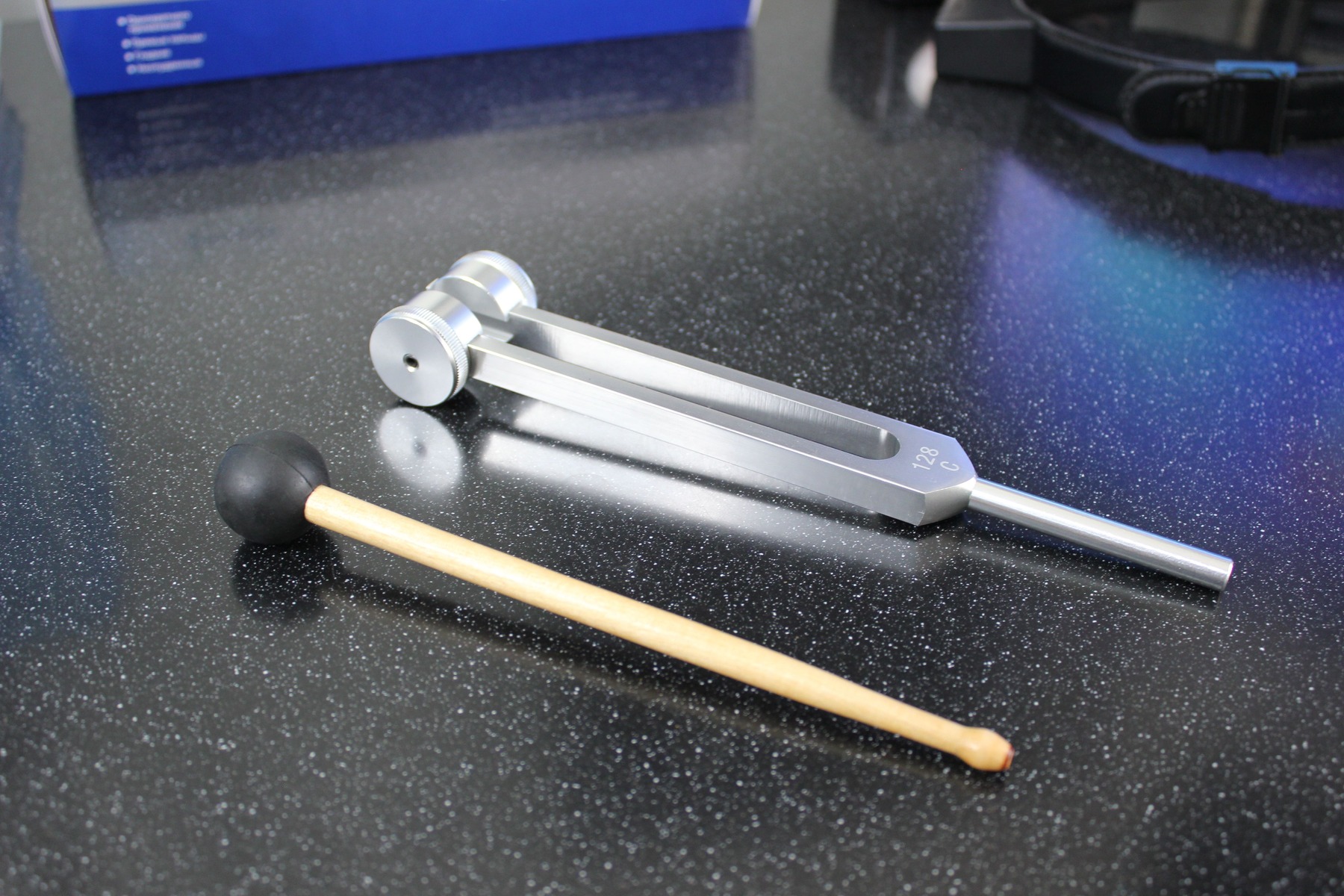
There is no contradiction between an everyday tuning fork that fades smoothly and a microscopic resonator that loses energy in packets. Macroscopic vibrations contain enormous numbers of phonons. Losing them one by one produces steps far too small and rapid to distinguish, just as individual pixels disappear into a continuous-looking picture from a distance.
There is a second problem. Ordinary microphones, optical interferometers and position sensors respond to displacement. The average displacement of a decaying oscillator can decrease smoothly even when its energy occupies discrete levels. Measuring position alone does not label each rung of the energy ladder.
The Stanford experiment instead coupled a nanomechanical resonator to a superconducting qubit in a way that made the qubit’s frequency depend on phonon number. Each added phonon shifted the qubit by 328 kilohertz. Carefully chosen microwave pulses could then turn that shift into a repeated question about whether the mechanical state contained an odd or even number of phonons.
A long-lived resonator made repeated questions possible
The device used a microscopic lithium-niobate mechanical resonator fabricated with chipmaking techniques. The researchers integrated it with the superconducting circuit using an aligned transfer-print process, placing the delicate mechanical component close enough to the qubit for strong dispersive coupling without destroying either subsystem’s performance.
Its crucial feature was time. Left to ring down without the continuous checking sequence, the mechanical excitation had a lifetime of 2.1 milliseconds. That sounds brief, but it is long enough for hundreds of fast quantum measurements. The Stanford research team compares the resonator to a microscopic tuning fork that, scaled to an ordinary tuning fork, would ring for hours.
Takuma Makihara and Erik Szakiel were co-first authors of the work, with Amir Safavi-Naeini leading the Stanford team. Their device converted an event that had previously been visible mainly through averaged statistics into a time-resolved trajectory for an individual experimental run.
Measurement both prepared and followed the state
The qubit readout was not perfect. One parity check gave only limited confidence about whether the resonator was in the one-phonon or zero-phonon state. The researchers therefore used repeated outcomes to prepare, or herald, the state they wanted to follow.
They selected runs in which six consecutive checks indicated one phonon. After this post-selection, the resonator was in the single-phonon state with 85 percent fidelity. The same sequence then continued, producing 294 checks in each trajectory.
The public data and code archive contains 8,447 selected trajectories, along with the spectra, Bayesian fit results and forward-backward analysis used to estimate the hidden state. The open dataset makes the central claim unusually inspectable: the jump is not based on three handpicked traces.
In typical trajectories, readouts stayed mostly consistent with the excited state for a stretch, then abruptly became mostly consistent with the ground state. The switching point changed from run to run. Pooling the trajectories produced an exponential distribution of waiting times, the memoryless pattern expected for spontaneous quantum decay.
What “real time” and “direct” mean here
The observation was direct in the experimental sense that the team resolved individual transition histories rather than reconstructing the decay only from averages over many identically prepared systems. It was real time because the sequence located the transition during a single ringdown, with checks much faster than the mechanical lifetime.
It was still an inference from a detector. Each qubit result was noisy, so a Bayesian forward-backward method estimated the most likely phonon state from the full measurement record. The result should not be imagined as a literal movie of a visible object snapping to rest.
The measurement was also only approximately nondestructive. Without continuous interrogation, the resonator’s lifetime was 2.1 milliseconds. Under the repeated parity-check sequence, the observed one-phonon lifetime was about 649 microseconds. Each question carried a small chance of disturbing the very excitation being monitored.
That back-action does not erase the result. It defines the achievement more precisely: the detector extracted enough information to distinguish discrete one- and zero-phonon intervals before its own disturbance and natural loss ended the excitation.
How this advances earlier quantum acoustics
Mechanical resonators have reached the quantum ground state before, and researchers have created and detected single phonons through other protocols. Quantum jumps were also observed decades ago in trapped ions and later in photons. What remained missing was a succession of sufficiently rapid, phonon-number-sensitive measurements that could follow an individual mechanical transition as it unfolded.
ScienceBlog recently reported how a single phonon changed the state of a single atomic defect in diamond. That experiment demonstrated a controlled interaction between quantum sound and a spin. The new work asks a complementary question: can one mechanical excitation be repeatedly read until its exact loss becomes visible?
It also draws a useful boundary around another kind of mechanical experiment. A classical nanostring can be steered around a Bloch sphere because two coherently coupled modes share the mathematics of a two-level system. That does not make the string quantum. Resolving discrete zero- and one-phonon energy states, as in the Stanford device, is a genuinely quantum measurement.
Watching is useful if an error can be corrected
A phonon lost from a mechanical quantum memory is not merely an interesting event. It is an error. A processor cannot correct an error that remains invisible, so repeated nondemolition-style checks are a foundation for any scheme that hopes to preserve information encoded in mechanical states.
The present experiment did not demonstrate error correction. Its 85 percent state-preparation fidelity and measurement-induced shortening of the lifetime leave substantial engineering work. A future device would need to detect loss reliably while introducing much less loss of its own, then take an operation that restores or protects the encoded information.
Mechanical systems are also promising sensors because minute forces, accelerations and added masses can shift their motion. Safavi-Naeini’s group is exploring whether related devices could help identify proteins inside cells. Packing many resonators onto a chip could eventually support more complex acoustic quantum circuits.
Those applications remain prospective. The immediate result is simpler and more fundamental. A vibration distributed across a solid object was prepared with one quantum of energy, questioned hundreds of times and followed to the random instant when that quantum was gone. The averaged ringdown remains smooth, but an individual history ends with a step.