

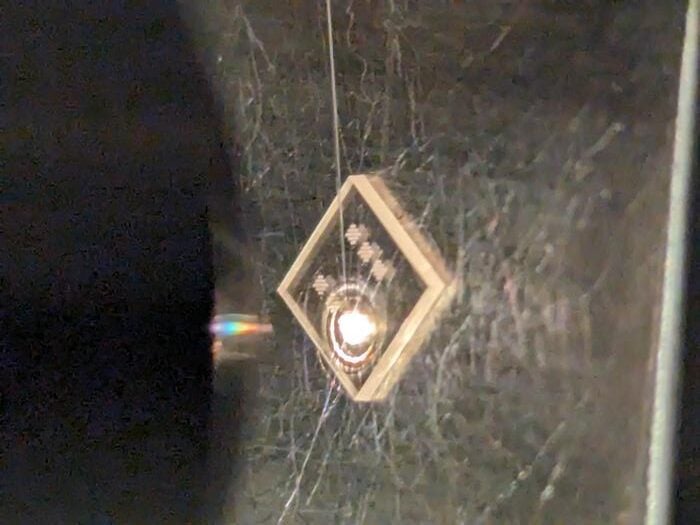
A phonon is absurdly small. The quantum of vibrational energy, the irreducible minimum of sound, it carries no mass and lives only briefly before dissolving back into the thermal noise of whatever material surrounds it. For quantum engineers trying to build the next generation of computing hardware, that brevity has long been the problem. You cannot build an information highway out of something that barely exists. And yet a team at Harvard has just demonstrated that a single phonon, one solitary packet of vibration humming through a sliver of engineered diamond, can reach inside an atomic defect and change its quantum state. The implications go considerably beyond the neat physics of the thing.
The result, published in Nature, marks the first observation of what physicists call the acoustic Purcell effect at the level of a single spin qubit, and it plants a flag in a field that has been trying to get here for the better part of a decade.
To understand why it matters, it helps to think about the problem quantum engineers are actually trying to solve. Today’s most capable quantum processors, whether they are built from superconducting circuits or from atomic defects in crystals, tend to be brilliant in isolation and terrible in conversation. Getting one type of qubit to hand quantum information to another is roughly like trying to get two musicians playing in different keys to improvise together without a shared instrument. Light has been the obvious candidate for connecting them, but light carries its own complications: it is hard to confine, easy to lose, and not every qubit talks to it naturally. Sound, it turns out, might offer something better.
Marko Loncar, who leads the Harvard group, put it directly: “At the heart of the experiment is a phonon, the smallest possible unit of sound. When we listen to music, it takes countless phonons working together to move our eardrums and maybe even get us spinning on the dance floor. But qubits are far more sensitive: a single phonon can be enough to change their quantum state, to excite them, or, as in our experiment, to help them relax.”
A Diamond Microphone for a Single Atom
The device Loncar’s team built is, by any reasonable measure, a remarkable piece of engineering. They took a diamond waveguide, carved it into an optomechanical crystal with a pattern of eye-shaped holes, and implanted a single silicon-vacancy center (a defect where two adjacent carbon atoms in the lattice are replaced by a silicon atom and a void) at precisely the right location to feel the mechanical breathing of the structure. The whole assembly was cooled to around 44 millikelvin, a fraction of a degree above absolute zero. At that temperature, the device’s 12-gigahertz mechanical mode held fewer than one-fiftieth of a phonon on average, sitting nearly in its quantum ground state.
What the researchers then observed was the acoustic analog of an effect Edward Purcell first predicted in 1946 for electromagnetic cavities: that a resonator shaped correctly around an emitter can dramatically alter the rate at which that emitter sheds energy. When they tuned the spin qubit’s frequency into resonance with the mechanical breathing mode by adjusting an external magnetic field, the qubit’s relaxation rate jumped tenfold. The phonon, in other words, was doing exactly what they had predicted and designed it to do.
The Numbers That Matter
That tenfold enhancement is the headline number, but the more consequential figure is the cooperativity, the ratio that tells you whether a quantum system is truly exchanging information coherently with its environment or just losing energy into it. The Harvard device achieved a T1-based cooperativity of roughly 10, the highest spin-phonon cooperativity measured to date, as far as the authors are aware. It is still short of what most practical applications require, in part because the material deposited during cavity tuning introduced unwanted mechanical damping. But Loncar’s team calculates that switching to electrostatic tuning methods could improve the cooperativity by two orders of magnitude, placing the system comfortably in the regime needed for genuine quantum-coherent interconnects.
Graham Joe, first author on the paper and a former Harvard graduate student who helped conceive and run the experiments, is candid about what makes phonons worth this level of effort. “Many quantum systems, including superconducting qubits, quantum dots, or solid-state defects are known to interact strongly with phonons,” he said. “So quantum acoustics holds a lot of promise as a sort of ‘universal quantum bus’ which could connect up disparate sorts of quantum systems into hybrid systems.” The appeal is partly geometric. Mechanical vibrations at a given frequency occupy far smaller volumes than electromagnetic cavities at the same frequency, which matters when you are trying to pack quantum hardware onto a chip.
There is also a secondary result that deserves attention. Because the silicon-vacancy center is so sensitive to mechanical noise around it, the researchers could use it as an atomic-scale microphone, mapping the phonon spectrum of their nanostructure all the way up to 28 gigahertz. This kind of broadband mechanical spectroscopy, performed with a single atom as the detector, opens a route to characterizing the internal noise of quantum devices, a problem that plagues superconducting circuits and others, with resolution no conventional instrument can match.
Skeptics might note that the T2* cooperativity, which captures decoherence as well as relaxation, sits around 0.01 in the current device, well below the threshold needed for most algorithms. That gap is real and the team does not paper over it. Improving it will require both better mechanical quality factors and tighter control over the magnetic noise environment of the spin. Engineering problems, rather than conceptual ones, but not trivially solved.
Still, the architecture the Harvard group has assembled, a diamond optomechanical crystal that simultaneously provides a high-quality optical interface for spin readout and a high-quality mechanical interface for spin control, looks increasingly like the kind of platform the field has been searching for. Connecting color-center spin qubits, which can hold quantum information for milliseconds or longer, to superconducting processors capable of fast, high-fidelity operations has been a stated goal of the quantum networking community for years. Sound, of all things, might be the bridge. Joe summarized the dual significance of the result without fanfare: “This experiment was both a compelling demonstration of new tools for sensing the environment of a single atom, and a meaningful step towards practical quantum acoustic devices.”
Whether that step turns into a stride depends on what happens next on the engineering side. But for the first time, researchers have watched a single phonon reach into a single atom and move it. That is not nothing.
Source: Joe et al., “Purcell-enhanced spin-phonon coupling with a single colour centre,” Nature (2026)
Frequently Asked Questions
Why would you use sound instead of light to connect quantum computers?
Light is the obvious choice for connecting quantum systems, but it comes with real practical problems: photons are hard to confine, easy to lose, and not all qubit types interact with them naturally. Phonons, the quantum units of vibration, occupy far smaller volumes at equivalent frequencies, making them easier to integrate onto compact chips. They also interact strongly with a broad range of qubit types, including superconducting circuits and atomic defects, which is exactly what you need if you want to build hybrid systems that mix the best properties of each.
What does “acoustic Purcell effect” actually mean?
The Purcell effect, first predicted in 1946 for electromagnetic cavities, describes how a resonator shaped correctly around a quantum emitter can dramatically speed up or redirect the rate at which that emitter sheds energy. The Harvard team observed the same phenomenon for sound: by engineering a nanomechanical resonator around a single atomic defect in diamond, they made the qubit relax ten times faster when its frequency was tuned into resonance with the mechanical breathing mode. It confirms that the physics of cavity quantum electrodynamics, usually described in terms of light and atoms, has a direct acoustic counterpart that can be controlled with similar precision.
Could a phonon-based quantum bus work alongside today’s superconducting quantum processors?
That is exactly what the Harvard researchers are aiming for. The architecture they built, a diamond optomechanical crystal that interfaces optically with the spin qubit for readout and acoustically for control, is designed to slot into hybrid systems that combine the long coherence times of atomic spin memories with the fast gate operations of superconducting processors. The cooperativity achieved so far is below what most practical applications require, but the team identifies a credible path to improving it by two orders of magnitude using electrostatic rather than material-deposition cavity tuning.
What is a silicon-vacancy center, and why use it here?
A silicon-vacancy center is a specific type of atomic defect in diamond, formed where two adjacent carbon atoms in the crystal lattice are replaced by a silicon atom and an empty site. It behaves as a quantum memory, storing quantum information in its electron spin state for milliseconds or longer at cryogenic temperatures. It was chosen for this experiment partly because it is unusually sensitive to mechanical strain, meaning the acoustic vibrations of the surrounding diamond structure couple strongly to its quantum state. That strong coupling is precisely what makes the phonon-mediated interactions the team observed possible.