

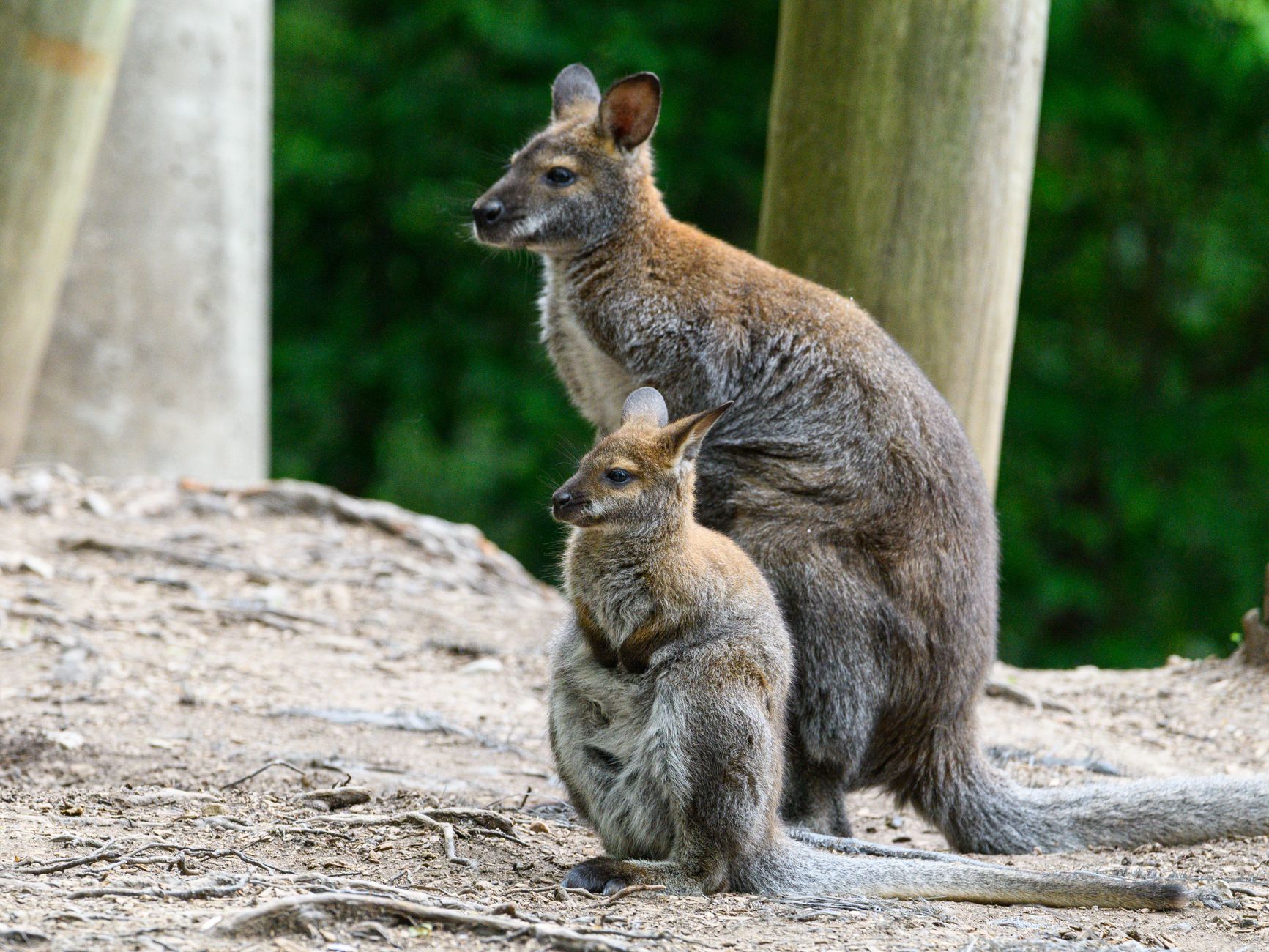
A female red kangaroo can be caring for three young without carrying anything resembling triplets.
One is an embryo whose development has paused inside the uterus. A second is a tiny joey growing in the pouch. The third is older, spending its time outside but still returning to its mother to drink. The two nursing young may be separated by many months and have very different nutritional needs.
The mother meets those needs through separate mammary glands. One teat can supply early-stage milk to the pouch young while another supplies richer, later-stage milk to the young-at-foot. Meanwhile, signals associated with nursing help determine when the dormant embryo resumes development.
The familiar claim that a kangaroo can have three offspring “at once” is therefore true in a particular sense. It describes three dependent generations at different stages, not three similarly developed young. It is an overlapping reproductive sequence in which pregnancy, pouch development and weaning run on separate clocks.
One mother, three developmental clocks
The red kangaroo is now formally known as Osphranter rufus, although much of the foundational literature calls it Macropus rufus or uses still older scientific names. It is Australia’s largest living marsupial and a species adapted to an environment where rainfall and food can be sharply unpredictable.
Under favourable conditions, a mature female can mate soon after giving birth. The new fertilized egg begins developing even while the newborn from the previous pregnancy is establishing itself in the pouch.
That overlap could create an impossible queue. Gestation lasts only about 33 days, while the pouch young needs months of care. The solution is not to speed every offspring through the same schedule. It is to pause one.
A detailed species account in Mammalian Species describes females simultaneously supporting a young-at-foot, a pouch young and a blastocyst held in developmental arrest. The arrangement is possible, rather than inevitable; food, drought, the loss of a young and the mother’s condition can all change the sequence.
Birth comes extraordinarily early
A red kangaroo gives birth after an average gestation of about 33 days. The newborn is tiny, hairless and profoundly undeveloped by placental-mammal standards. Its hindlimbs are rudimentary, but its forelimbs, nostrils and tongue are developed enough for the next task.
The joey emerges and makes its way through the mother’s fur to the pouch, where it locates a teat and attaches. It receives no ride from the birth opening to the pouch. The climb is part of the newborn’s first minutes outside the reproductive tract.
A previous ScienceBlog article followed that newborn climb and the unusually early development of a joey’s forelimbs. What happens after attachment is just as unusual. The teat elongates as the young grows, and the attached joey remains dependent on milk through a long period of development that placental mammals complete before birth.
The pouch is therefore more than a carrying bag. It is the site where much of early development continues, supported by milk whose composition changes as organs mature, fur appears and the young becomes capable of leaving.
The next embryo stops at about 85 cells
Pregnancy does not necessarily prevent a female red kangaroo from returning to oestrus after birth. She can mate again within days, and the resulting embryo descends into the uterus.
If the new pouch young is suckling normally, however, that second embryo does not proceed directly to another birth. It develops for roughly 40 days to a blastocyst of about 85 cells, close enough to justify the common shorthand of “roughly 100 cells,” and then enters embryonic diapause.
Diapause is not freezing in the literal sense. The blastocyst remains a living biological system, but cell division and growth are held at an extraordinarily low level. Development can remain suspended while its older sibling occupies the pouch.
This is a reserve offspring, but not a spare joey already waiting in miniature. It has not formed the body structures of the newborn that will later crawl to the teat. It is an early cluster of cells whose further development has been postponed.
A historical CSIRO account of red kangaroo reproduction describes the blastocyst remaining dormant through much of the pouch phase. If the pouch young dies, the inhibitory signal can be removed early and the embryo can reactivate. If development proceeds normally, reactivation begins as the older joey starts leaving the pouch and suckling becomes less constant.
Suckling helps hold the pause
The coordination is often described as if the mother consciously decides when to restart a pregnancy. The control is physiological. The sucking stimulus from the pouch young affects the mother’s hormonal system and suppresses renewed development of the blastocyst.
As the joey matures, it begins putting its head out, eating vegetation and taking short trips. In red kangaroos, first excursions occur at roughly 200 days, although exact timing varies. Less frequent suckling changes the endocrine conditions that maintained diapause.
The blastocyst then resumes development. After about another month, the next tiny young is born and begins its own journey to the pouch. The older sibling may have left the pouch permanently but can remain nutritionally dependent for several more months.
This creates the three-stage overlap: a young-at-foot still nursing, a new pouch joey attached to another teat, and, after another mating, a fresh blastocyst entering diapause. It is a conveyor only in the loosest metaphor. Every stage is responsive to survival, nursing and environmental conditions.
Two teats can make two milks
Supporting the two visible offspring requires more than producing a larger volume of one milk. A newborn pouch young and an older joey beginning to graze are building different tissues, using different digestive systems and growing at different rates.
Red kangaroos have four teats, each connected to a separate mammary gland. When two young of different ages nurse concurrently, different glands can occupy different stages of lactation even though both sit inside the same mother and experience the same circulating hormones.
The phenomenon is called concurrent asynchronous lactation. A review of marsupial and monotreme milk describes one red kangaroo gland producing protein-rich fluid for a small pouch young while another produces mature milk for a young-at-foot.
The contrast is not merely colour or thickness. A classic study of red kangaroo mammary glands found that early milk fat contained much more palmitic acid and relatively little oleic acid, while later milk for the older young showed the opposite pattern. The gland supplying the young-at-foot was also anatomically more fully developed than the gland serving the small pouch young.
Milk changes across nearly a year
Kangaroo milk is not a static formula dispensed for longer than human milk. Its composition changes dramatically as lactation advances.
A field study following milk from early pouch life to weaning found that total solids and fat rose over time, with protein and casein also tending to increase. Other components follow their own trajectories as the young’s digestive system, metabolism and immune needs change.
Research published by CSIRO scientists in 1982 confirmed that milk composition tracks the age of the young attached to the individual gland. Two adjacent teats on the same female can therefore be delivering meaningfully different foods at the same moment.
That local control is one of the most remarkable parts of the system. The mother’s hormones provide a shared background, yet each gland responds to its own lactational history and patterns of milk removal. Scientists understand several pieces of that regulation, but the full molecular control of simultaneous, stage-specific milk production is still not settled.
The phrase “different milk for each joey” is accurate, provided it is not imagined as two perfectly fixed recipes. Each gland changes continuously with its associated young, and natural variation occurs among females and across environmental conditions.
A strategy built for uncertainty
Red kangaroos live across arid and semi-arid Australia, where a productive season can be followed by drought. Their overlapping reproductive system allows rapid continuation when conditions are good without committing every embryo to immediate development.
Embryonic diapause reduces the delay between the loss or independence of one pouch young and the birth of the next. If a young dies, the blastocyst can resume sooner without requiring another successful mating at that moment.
But rapid reproduction is not cost-free. Lactation demands energy, and drought can reduce female condition and offspring survival. The biological machinery coordinates young at different stages; it does not guarantee that all three will reach independence.
This is why zoo descriptions often add the condition that three young can be supported when food is plentiful. The three-generation arrangement represents the system operating with enough resources, not a permanent maximum that every female maintains.
Three offspring, carefully qualified
The paused blastocyst, pouch joey and young-at-foot are all offspring, but they are not equivalent burdens. One is microscopic and metabolically restrained. One is completing early development through near-continuous nursing. One is mobile, grazing and gradually weaning while still returning for milk.
The mother coordinates them through several linked systems: short pregnancy, lactational diapause, an extended pouch phase, continued nursing outside the pouch and mammary glands capable of following separate schedules.
Other marsupials also use diapause or asynchronous lactation, and red kangaroos are not the only mammals capable of overlapping care. What makes their example so memorable is how clearly the stages line up in one animal.
At one moment, a female can hold an early embryo in reserve, grow a second young through milk in the pouch and feed an older sibling from a different gland. It is not three versions of the same task. It is three stages of life, each kept on its own biological clock.