

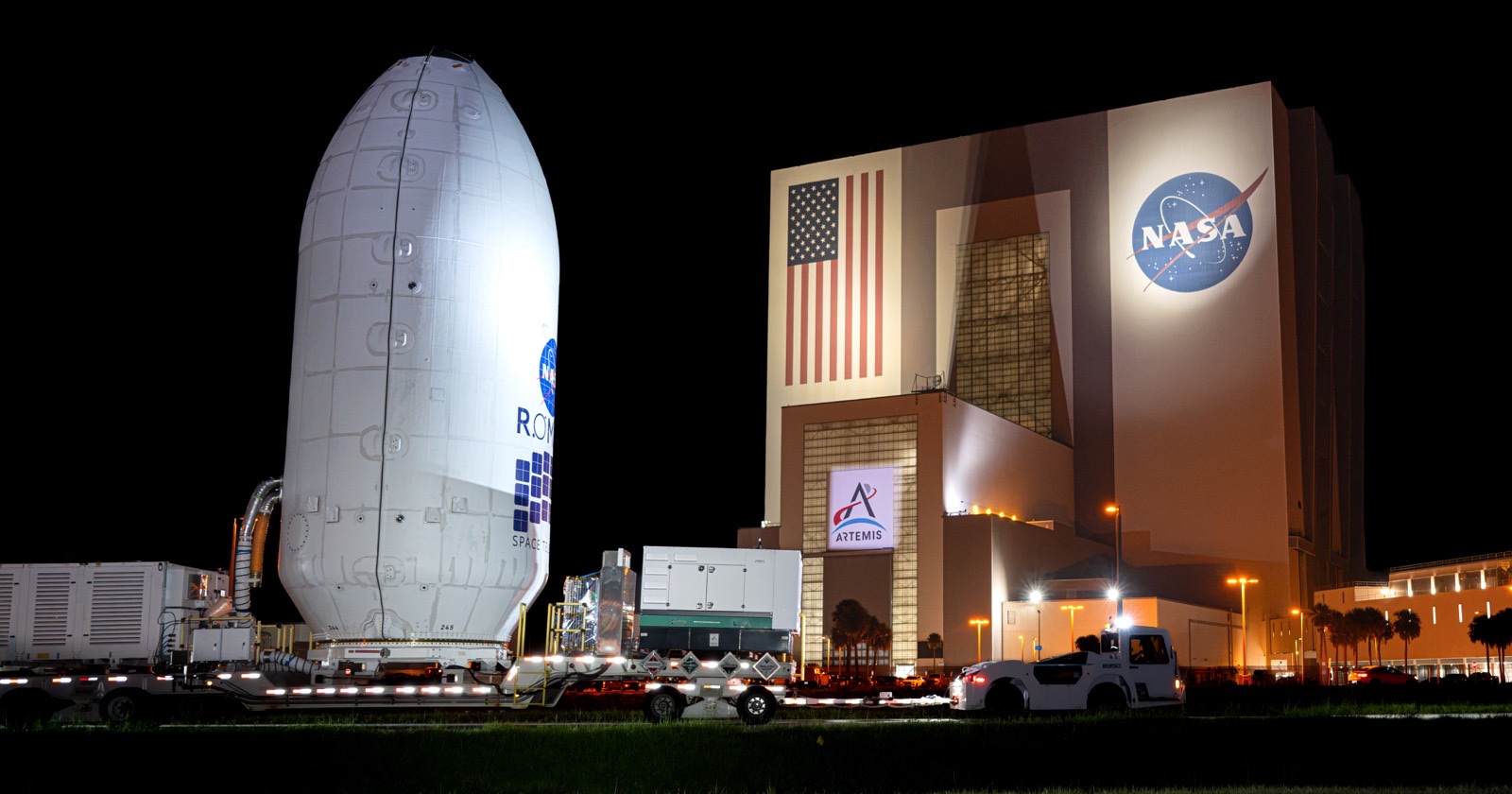
NASA’s Nancy Grace Roman Space Telescope launched successfully on Sunday, August 30, at 7:26 a.m. EDT aboard a SpaceX Falcon Heavy from Kennedy Space Center. The observatory separated from the rocket’s second stage at 7:57 a.m., established communications and began its journey toward the Sun–Earth L2 region.
Roman carries a primary mirror 2.4 metres across, exactly the same diameter as Hubble’s. Yet its main camera will see at least 100 times more sky in one exposure. That is not a contradiction. A telescope’s sharpness and the width of its view are related to different parts of the machine.
The most useful way to understand Roman is not as a newer Hubble. It is a survey observatory that combines Hubble-class detail with a panorama. The shared mirror diameter establishes one part of that comparison. Roman’s optics and enormous detector array establish the other.
Two mirrors with the same diameter
Both telescopes begin with a circular primary mirror 2.4 metres, or 7.9 feet, wide. A larger mirror collects more light, making faint objects easier to detect. Its diameter also sets the theoretical limit on the smallest angular detail a telescope can distinguish at a given wavelength.
That is why NASA can reasonably say Roman will produce images with near-infrared resolution comparable to Hubble’s. Put the observatories at the same wavelength and the same mirror diameter gives them a similar diffraction limit, though the full performance still depends on optical quality, sampling, pointing and detectors.
Roman’s mirror is not Hubble’s mirror moved into a new spacecraft. It is a separate lightweight mirror that was transferred to NASA by another US government agency and then reshaped and coated for the mission. NASA says it weighs less than one-quarter as much as Hubble’s primary mirror.
None of that determines how wide a finished image must be. A sharp photograph can cover a narrow patch or a broad one. Mirror diameter helps determine the fineness of the detail inside the frame. It does not, by itself, determine the frame’s boundaries.
The field of view lives behind the mirror
After Roman’s mirrors collect and focus incoming light, the Wide Field Instrument has to record it. This is where the comparison changes. Roman’s focal plane uses 18 detectors, each containing 4,096 by 4,096 pixels, arranged into an arch-shaped mosaic.
Together they form a camera usually described as 288 or roughly 300 megapixels. NASA’s current technical specification gives an active field measuring about 0.8 by 0.4 degrees, covering 0.281 square degrees once the narrow gaps between detectors are excluded.
The arch is not a decorative arrangement. Roman’s optical design produces its best corrected view along a ring around the centre of the focal surface. Placing the detectors along part of that ring lets the camera preserve fine image quality across a much broader area than a single rectangular sensor could cover.
Each pixel samples about 0.11 arcseconds of sky. Multiplying that sampling by hundreds of millions of pixels is what gives Roman its unusual combination: a view larger than the apparent area of a full Moon, recorded with detail in the same general class as Hubble’s infrared imaging.
Where the “100 Hubble pointings” comes from
Hubble does not have one fixed field of view. Its instruments and camera channels see different areas, so no single ratio applies to every possible Hubble observation. The familiar 100-times figure compares Roman with the broadest Hubble imaging footprints and deliberately rounds the result.
Hubble’s Advanced Camera for Surveys Wide Field Channel covers about 202 by 202 arcseconds. That works out to roughly 0.00315 square degrees before allowing for its detector gap. Roman’s 0.281 square degrees is about 89 times that area, close enough to describe as nearly 100.
Hubble’s near-infrared Wide Field Camera 3 is narrower, at 136 by 123 arcseconds according to the Space Telescope Science Institute’s instrument handbook. Against that camera, Roman’s field is about 218 times larger. NASA accordingly describes the infrared comparison as roughly 200.
So the headline’s 100 separate pointings is a good picture of the mosaic problem, not an exact exchange rate. It means Hubble would need on the order of 100 exposures aimed side by side to cover the sky area Roman records at once with its Wide Field Instrument.
One Roman exposure is not literally a finished Hubble mosaic
Area is only one ingredient in an astronomical image. Two observations also need comparable exposure times, filters, wavelength coverage, sensitivity, sampling and background conditions before their scientific content can be compared directly. A Roman frame cannot simply be substituted for any arbitrary set of 100 Hubble images.
Mosaics also overlap their tiles so software can align the stars, reject defects and bridge detector gaps. Roman will use repeated, slightly offset exposures for many of the same reasons. Its 18 detectors have gaps, and multiple visits can improve sampling, remove cosmic-ray contamination and build deeper measurements.
The claim is therefore about simultaneous footprint. Roman receives light from its whole 0.281-square-degree field in one pointing. Hubble must slew or offset, settle and expose again as it lays down adjacent pieces. Those repeated operations consume observing time even before the individual exposures are counted.
This qualification does not weaken Roman’s advantage. It explains it. The gain is not that Roman somehow compresses 100 times more detail into the same small detector. It begins with a far larger, carefully corrected focal plane and avoids much of the overhead required to assemble broad Hubble maps.
Why survey speed changes the science
Hubble excels when astronomers need a highly detailed view of one object or a small field. Roman is designed for questions that depend on populations: billions of galaxies, tens of thousands of supernovae, dense fields of stars and statistical samples of planetary systems.
NASA estimates Roman can survey the sky up to 1,000 times faster than Hubble while maintaining similar infrared sensitivity and resolution. That figure includes more than field area. Observing efficiency, detector performance and the way Roman’s surveys are organised also contribute.
Over its five-year primary mission, Roman is expected to image more than 50 times as much sky as Hubble covered in its first 30 years. The difference between 100 times the area per frame and 50 times the total historical coverage is a reminder that telescopes do not spend every minute taking identical exposures.
Roman will revisit selected fields instead of simply sweeping every patch once. Repetition turns the wide camera into a time-domain instrument, able to catch supernovae and other changing sources. An earlier ScienceBlog report examined estimates that Roman could record around 100,000 stellar explosions across its surveys.
A wider route into the dark universe
One of Roman’s central jobs is to measure how cosmic structure and expansion changed over time. Weak gravitational lensing slightly distorts the apparent shapes of distant galaxies. Mapping that effect across immense samples can trace the otherwise invisible distribution of matter between the galaxies and Earth.
Roman will also study galaxy clustering and distant exploding stars to test the history of cosmic expansion. These methods work differently and carry different systematic errors. The value of a broad survey is partly that it supplies large, consistently observed samples for several independent measurements.
ScienceBlog previously looked at Roman’s planned use of stellar halos to reconstruct how galaxies grew. That work depends on breadth as well as sharpness: the faint outskirts of many galaxies extend across large areas and become more informative when they can be compared systematically.
More objects do not automatically remove bias. Detector calibration, image distortions, selection effects and the redshift estimates used to place galaxies in cosmic history all require careful control. Roman’s wide field gives researchers statistical power, but the mission still has to prove that its measurements remain stable enough to use it.
The planet survey needs repeated panoramas
Roman’s Galactic Bulge Time Domain Survey will repeatedly watch a dense region toward the centre of the Milky Way. It will search for gravitational microlensing, temporary brightening that occurs when the gravity of a foreground object bends and magnifies light from a more distant star.
If the foreground star has a planet, that planet can add a short secondary feature to the light curve. The event does not repeat, so the camera must monitor huge numbers of stars frequently enough to catch brief deviations. A narrow field would either watch fewer stars or spend too much time moving among them.
This method is sensitive to planets at orbital distances that complement the close-in worlds found by transit surveys. It may also detect objects that drift without a host star. The contribution is a census, not a gallery of resolved planetary photographs.
Roman carries a second instrument, a technology-demonstration coronagraph, designed to block starlight and test techniques for directly imaging some giant exoplanets and surrounding dust. That narrower experiment should not be confused with the Wide Field Instrument or its 100-pointing comparison.
Roman complements Hubble rather than replacing it
Roman’s breadth comes with choices. Hubble can observe ultraviolet light that Roman’s Wide Field Instrument cannot. Hubble also carries specialised instruments and observing modes developed around targeted investigations rather than a single dominant wide-survey camera.
Hubble can examine a promising object Roman finds using different wavelengths or a more specialised setup. Webb can follow especially faint or distant targets with its larger mirror and deeper infrared reach. Ground-based observatories can add spectroscopy and long observing campaigns. Roman’s maps become more valuable when other telescopes can interrogate their contents.
Nor does Roman make Hubble’s archive obsolete. Hubble’s long time baseline allows astronomers to compare the sky across decades, and many of its ultraviolet observations cannot be recreated by Roman. The missions share a mirror diameter, but they were built in different eras to answer partly different kinds of questions.
A fairer analogy is the difference between a telephoto portrait and a sharp atlas. Hubble is not always the telephoto instrument, and Roman will also conduct focused observations, but the contrast captures their default strengths: one has built its reputation through precise fields; the other is organised to connect those fields across large parts of the sky.
Launch began the commissioning journey
Roman lifted off on August 30 at 7:26 a.m. EDT and separated cleanly from Falcon Heavy’s second stage 31 minutes later. NASA reported that the spacecraft was communicating with controllers as it began the roughly million-mile journey toward its operating region around L2.
During the journey and commissioning period, teams will deploy, calibrate and test the observatory before routine science work. NASA expects the first public Roman images in early 2027.
Those checks matter because the 100-pointing promise rests on more than the camera turning on. All 18 detectors must be characterised. Engineers must measure optical distortion, focus, detector response, pointing stability and thermal behaviour well enough for separate exposures and repeated visits to fit together reliably.
The successful launch did not immediately replace decades of Hubble mosaics. It began the harder process of proving that a 2.4-metre observatory can keep Hubble-like detail across a field almost 100 times wider than Hubble’s broadest camera.
That is the real significance of the comparison. The familiar mirror size tells astronomers how finely Roman should see. The vast focal plane tells them how much it can see at once. Put those two properties together, and the unit of discovery shifts from one carefully framed target toward whole populations spread across the sky.
Update, 15 September 2026: The headline and launch section were updated after Roman launched successfully on August 30 at 7:26 a.m. EDT and began its journey and commissioning phase.