

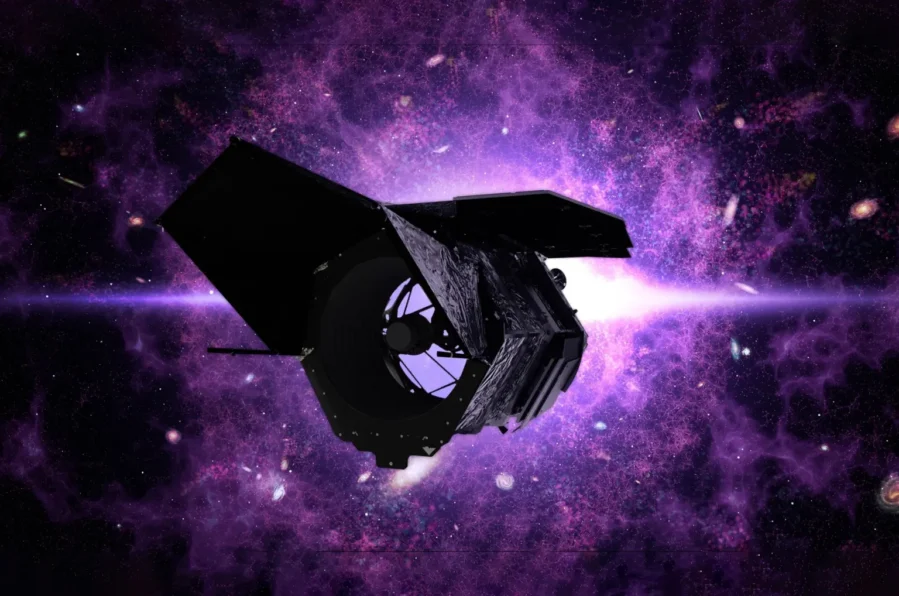
NASA’s upcoming Roman Space Telescope will transform our understanding of the universe by detecting an estimated 100,000 cosmic explosions during a single two-year survey.
The space observatory, launching in 2027, will scan the same patch of sky every five days, creating time-lapse movies of stellar deaths, black hole feeding frenzies, and potentially the universe’s first exploding stars—some dating back over 11 billion years.
This cosmic fireworks display will provide unprecedented insights into dark energy, the mysterious force driving the universe’s accelerating expansion. Scientists predict the survey will revolutionize multiple fields of astronomy while uncovering phenomena never before observed.
A Supernova Gold Rush
The High-Latitude Time-Domain Survey represents the most ambitious cosmic explosion hunt ever attempted. Benjamin Rose, an assistant professor at Baylor University who led the research published in The Astrophysical Journal, emphasized the survey’s broad impact: “Whether you want to explore dark energy, dying stars, galactic powerhouses, or probably even entirely new things we’ve never seen before, this survey will be a gold mine.”
Roman’s primary targets are Type Ia supernovae—stellar explosions that serve as cosmic measuring sticks because they reach consistent peak brightness. The telescope is expected to detect approximately 27,000 of these events, roughly ten times more than all previous surveys combined.
What makes this particularly exciting is Roman’s ability to peer deeper into cosmic history than ever before. While most previously detected Type Ia supernovae occurred within the last 8 billion years, Roman will observe thousands that exploded more than 10 billion years ago, with dozens potentially reaching back 11.5 billion years.
Beyond Standard Explosions
The survey will capture a diverse cosmic menagerie beyond the primary supernova targets:
- Core-collapse supernovae: About 60,000 explosions from massive stars running out of fuel
- Tidal disruption events: 40 instances of black holes shredding nearby stars
- Superluminous supernovae: 90 explosions that can outshine typical supernovae by 100 times
- Kilonovae: Five collisions between neutron stars or neutron stars and black holes
- Pair-instability supernovae: More than 10 explosions from the universe’s first massive stars
Each type offers unique scientific opportunities. Kilonovae, for instance, forge heavy elements like gold and platinum in their aftermath, but only one has been definitively detected to date. Roman’s discoveries could quintuple that number.
Hunting Primordial Giants
Perhaps most intriguingly, Roman may achieve the first confirmed detection of pair-instability supernovae—explosions from the universe’s first generation of stars. These primordial giants were hundreds of times more massive than our Sun and contained virtually no heavy elements, which hadn’t yet formed.
Their explosions were so powerful they left nothing behind, completely self-destructing when gamma rays inside converted to matter-antimatter pairs, causing catastrophic collapse. Rose expressed confidence about these discoveries: “I think Roman will make the first confirmed detection of a pair-instability supernova. They’re incredibly far away and very rare, so you need a telescope that can survey a lot of the sky at a deep exposure level in near-infrared light, and that’s Roman.”
Dark Energy’s Cosmic History
The massive supernova dataset will address one of cosmology’s biggest puzzles: the nature of dark energy. By measuring how the universe’s expansion rate changed over different cosmic epochs, scientists can trace dark energy’s evolution through time.
Current evidence suggests dark energy itself has changed over cosmic history, but gaps in our observational record make this difficult to confirm. Roman’s ability to detect supernovae across unprecedented distances will fill these crucial gaps.
Rose noted the broader implications: “Filling these data gaps could also fill in gaps in our understanding of dark energy. Evidence is mounting that dark energy has changed over time, and Roman will help us understand that change by exploring cosmic history in ways other telescopes can’t.”
Machine Learning Meets Cosmic Discovery
Distinguishing between different types of explosions requires sophisticated analysis techniques. Rebekah Hounsell, an assistant research scientist at the University of Maryland-Baltimore County working at NASA’s Goddard Space Flight Center, explained the approach: “By seeing the way an object’s light changes over time and splitting it into spectra—individual colors with patterns that reveal information about the object that emitted the light—we can distinguish between all the different types of flashes Roman will see.”
The research team has created comprehensive datasets that will train machine learning algorithms to automatically classify Roman’s discoveries. This automated approach is essential given the sheer volume of data the telescope will generate.
Hounsell acknowledged the survey’s broader impact: “While searching for type Ia supernovae, Roman is going to collect a lot of cosmic ‘bycatch’—other phenomena that aren’t useful to some scientists, but will be invaluable to others.”
Expecting the Unexpected
Roman’s survey may reveal entirely unknown types of cosmic phenomena. The telescope’s combination of wide field of view, deep sensitivity, and regular monitoring creates ideal conditions for serendipitous discoveries.
Future iterations of the simulation could incorporate additional cosmic variables like active galaxies and stellar variability. Other telescopes will likely follow up on Roman’s most intriguing discoveries, studying them across different wavelengths for deeper understanding.
As Hounsell anticipates: “Roman’s going to find a whole bunch of weird and wonderful things out in space, including some we haven’t even thought of yet. We’re definitely expecting the unexpected.”