

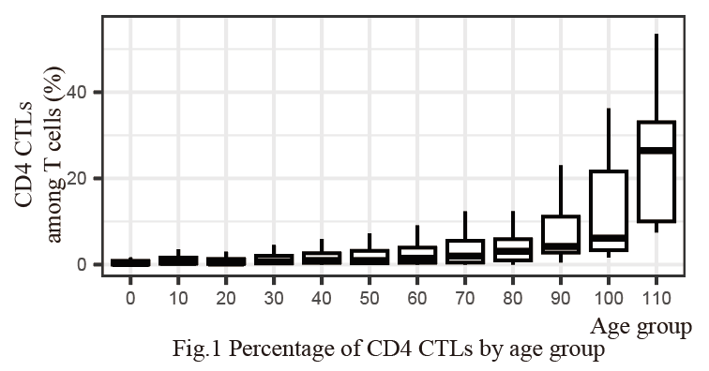
Reaching 110 does not mean carrying an ordinary 70-year-old immune system for four extra decades. A supercentenarian has survived an exceptional accumulation of infections, inflammation, tissue damage and cellular turnover. The people who arrive there are rare survivors, not a representative sample of ageing.
That makes a new finding in their blood intriguing, but also easy to overread. In ten people aged 110 or older, an unusual type of immune cell called a cytotoxic CD4 T cell made up a median 17.6% of all T cells. That is close to one cell in five.
The median was 9.6% in ten centenarians aged 100 to 109 and 4.0% in eight participants aged 70 to 99. The pattern, reported in Cell Reports, suggests that extreme old age can involve an abrupt reshaping of the T-cell population rather than a simple continuation of the decline seen earlier in life.
It does not show that these cells caused anyone to live past 110. It does reveal an immune system that, even at the far edge of the human lifespan, may still be making forceful and highly individual responses to something.
Why a killer CD4 cell is unusual
T cells are often introduced as a tidy division of labour. CD4 T cells are the helpers and coordinators. They recognise antigens presented to them, release signals and organise other immune cells. CD8 T cells are the conventional killers, equipped to destroy infected or abnormal cells.
Biology is less tidy. Some CD4 cells acquire cytotoxic machinery, including granzymes and perforin, and become capable of direct attack. These cytotoxic CD4 T lymphocytes, or CD4 CTLs, are uncommon in most people but can expand during chronic viral infection, cancer and ageing.
They are not automatically beneficial. Cytotoxicity can remove dangerous cells, but a forceful or misdirected immune response can damage healthy tissue. ScienceBlog’s earlier look at immune youthfulness in older adults described that broader tension: retaining active T-cell populations may preserve defence while also increasing the opportunity for autoimmunity.
The new study is narrower. It asks what these unusual CD4 killers look like in the extraordinarily selected people who have already survived beyond 110.
Three age bands, one steep change
The researchers studied 28 people. Eight were between 70 and 99, ten were centenarians between 100 and 109, and ten were supercentenarians aged at least 110. Calling the first group a comparison group is more accurate than calling it young; even its youngest members had already reached an age at which immune function commonly changes.
The team combined single-cell RNA sequencing with measurements of proteins on the cell surface and sequencing of T-cell receptors. That combination allowed them to count the cells, identify their molecular state and work out whether many belonged to the same family of descendants.
The medians rose from 4.0% to 9.6% to 17.6% across the three groups. Yet the graph does not describe a smooth clock inside every person. Variation became wide at the oldest ages. Some individuals carried far more CD4 CTLs than others, so the result is a group pattern, not a rule that every immune system follows on its 100th birthday.
The investigators then checked public single-cell datasets spanning more than 1,500 samples and more than five million cells across the human lifespan. Those data also supported a sharp rise, and increasing variability, around extreme old age. The University of Osaka’s account of the work describes the expansion as beginning around age 100.
A cell family leaves its signature
A T-cell receptor is a molecular recognition system. Each lineage carries a particular receptor sequence that helps determine which antigen it can recognise. When a T cell encounters its target and proliferates, its descendants inherit essentially the same receptor.
That turns receptor sequencing into a record of immune expansion. If thousands of cells carry the same receptor sequence, they are not thousands of independent accidents. They are a clone, a family descended from a cell that was selected to multiply.
In the very old participants, a few clones occupied an unusually large fraction of the cytotoxic CD4 population. Across the cohort’s dominant lineages, the most abundant clone averaged 33.3% of a person’s CD4 CTLs. That figure is not 33.3% of all T cells. It is one-third of the already specialised cytotoxic CD4 compartment.
The expanded clones were also mostly private. Different people carried different dominant receptor sequences. There was no shared supercentenarian receptor that could plausibly be called a universal longevity switch.
Private expansion makes lifetime immune history a more likely explanation. A persistent infection, repeated reactivation of a virus or recurring abnormal-cell antigen could repeatedly summon one useful lineage. The sequence data show that expansion happened. They do not reveal which target caused it.
Expansion without the usual ending
Repeated stimulation often drives a T cell towards exhaustion. In that state, the cell can remain present while losing part of its ability to proliferate, signal or kill. A huge clone is therefore not necessarily an effective one.
The supercentenarians’ expanded cells did not show the classic molecular profile of terminal exhaustion. The researchers also stimulated selected cells outside the body and found that descendants within a clone could produce different combinations of cytokines. Identical receptor ancestry had not locked every cell into an identical functional state.
The analysis suggested a path from conventional helper cell towards killer. Loss of the surface marker CD27 appeared before loss of CD28, with a CD27-negative, CD28-positive state acting as an intermediate. This is molecular reconstruction, not a film of one cell changing across decades, but it gives the expansion a plausible developmental sequence.
“Not exhausted” needs careful handling. It refers to measured markers and behaviour in laboratory stimulation. It does not mean the participants possessed completely youthful immunity, or that the cells would respond perfectly to a new pathogen inside the body.
The tumour resemblance is a clue, not a diagnosis
The researchers compared dominant receptor sequences with databases containing T cells expanded in other settings. Some resembled receptors seen among tumour-expanded cells, especially in lung cancer samples. The supercentenarians had no known history of the cancers used for that comparison.
That resemblance opens several possibilities. The cells might recognise an antigen shared by infected, senescent or abnormal cells. They might reflect long-term surveillance against cellular changes that become more common with age. Or similar receptor sequences might be less specific than the most exciting interpretation assumes.
The possible connection between immune repertoire and longevity is worth testing. ScienceBlog recently examined research on adult thymic health, T-cell-receptor diversity and later-life outcomes. That involved a different cell source and study design, but it reinforces an important point: later-life immunity is about the structure of the available repertoire, not simply the number of cells.
It does not establish that the same process occurred in these ten supercentenarians. A receptor match is not a cancer screen, proof of an infection or evidence that the participants survived because their immune systems eliminated tumours. The relevant antigens were not identified.
What a study of ten survivors cannot tell us
Supercentenarian biology imposes a statistical problem: there are very few supercentenarians to study. Ten participants can reveal a striking cellular pattern, especially when single-cell methods generate rich measurements, but ten people cannot represent every route to extreme longevity.
The design was cross-sectional. Researchers sampled people after they had reached their age group rather than following them for decades. The cells may have contributed to survival. They may instead have accumulated because these people lived long enough to encounter the same antigens repeatedly. A genetic trait, past infection or unmeasured health factor could influence both longevity and the T-cell pattern.
There is also survivor bias. Everyone in the oldest group had already passed through an extraordinary filter of mortality. Comparing them with people in their seventies, eighties and nineties cannot reveal how many people once had similar immune cells but did not survive.
The samples came from blood. T cells living in skin, lung, intestine, lymph nodes and tumours can behave differently from cells in circulation. Functional tests performed outside the body add useful evidence, but they cannot reproduce the complete tissue environment.
This is not an intervention study and it offers no basis for trying to increase cytotoxic CD4 cells with a drug, supplement or infection. A large, persistent clone could be protective in one context and harmful in another.
A stronger sequel to an earlier clue
The result did not appear from nowhere. In 2019, some of the same researchers used single-cell methods on blood from seven supercentenarians and five younger controls. Their earlier study found that cytotoxic CD4 cells were unusually abundant and that a handful of clonotypes could occupy 15% to 35% of the entire CD4 T-cell population.
The 2026 work adds a centenarian group, traces the age pattern in broader public data and examines the transition and functional diversity of the clones in more detail. Its underlying sequence data are also available through an Osaka University repository, making it possible for other researchers to reanalyse the evidence.
That is meaningful progress, but it remains descriptive biology. The next tests are harder: identify the antigens these clones recognise, compare blood with tissues, determine whether similar patterns appear in other populations and follow people prospectively to see whether the cells predict infection, cancer, autoimmunity or survival.
Extreme ageing may be reorganisation, not just loss
Immune ageing is usually told as a story of depletion. The thymus produces fewer new T cells, the repertoire narrows, vaccine responses weaken and chronic inflammation rises. Those changes are real. The supercentenarian data add a second story in which the remaining system concentrates heavily on selected, experienced lineages.
Concentration has a trade-off. A large clone trained by decades of exposure might be unusually persistent against an old adversary. At the same time, devoting so much of the repertoire to yesterday’s targets could leave less diversity for a novel pathogen. Resilience and narrowing can coexist.
The most honest interpretation is therefore modest. Ten people who lived past 110 carried an uncommon population of CD4 killer cells at striking abundance. Those cells had expanded clonally and retained signs of functional flexibility. Their receptors hinted at repeated encounters with persistent or abnormal targets, but the targets themselves remained unknown.
The study has not found the immune secret of extreme longevity. It has found something subtler: at 110, the human immune system may still be actively rewriting its internal balance, shaped by a lifetime of threats that each survivor met in a different way.