

NASA’s Nancy Grace Roman Space Telescope left Earth on August 30 aboard a SpaceX Falcon Heavy, beginning a three-month trip toward the Sun-Earth L2 region about one million miles away. The observatory’s launch was the end of a construction story that began with an unusual phone call between two parts of the U.S. government.
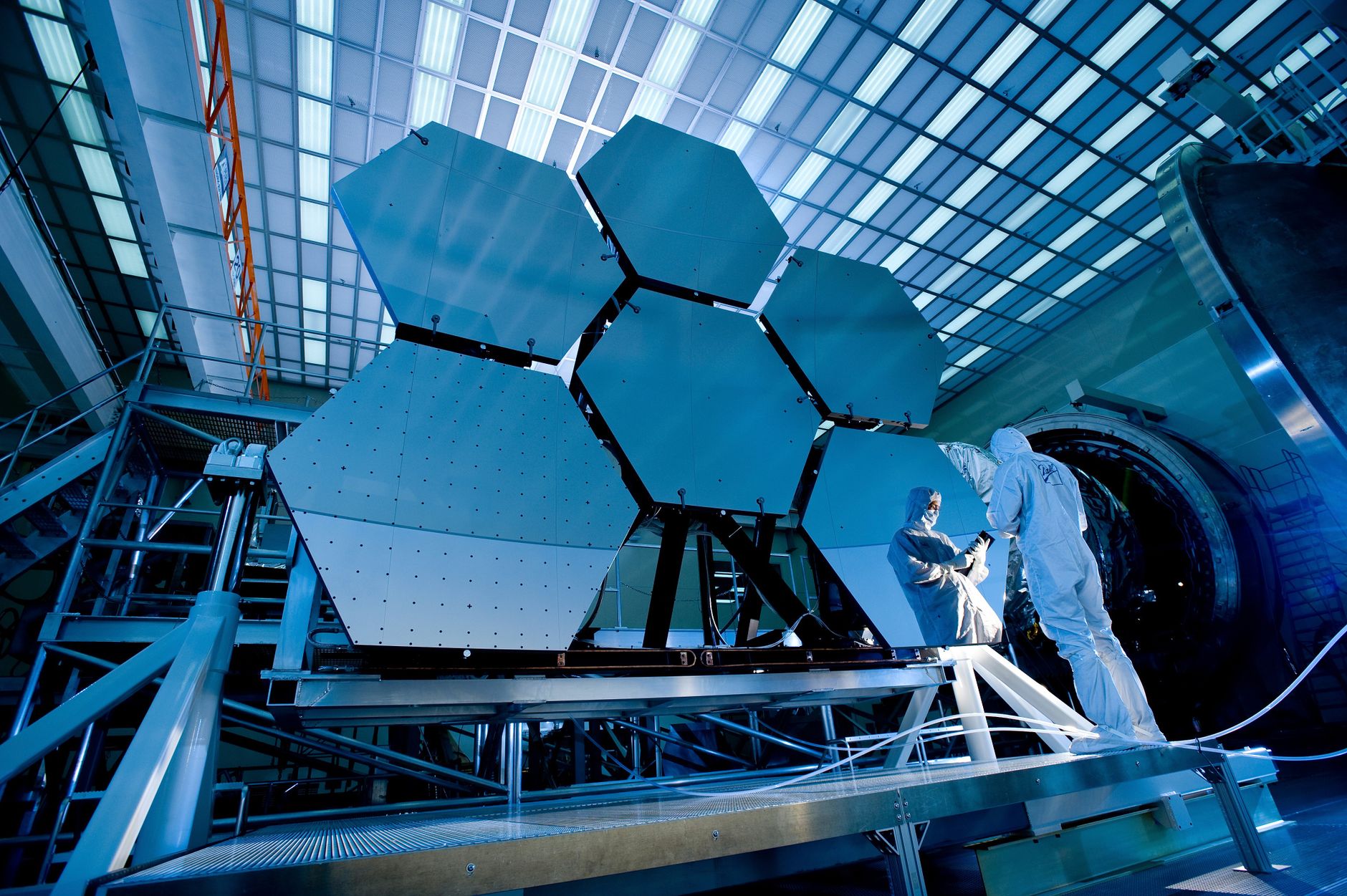
At the center of Roman is a 7.9-foot, or 2.4-meter, primary mirror inherited from the National Reconnaissance Office, the agency that develops and operates American reconnaissance satellites. It is the same diameter as Hubble’s primary mirror. The hardware had never flown and was no longer required for an intelligence mission.
That description needs one immediate qualification. NASA did not receive a finished spy satellite that only had to be pointed away from Earth. It received sophisticated optical hardware, then spent years turning one of the donated assemblies into part of a civilian observatory designed for infrared astronomy.
Two unused telescopes appeared in 2011
The mission now called Roman existed before the intelligence hardware entered the picture. The 2010 astronomy and astrophysics decadal survey had recommended a Wide Field Infrared Survey Telescope, or WFIRST, as its highest-priority large space mission. Early concepts used a smaller mirror, generally in the 1.3- to 1.5-meter class.
Then the National Reconnaissance Office contacted NASA in January 2011. The intelligence agency had two unused telescope assemblies available for transfer. When the arrangement became public in June 2012, contemporaneous reporting placed the hardware in storage in Rochester, New York, at the facility of the contractor then known as ITT Exelis.
The assemblies had 2.4-meter primary mirrors, mirror supports, a secondary mirror structure and equipment for controlling the optics’ temperature. They did not include a scientific camera, spacecraft bus, solar panels, communications equipment or launch vehicle. Whatever classified sensors had originally been intended to sit behind the optics were not part of the gift.
The NRO has not publicly disclosed every detail of the reconnaissance program for which the hardware was built. That leaves room for confident-sounding stories that go beyond the public record. The useful, documentable fact is narrower: the agency had high-quality, space-capable telescope assets it no longer needed, and NASA was allowed to examine them for scientific use.
The gift changed WFIRST rather than creating it
A larger mirror gathers more light and can resolve finer detail at a given wavelength. Moving from a roughly 1.3-meter concept to a 2.4-meter aperture therefore offered WFIRST much more scientific reach. A NASA technical history of the design says the larger aperture provided about three times the collecting area and a point-spread function roughly half as wide as the earlier concept.
NASA convened a new science definition team to determine whether the donated hardware could serve the goals set by the decadal survey. Its 2013 design study described a mission built around one of the newly available, Hubble-quality telescope assemblies. The result was WFIRST-AFTA, with AFTA standing for Astrophysics Focused Telescope Assets.
This was a substantial redesign, not a simple substitution. A telescope created to look down at Earth operates under different optical, thermal and mechanical requirements from one intended to measure faint infrared light across deep space. Roman’s team modified the inherited primary mirror’s shape and surface, then added a silver coating chosen for its performance at near-infrared wavelengths.
NASA’s account of the completed observatory says the primary mirror now weighs 410 pounds, or 186 kilograms, less than one-quarter the weight of Hubble’s. It works with nine additional mirrors, supporting structures and electronics in the Optical Telescope Assembly.
The mirror gave NASA a head start. It did not provide the rest of the telescope.
A Hubble-sized mirror with a much wider view
Roman’s most important comparison with Hubble is not that the two observatories are copies. They share a primary-mirror diameter, which helps give Roman Hubble-like sharpness, but their principal cameras were designed for different jobs.
Roman’s Wide Field Instrument is a roughly 300-megapixel infrared camera made from 18 detectors. It can capture a patch of sky at least 100 times larger than Hubble can cover in a comparable exposure. A recent ScienceBlog explainer examined how Roman combines the familiar 2.4-meter aperture with that much broader field.
The difference turns Roman into a survey instrument. Hubble has spent decades producing detailed observations of selected targets and relatively small fields. Roman is designed to map large populations: billions of galaxies, changing stars and supernovae, and thousands of planets detected through gravitational microlensing.
Its second instrument, a coronagraph, was not part of the intelligence transfer. NASA’s Jet Propulsion Laboratory built it as a technology demonstration for blocking a star’s glare and directly imaging some large planets and planet-forming disks. The Wide Field Instrument, coronagraph, spacecraft, sunshield, detector systems and ground infrastructure all had to be designed, built and tested around the inherited optical starting point.
The free hardware did not make Roman cheap
Calling the mirror free can obscure the economics. NASA did not pay the NRO to acquire the telescope assets, and officials initially estimated that reusing the hardware might avoid hundreds of millions of dollars in optical-development work. But accepting a valuable component is not the same as receiving a complete mission at no cost.
The larger aperture expanded what WFIRST could do, while also demanding a new design around hardware that had not been built for the exact mission NASA originally proposed. Engineers had to alter the optics, develop new instruments, integrate the observatory, qualify it for launch and operate an extensive science and communications program.
The latest Government Accountability Office assessment records Roman’s replanned life-cycle cost at $4.316 billion. That figure covers the mission over its life cycle, not the price of the donated mirror. It is also why the transfer should not be told as a story about NASA finding a spare telescope in a warehouse and saving billions.
The better reading is that the government already owned an unusually capable optical asset. Reusing it let NASA pursue a more ambitious version of a mission astronomers had already made a priority. Whether every downstream design choice saved money compared with building the smaller original concept is much harder to isolate.
What remains classified
The spy-satellite origin gives Roman an appealing backstory, but it also places a boundary around what can be said responsibly. The public record identifies the National Reconnaissance Office, the two transferred telescope assemblies and their broad capabilities. It does not provide a complete technical history of the classified system that produced them.
Roman also should not be described as an intelligence satellite converted whole into a science observatory. The donated equipment supplied a foundation for the optical design. The finished spacecraft is a NASA mission assembled from millions of components by more than a thousand technicians and engineers, with contributions from U.S. contractors and international partners.
A 2024 NASA Office of Inspector General audit describes Roman as using a repurposed 2.4-meter primary mirror obtained from the U.S. intelligence community. The same report details the Wide Field Instrument, coronagraph and science program that NASA built around it. That distinction between inherited hardware and completed observatory is central to understanding what the government transfer accomplished.
The mirror is now finally in space
NASA reported that Roman launched at 7:26 a.m. EDT on August 30. Controllers received telemetry seven minutes later, and the observatory separated from Falcon Heavy about 31 minutes into the flight. NASA subsequently confirmed that its solar panels and lower instrument sunshade had deployed.
The telescope is now traveling toward L2, where it will orbit the Sun in step with Earth. Engineers will spend the commissioning period deploying remaining hardware, checking the optics and calibrating both instruments. NASA expects to release the first images in early 2027.
Only then will the repurposed mirror begin the work for which NASA adapted it: collecting infrared light from galaxies, exploding stars and planetary systems rather than forming images of Earth. The hardware’s earlier assignment remains partly hidden, but its next one will produce public data with no proprietary period.