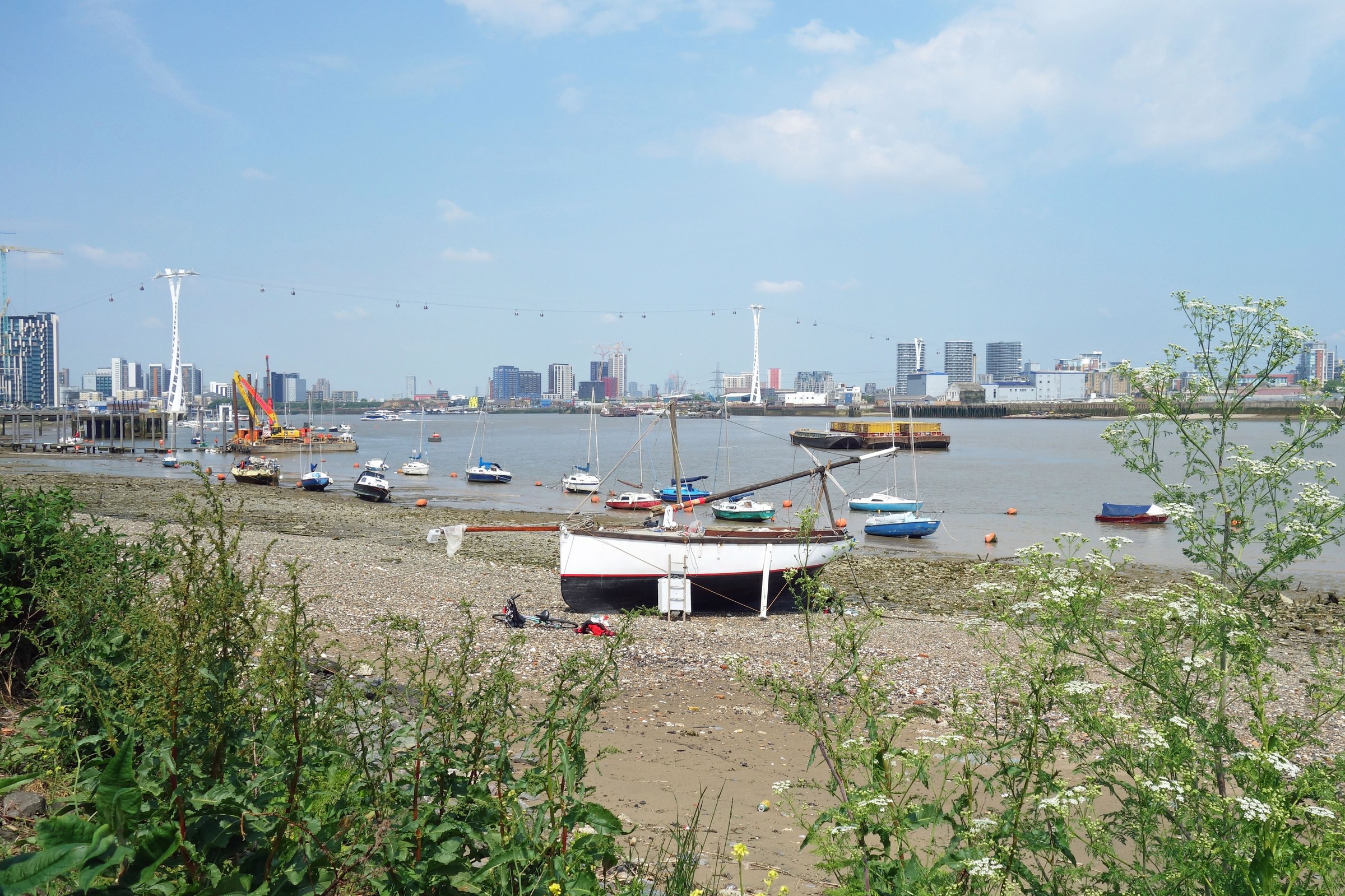
The Tidal Thames was declared biologically dead in 1957 with zero fish species, and over 115 species have been recorded in it since, according to The State of the Thames 2nd Edition, a report from the Zoological Society of London (ZSL).
ZSL published the report on 19 January 2026, five years after the first edition, its project page says. The Tidal Thames is the stretch of river that rises and falls with the tide, from Teddington through London to the sea.
Why, then, has the average number of species caught per net sample in the upper and middle stretches slightly declined since 1992?
The figure of over 115 is a running total of every species recorded since 1957, the report’s wording makes clear. It is not a count from a single survey, and it is not the number of species living in the river today.
Mike Elliott, emeritus professor of estuarine and coastal sciences at the University of Hull, was not involved in the report. “Yes, by most accounts and historically, the Thames can be regarded as a success story even if it literally took a ‘stink’ over a century ago to get MPs and others take notice,” he said in an email.
The report draws on 21 indicators assessed by experts from 21 organisations, the project page says. Thames Water, the water company for London, funded the preparation of the report. The acknowledgements state that the content remains independent and that Thames Water had no editorial influence over it.
Fewer species per net
The fish indicator is rated “Deteriorating” over the long term and “Data stable” over the short term, the report’s assessment shows. “Fish populations have been deteriorating in the long term, but appear to have stabilised in the short term,” the report says.
That judgement rests on Environment Agency seine-net samples. A seine net is a long net anchored on the bank and pulled round in a semicircle to enclose fish. The measure is species per sample, meaning the average number of different fish species caught in each haul.
Species per sample showed a slight but statistically significant decline in the Upper and Middle Tidal Thames between 1992 and 2023, the report says. From 2014 to 2023 there was no significant trend in either direction.
The report offers two readings of the slight decline. It “might be due to changes in sampling methods”, or it “could be an indication of pressures on fish populations either in the Tidal Thames, or further afield.” Further research is needed to determine the cause, ZSL’s project page says.
“Fish are a good indication of water quality and especially dissolved oxygen,” Elliott said. He added that “we are now going backwards because of unregulated sewage discharges”, and that a fall in the number of fish species would not surprise him.
Elliott said the peak tally of about 120 species “did include some freshwater species and some marine ‘straggler species'”. He described stragglers as fish “found by accident either washing in from the sea or down from the river”. UK, European and global analyses of how many species an estuary like the Thames should support suggest that 100 to 120 is appropriate, he said.
In a follow-up email Elliott sent his own graph of species counts over time, which he said “shows we are reaching the stable situation for species”. The report, by contrast, “gives the number of species per sample which is subject to many influences”, he said. He had “seen but not read the 2026 report in detail”.
Many fish in the estuary depend on conditions at sea or in the rivers upstream, Elliott said, “so the influences are far and wide”. The 1957 verdict followed decades of absence. From 1920 to 1964 fish were largely absent from Fulham downriver to Tilbury, the report says, citing a 1998 volume edited by Attrill.
Seahorses, sharks and seals
Juvenile short-snouted seahorses are present in the Thames, a caption in the report says. Three shark species, tope, starry smoothhound and spurdog, are named on ZSL’s project page. They are found in the Greater Thames Estuary, the wider mouth of the river towards the North Sea, not in the river through London.
Seals are surveyed from Gravesend to Felixstowe and Deal, in the estuary. The 2024 estimate was about 599 harbour seals and 2,987 grey seals, the report says. Harbour seals peaked at 796 in 2017 and had fallen to 599 by 2024, below their 2013 level.
The harbour seal indicator is rated “Deteriorating” over the short term and “Data stable” over the long term. Grey seals are improving on both timescales, with 2024 counts about 3.5 times those of 2013. Rising grey seal numbers may threaten harbour seals through competition for haul-out sites and prey, and through the risk of phocine distemper virus, the report says.
Nitrate, a nitrogen compound that can be dangerous to aquatic life, is rated “Deteriorating” over the long term and “Data stable” over the short term. Sewage effluent continues to cause gradually increasing nitrate concentrations, ZSL’s page says. The Environment Agency identifies industry and sewage as the main source in London waterways.
Dissolved oxygen, the oxygen in the water that fish need to breathe, is improving on both timescales, the report says. The Thames Tideway Tunnel, a £4.6 billion “super sewer”, was fully connected in 2025, according to ZSL’s page.
The Tidal Thames also supports 92 species of bird, ZSL’s project page says. Summer water temperature in the river has risen by 0.13C a year on average since 2007, the same page says.