

A new methylation clock works in 128 different mammal species, using the same methylation signals. This is the latest evidence that at least some of the mechanisms of aging have been conserved by evolution—strong evidence that aging has a useful function in ecology, so that natural selection actually prefers a finite, defined lifespan.
Einstein taught us that time is relative. Indeed, there are rodents that live less than a year, and Bowhead whales that live more than 200 years. Some of this is just about size and has a basis in physics; but it is well-known that size is only part of the story. Bats and mice are the same size, but bats live ten times longer. Humans are much smaller than horses, but live three times as long.
The first time I met Cynthia Kenyon was circa 1998. She offered me a one-line proof that aging is programmed: the enormous range in lifespans found in nature defies any theory about damage accumulation, because no conceivable process of chemical damage could vary so widely in its fundamental rate. (Think mayflies and sequoia trees.) My own one-line proof is that yeast and mammals share in common some genetic mechanisms that regulate aging, though the last common ancestor of yeast and mammals is more than half a billion years old. These mechanisms include sirtuins and the insulin metabolism.
These intuitions about aging rate and evolutionary conservation have recently come to the world of big data. In this new BioRxiv manuscript, Steve Horvath collaborates with an all-star cast of biologists the world over to compile evidence that there is a universal mechanism underlying development and aging in all mammals, and it is a pan-tissue epigenetic program, not a process of chemical damage.
| Brief background on methylation: It is increasingly clear that aging has a basis in gene expression. The whole body has the same DNA, and it doesn’t change over time. However, different genes are turned on and off in different times and places. Turning genes on and off is called “epigenetics”, and evolution has devoted enormous resource to this process. One of many epigenetic mechanisms is the presence or absence of a methyl group on Cytosine, which is one of the 4 building blocks of DNA (A, C, T, G). There are over 20 million regulatory sites in human DNA where methyls can appear or not. Of these, several thousand have been found to consistently correlate with age. The correlation is so strong that the most accurate measures of biological age are now based on methylation. There is (IMO) a developing consensus in the community that methylation changes are an upstream cause of aging, and there remains strong resistance to this idea on theoretical grounds. More background here |
The team assembled tissue samples from 59 organs across 128 species of mammals, and looked for commonalities in the progression of methylation that were independent of species and independent of tissue type. They found thousands of methylation sites that fit the bill, attesting to an evolutionarily-conserved mechanism “connected to” aging. It is a short leap to imagine that “connected to” implies a root cause.
How did the authors map age for a mouse onto age of a whale? Just as I might say, “I’m only 10 years old, in dog years,” a year for a whale might be a hundred “mouse years”. The authors took three different approaches. (1) Just ignore it, mapping chronological time directly. (2) Adjust time for the different species based on the maximum lifetime for that species. (3) Adjust time for the different species based on the time to maturity for that species.
Predictably, (1) produced paradoxes; (2) and (3) were similar, but (3) produced the best results. What they didn’t do — but might in follow-on work — was to optimize the age-scaling factor individually for each species to target the best fit with all the other species. Even better would be to choose two independent scaling factors to optimize the fit of each species. Ever since the original 2013 clock, Horvath has divided the lifespan into two regimes, development and aging: In development, time is logarithmic, moving very fast at the beginning and slowing down at the end of development. In the aging regime, time is linear. So it would be natural (optimum, in my opinion) to choose two separate scaling factors that best map each species’s life history course onto all the others. Mathematically, this is (roughly) as simple as matching the slopes of two lines. Horvath has told me he is interested in pursuing this strategy but for some species the existing data doe not cover the lifespan sufficiently to support it.
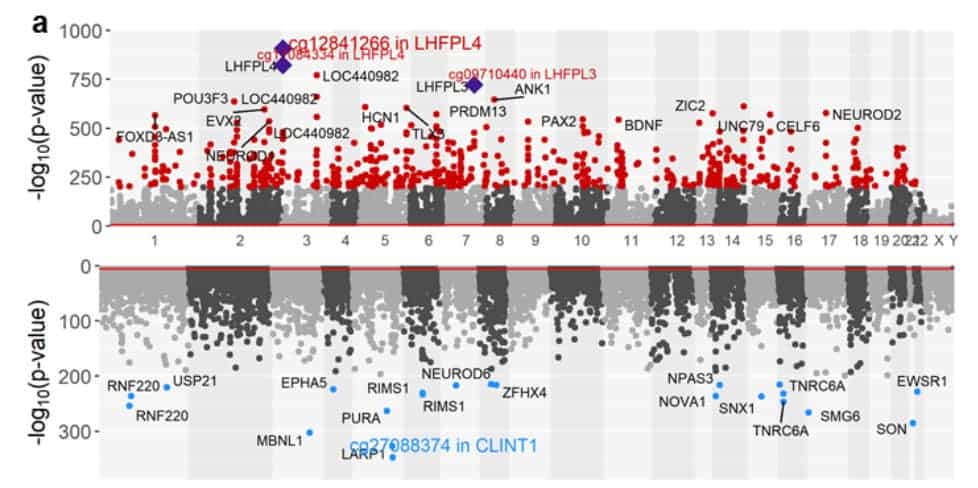
“Cytosines that become increasingly methylated with age (i.e., positively correlated) were found to be more highly conserved (Fig. 1a) …Interestingly, although there were 3,617 enrichments of hypermethylated age-related CpGs [i.e., increased methylation with age] across all tissues, only 12 were found for hypomethylated [the opposite] ones.”
Interpretation: with age, we (and other mammals) tend to lose methylation, i.e., to turn on genes that shouldn’t be turned on. There are more sites that demethylate with age than that methylate with age. But the sites that gain methylation tend to be more highly conserved between species. I presume a lot of demethylation is stochastic. It’s easy for a methyl group to “fall off”, but attaching one in the right place requires a specialized enzyme (methyl transferase). What we are seeing here is stronger genetic determinism for the process that requires active intervention.
Question: Would it be useful to develop a methylation clock based solely on sites that gain methylation? What we would thereby avoid is the situation where the age algorithm combines a great many large positive numbers with a great many large negative numbers to make a small difference. This characteristic makes the algorithm overly sensitive to bad data from one or a few particular sites. We can see from the figure above that (red) sites from the top half of the plot have stronger evidence behind them than the (blue) sites from the bottom. What we would lose would be diversity in the basis of the measurement. If retaining that diversity is desirable, it would be possible to design a clock algorithm with both red and blue sites in such a way that all coefficients are relatively small, and no one site contributes inordinately to the age calculation, even if data for that site is completely missing.
| Speculation for statistics geeks: I think the methodology that has become standard for developing methylation clocks is not optimal. The standard method is to identify N sites (typically a few hundred) where methylation is well-correlated with age, then derive N coefficients such that you can multiply each coefficient by the corresponding methylation, add up the products, and you get an age estimate*. The way I would do it is with a more complicated calculation, from a methodology called “maximum likelihood”. The idea is to choose the age that minimizes the difference between the expected methylation and measured methylation for the collection of the N sites. To be more specific, minimize the sum of the squares of the z scores for each site, where z is the number of standard deviations by which the measured methylation is different from the expected methylation.It may sound like a complicated calculation to find the age at which this number is a minimum, but it is not. Yes, it’s a guessing game; but the algorithm called “Newton’s method” allows you to make smart guesses so you home in on the best (min Σz2) age within four or five guesses. The calculation is more complicated to program, but it would still execute in a tiny fraction of a second. My proposed method requires maybe 10 or 20 times as many fixed parameters within the algorithm; but the data submitted from each sample is the same. Caveat – This is all theoretical on my part. I don’t know how much performance would be improved in practice. ———————— *Two footnotes: (1) A constant is also added. (2) In case the subject is young, below the age of sexual maturity, what you get is a logarithm of age, not age itself. |
“Importantly, age-related methylation changes in young animals concur strongly with those observed in middle-aged or old animals, excluding the likelihood that the changes are those involved purely in the process of organismal development.”

These plots are adduced as evidence that aging and development are one continuous process under epigenetic control. They come from EWAS=epigenome-wide association studies. Start by asking which sites on the methylome are most closely correlated with age, across many different animals and different tissues in those animals. Start with just the young animals (different ages, but all before or close to sexual maturity. Arrange all the different sites according to how they change methylation with age (increasing or decreasing), just in this age range. Then repeat the process, re-ordering the sites according to how they change with age during middle age.
The left plot above includes a dot for each methylation site, ordered along the X axis according to how they change during youth, and along the Y axis according to how they change during middle age. The point of the exercise is that it is largely the same sites that increase (or decrease) methylation in youth and in middle age.
The middle plot shows the corresponding correlation between middle age (X axis) and old age (Y axis). The right-hand plot shows the correlation between young (X axis) and old age (Y axis). (I believe the labeling of the figure on the right is a misprint.)
This evidence points to a conceptual framework that views development and aging as one continuous process. Development is a lot more complicated than aging. Consequently, most of the sites in the clock are developmental. Maybe a clock could be optimized for aging only, and it would be more useful for those of us who are using the clocks to assess anti-aging interventions.
“The cytosines that were negatively associated with age in brain and cortex, but not skin, blood, and liver, are enriched in the circadian rhythm pathway”
Here we see again the intriguing connection between the brain’s daily timekeeping apparatus and the epigenetic changes that drive development and aging.
“The implication of multiple genes related to mitochondrial function supports the long-argued importance of this organelle in the aging process. It is also important to note that many of the identified genes are implicated in a host of age-related pathologies and conditions, bolstering the likelihood of their active participation in, as opposed to passive association with, the aging process.”
Another theme in the set of age-correlated genes that the team discovered is mitochondrial function. Mitochondria have an ancient association with cell death, and a long, conserved history with respect to aging. The simple damage themes associated with the free radical theory have yielded to a more complex picture, in which free radicals can be signals for apoptosis or inflammation or enhanced protective adaptations.
The big picture
“Therefore, methylation regulation of the genes involved in development (during and after the developmental period) may constitute a key mechanism linking growth and aging. The universal epigenetic clocks demonstrate that aging and development are coupled and share important mechanistic processes that operate over the entire lifespan of an organism.”
This is cautiously worded, presumably to represent a consensus among several dozen authors, or perhaps to appease the evolutionary biologists looking over our shoulders. The statement is akin to what Blagosklonny has for years called “quasi-programmed aging”, to wit, there are processes that are essential to development that fail to turn off on time, and cause damage as the organism gets older. In the version put forward in this present ms, it is not the gene expression itself but the direction of change of gene expression that carries momentum and cannot be turned off.
| Evolutionary theory
Modern evolutionary theory began with Peter Medawar, a Nobel laureate and giant of mid-century biological understanding. (He was 6 foot 5.) Medawar’s 1952 monograph contains the insight that launched all modern theories for evolution of aging. His fundamental idea was that it’s a dog-eat-dog world in which very few few animals live long enough for aging to be a factor in their death. The three main branches of evolutionary theory in response to Medawar are called Mutation Accumulation, Disposable Soma, and Antagonistic Pleiotropy. According to Medawar’s thought (and all three theories that followed) old age exists in a “selection shadow” so random processes are at work in old age. It follows that we would expect the aging of a bat and a bowhead whale to be subject to very different random processes. If it is a burden of recently acquired mutations that natural selection has not yet had time to weed out, these should be different for different species. Or if it is about tradeoffs (pleiotropy) between needs of the young animal and the old animal, we would not expect the bat and the whale to be subject to the same tradeoffs. The Medawar paradigm and its three popular sub-theories all predict that there should be little overlap between the genetic factors involved in aging of species that are adapted so differently. Therefore, the present work documenting a common epigenetic basis of aging is a challenge to the established evolutionary theories of aging. |
As I see it, the expression of genes is exquisitely timed for many purposes, so we must view gene expression as subject to tight bodily control. “Accidents” or “mistakes” or “evolutionary neglect” are implausible. For some genes, methylation changes from minute to minute in a way that is adaptive and responsive. Blagosklonny’s idea that there are genes turned on for development and then the body forgets to turn them off doesn’t feel right. Equally, the idea that certain genes are being turned on (or off) progressively through development and then, after development has ended, the process has a momentum of its own so the body can’t stop further turning on (or off) of these same genes is equally implausible. I assume the body is adapted to do exactly what it wants with gene expression, and if the body expresses a combination of genes that causes aging, it’s because that’s what natural selection has designed the body to do. Of course, this looks to be a paradox, as aging is completely maladaptive according to the notion of Darwinian fitness that became accepted in the first half of the 20th century; but evolutionary biologists have broadened the notion of fitness since then, and I’ve written volumes concerning this paradox.
The bottom line
For personal application to individuals who want to know how well they are doing and their future life expectancy, I recommend Horvath’s Grim Age clock as the best available. (Elysium has done a lot of work on their Index product, and it may be as good or better, but it’s impossible to evaluate unless they release their proprietary methodology.) For application to studies of anti-aging interventions (including my own project, DataBETA), the choice of clocks is not clear, because it depends not just on statistics but on theory. We want a clock that is not only accurate, but that is based on epigenetic causes of aging, not epigenetic responses to aging. The multi-species clock is a welcome contribution, precisely because epigenetic processes that are conserved across species are more likely to be linked to the root cause of aging. For the future, I’ve made suggestions above for ways the multi-species clock might be made even better.
Discussion
200 reader comments
Imported threads are marked Archive. New comments are welcome and moderated for spam.
Critics of programmed aging support the idea that development is programmed and after development ends, the body is exposed to natural degradation, which is not programmed. If that is the case age span of an individual in a species should be random after the development program ends and follow random probability distribution. In humans if there is consensus that the development program ends at age 25, age span in humans should display a random distribution after age 25.
"Critics of programmed aging support the idea that development is programmed and after development ends, the body is exposed to natural degradation, which is not programmed."
No they don't support that idea, not in my case at least. The body is always exposed to degradation, both before and after development. It is just better at handling and defending against the degradation early in life. Programming also doesn't stop after development. There always exists some programming to defend against degradation but it is limited in what it can do.
'Programming also doesn’t stop after development. There always exists some programming to defend against degradation but it is limited in what it can do'
But that is precisely what programmed aging is all about, the rate of decline of the renewal and repair factors specific to a particular species.
Yeah ..trying to look at aging and saying it s programmed can leave room for argument by those who have not really taken the deep dive and looked into it with the proper perspective. To those who argue aging is not programmed I tell them try someting simpler that has the same effect as aging from an evolutonary persepctive>> the end of your spreading your genes ..
Expain how menopause is not programmed first, and when you can do that then come back and tell us how aging is not programmed. HAHA good luck
Josh I was curious on your thoughts on this latest biological clock and if it is useful .
https://interestingengineering.com/scientist-create-clock-that-measures-biological-age
New aging clock paper - https://onlinelibrary.wiley.com/doi/10.1111/acel.13320
Hi Olafur,
Apparently you know a thing or two about the advanced glycation end products. :)
Do you know about any ways to moderate the damage caused by AGEs in the extracellular matrix knowing that reversing that damage is currently not possible.
Reducing blood glucose seems to be a nobrainer but is there anything to do against AGEs beyond this?
Azithromycin shown to significantly reduce nflammation:
https://journal.chestnet.org/article/S0012-3692(12)60630-8/abstract
Hi Josh,
I think it is more important how one feels AND it is perceived by the others than any clock. Though it would be interesting to correlate the clock with how fit is a man (woman) in the daily life. Is there any study regarding this ?
I may suggest "loss of bivalent chromatin" is a better indicator than "loss of global DNA methylation" for biological aging measurement. it's from my observation on 3 things:
1. cancer shows abnormal hypermethylation on bivalent genes comparing to embryogenesis. there are several papers on this topic. the following is just 2 of them:
https://www.biorxiv.org/content/10.1101/2020.12.02.406751v1
https://www.nature.com/articles/srep37393
2. ischemic preconditioning is an effective way to save lives for harmful ischemic injuries. scientists found ischemic-tolerant epigenetics(go through prolonged ischemic injury after short ischemic preconditioning) is similar with hibernation pattern. as we know, mammals with hibernation will live much longer than no-hibernation. these hibernation animals live longer than our humans as well. so i can say ischemic preconditioning should have anti-aging capability.
however, scientists found both of ischemic-tolerance and ischemic preconditioned are global DNA hypomethylation.
3. no matter aging or cancer, keeping cell identity is very critical. H3K27me and PRC2 play important role to maintain cell identity.
currently i am trying to figure out the root cause for "loss of bivalent chromatin" from the complex relationship between bivalent chromatin, PRC2, 2-OGDDs like Jmjc-KDM, TET, oxygen, glycolysis and TCA cycle. then we will get a systematic solution, not just focus on cellular or ECM rejuvenation.
for example, loss bivalent chromatin could abnormally activate glycolysis pathway and disregulate glycolysis, then too much methylglyoxal (MG) will be produced. then too much AGEs and finally abnormal ECM. abnormal ECM further hurt cell and this becomes vicious feedback loop. samely, loss bivalent chromatin could initiate aberrant cellular pathway, then transmit to ECM by cytokines/chemokines etc. a vicious cycle will be formed too.
if we put embryogenesis, cancer, regeneration like axolotl/zebrafish into the above complex relationship, i am sure we can get something.
Josh:
I urge caution in use of the term "methylization signal." Under the general theory of relativity, a signal cannot travel at a speed that exceeds the speed of light in a vacuum. This has the consequence that one cannot receive a signal from the future.
In an attempt at exercising control over human aging, the control system must receive information from the future in regard to the outcome of events of the future given the outcomes of events of the present. This information cannot be carried by a signal. Thus, this information cannot be carried by a methylization signal. The term "methylization data" would be a suitable replacement for the term "methylization data" for some purposes.
Terry Oldberg
What a coincidence...we were talking about eyes and up pops another study related to David Sinclair's new study of eyes>>>>
I think the flood gates are opening up for these yamanka factor rejuvenation studies....buckle up here they come (and I wasn't researching eyes...but Oct4
just saw Sinclairs video he does not use the myc-c factor as it has a cancer risk adn is apprently not needed for some tissues..>>>
Cell Stem Cell
. 2021 Jan 7;28(1):5-7. doi: 10.1016/j.stem.2020.12.006.
Unlocking Tissue Regenerative Potential by Epigenetic Reprogramming
Pradeep Reddy 1, Sebastian Memczak 1, Juan Carlos Izpisua Belmonte 2
Affiliations expand
PMID: 33417872 DOI: 10.1016/j.stem.2020.12.006
Abstract
The regeneration potential of axons projecting from retinal ganglion cells (RGCs) is lost shortly after birth. In Nature, Lu et al. (2020) demonstrate that epigenetic reprogramming of RGCs by overexpression of Oct4, Sox2, and Klf4 leads to axon regeneration and restoration of vision in a glaucoma model and aged mice.
Copyright © 2020 Elsevier Inc. All rights reserv
I have seen this study. It's an important research and sure offers exciting opportunities in the future. While very effective for the intended purpose here, unfortunately as expected the therapy only demonstrates regeneration of the cells (the retinal ganglion cells). While that is great and important for future rejuvenation therapies this kind of rejuvenation therapy does not rejuvenate the extracellular matrix of the eyes. I'm still waiting for anyone to show me good evidence or reasoning for cellular reprogramming being a possible means to rejuvenate the extracellular matrix in vivo.
I think Sinclair's approach worked because he effectively de-differentiated cells so that they could heal the damage he did - ordinarily these type of cells no longer exist in the nerve. It is probably also true thar the cells that made the lens are no longer present. We should also be aware that the division between cell and ECM is not as black and white as often made out. ECM structure interacts with cells via actin fibres within the cell, and this is partly what decides what type of cell it is. Part of what makes a stem cell different is it's small size and less complex interior structure. Making cells smaller and simpler is what frees them from the suppressive effect of the (aged) ECM. In this way we can see that cellular reprogramming and any future rejuvenation of the ECM are two sides of the same coin.
"I think Sinclair’s approach worked because he effectively de-differentiated cells so that they could heal the damage he did – ordinarily these type of cells no longer exist in the nerve. It is probably also true thar the cells that made the lens are no longer present. We should also be aware that the division between cell and ECM is not as black and white as often made out. ECM structure interacts with cells via actin fibres within the cell, and this is partly what decides what type of cell it is. Part of what makes a stem cell different is it’s small size and less complex interior structure. Making cells smaller and simpler is what frees them from the suppressive effect of the (aged) ECM. In this way we can see that cellular reprogramming and any future rejuvenation of the ECM are two sides of the same coin."
These are great points you're making here Mark! The ECM surely interacts with cells and vise versa. That is one reason it is often more difficult to rejuvenate cells in vivo than in vitro. In cell culture you can regularly add fresh media so the cells are always surrounded by fresh media which signals they are in a young environment which in turn can help them reprogram to a younger state. In the body of an old adult the same kind of cells would be surrounded by an old damaged and stiff ECM and the cells will sense that to some degree and we know that an old ECM makes it harder for cells in it to get reprogrammed/rejuvenated. The ECM therefore can be an ally or an enemy when it comes to cellular rejuvenation. For this reason I think cellular reprogramming in vivo is going to be harder in older people than younger people, which is ironic because the old people are the ones needing it more.
Olafur,
Your argument against comparing the conserved similarities between trees and humans does not explain why almost all of the trees have a much much shorter lifespan whereas very few live in full bloom of youth for thousands of years.
Secondly Prof Richard Morimoto has given evidence of a change occurring just after puberty when there is no chance of stochastic damage accumulation:
https://www.cell.com/fulltext/S1097-2765(15)00499-2
This repressive mark on Heat Shock Response transcription dropping its initiation against stress by 60% to 80% just after puberty can only be an outcome of programmed intervention. Morimoto himself uses the word and says this fall in protein folding efficiency so early after puberty is conserved across species.
Tony Wyss-Coray in this paper in Nature Medicine titled Undulating Changes in Human Plasma Proteome Profiles Across Lifespan tells us that they observed waves of proteome changes cresting at 34, 60 and 78 in 4,263 humans of different age. Such temporal coincidence can not occur in all participants by stochastic events.
Regarding ECM it is not in isolation and it is wrong to assume that Elixir rejuvenation will not rejuvenate ECM. There is constant crosstalk between cells, ECM and plasma components:
https://www.ncbi.nlm.nih.gov/pmc/articles/PMC4767504/
You will find Mina Bissell's TED talk fascinating where she describes how a healthy cell in an old ECM turned cancerous and this cancerous cell in a young ECM turned normal again.
'The body obviously evolved to be able to develop into a healthy young functioning adult but it never evolved to resist entropy indefinitely'
Why should the body waste time in reversing damage, when it can easily eliminate the damage and generate new. The multicellular body evolved to resist entropy by generating new and eliminating waste, which goes haywire during aging.
"Why should the body waste time in reversing damage, when it can easily eliminate the damage and generate new."
Many kinds of damage in the body can't be eliminated or renewed by any type of cellular reprogramming. If you claim otherwise you are going to need to provide some strong evidence for that. A good example would be pointing me towards a study that shows that extracellular glucosepane cross-links surrounding cells can be fixed by reprogramming those cells. Also some parts of tissues do not regenerate at all even in a one year old baby, then there is no good reason to think that they would regenerate when you turn back the clock of an adult to even such a young age.
extracellular glucosepane accumulates as we age, studies done point out that extracellular glucosepane accumulation accelerates after age 60 till 90 and beyond, i.e accumulation is multiple times in the 30 year period from 60 till 90 than from the 30 year period fro age 30 till 60. the question is why is it so.
does proteolytic digestibility tackle extracellular glucosepane, which degrades as we age, can proteolytic digestibility be improved with anti aging intervention such as young blood plasma, effectively improving ECm turnover. i am afraid no study has been done on this.
https://www.mdpi.com/1422-0067/18/5/984/htm
'The Proteolytic System
While stable AGEs accumulate over time on proteins with a long half-life such as collagen of the skin, the AGE burden in organs that have higher protein turnover is shifted to a certain extent away from the modified protein to the proteolysis machinery. In this regard proteolysis is the only universal AGE detoxification mechanism. AGE modified proteins are more resistant to digestion by the proteasomal—as well as the lysosomal proteolytic system [127]. This does not necessarily result in accumulation of AGE-modified proteins as long as the proteolytic system is able to adapt the digestive capacity.'
https://www.sciencedirect.com/science/article/pii/S0925443918303296#bb0155
'Anti-glycation pathways generally only operate on intermediates of glycation. Once generated, excessive AGEs accumulate and eventually become insoluble causing intense changes in the subcellular metabolism. However, there are intracellular degradative mechanisms that help clear these toxic adducts. Both the ubiquitin-proteasome system (UPS) and autophagy have been reported to contribute to the removal of AGEs (Fig. 2) [[28], [29], [30], [31]]. They may operate autonomously or cooperatively. At present, there is little information about the molecular processes and factors involved in the targeting of AGEs to these degradative routes'
"https://www.sciencedirect.com/science/article/pii/S0925443918303296#bb0155
‘Anti-glycation pathways generally only operate on intermediates of glycation. Once generated, excessive AGEs accumulate and eventually become insoluble causing intense changes in the subcellular metabolism. However, there are intracellular degradative mechanisms that help clear these toxic adducts. Both the ubiquitin-proteasome system (UPS) and autophagy have been reported to contribute to the removal of AGEs (Fig. 2) [[28], [29], [30], [31]]. They may operate autonomously or cooperatively. At present, there is little information about the molecular processes and factors involved in the targeting of AGEs to these degradative routes’"
Nice to see you looking up some references kumal. Thanks for that.
Regarding the degradative mechanisms mentioned above, note that these degradative mechanism are intracellular. Cells do have pretty good capacity to clear damage inside of them including removing AGEs however these degradative pathways aren't found in the extracellular matrix. To fix similar damages in the ECM the cells would need to somehow take damaged molecules from the ECM and transport them into cells which is not something they do to any significant degree.
Well here is a case where a woman grew brand new ECM....
check out this youtube video about a woan who grew her severed fingertip back
https://youtu.be/MZdS0tDyS0w
now that is some real good ECM repair!..grow some brand new ECM
https://www.sciencedirect.com/science/article/pii/S0925443918303296#bb0155
'At present, there is little information about the molecular processes and factors involved in the targeting of AGEs to these degradative routes'
"Well here is a case where a woman grew brand new ECM….
check out this youtube video about a woan who grew her severed fingertip back
https://youtu.be/MZdS0tDyS0w
now that is some real good ECM repair!..grow some brand new ECM"
Although impressive that's creating a new ECM not fixing an old one. Those are two very different things. A regrowth of a fingertip is an example of programmed development not programmed aging. She didn't fix the old fingertip she grew a new one. Regrowth of limbs and organs is great and will be very useful, I'm all for it, but we must also fix the ECM in those organs that cannot be regrown like the brain.
Average age of new born baby is 3.5 kg, and the average of an adult is 63 kgs, 95% percent of the body is not present at birth and the body acquires this 95% mass in approx 18 to 20 yrs.
Therefore everything can be regenerated
correction 'average weight'
Everything can be generated. But that doesn't prove that it can be REgenerated, it's not the same thing.
"Everything can be generated. But that doesn’t prove that it can be REgenerated, it’s not the same thing."
Thanks Raphael. Your answer is spot on. Those are indeed very different things. The body obviously evolved to be able to develop into a healthy young functioning adult but it never evolved to resist entropy indefinitely to be able to stay in a perfect state of young and healthy body indefinitely. Saying the program for that exists in humans (or any similar animals) is therefore a huge stretch and requires a lot of proof to be taken as a serious possibility.
one thing should be noticed for this study is that eye are immune-privileged. i am not sure this partial OKSM reprogramming method will work on non immune-privileged organ without cancer risk or not.
Regarding your "speculation for statistics geeks". As I understand it, you are proposing a model where the distribution of methylation levels at a given age is independently gaussian at each of the chosen CpG sites. Is this sketch correct? If so, is there strong reason to believe that either of these assumptions (independence, normality) holds well enough for this to be a useful model?
To anyone that believes in aging being caused by programming (rather than merely being influenced by programming) here is a great and very important paper I suggest reading: http://pmid.us/32540391
This paper gives examples of various stochastic damages that accumulate with aging with many of them occurring in places where they are not subject to any repair at all even in youth. Therefore many of those damages represent damages that will not be directly fixed by reprogramming or rejuvenation of cells. To expect them to be fixed by rejuvenating your cells is a bit like expecting your garden to be fixed by simply fixing your house.
Now here is a challenge for people that believe aging is fundamentally programmed. Please give evidence or very good reasoning for a mechanisms by which these damages will be fixed in a human being by mere cellular rejuvenation. Lets take cross-linking of the extracellular matrix of the skin as an example. Cross-links accumulate in collagen and elastin fibers of the extracellular matrix with age and this is a stochastic process that occurs also in vitro in a cell free media where there is no cellular programming to influence it or cause it. Please provide evidence or well supported explanations for how fixing the cells by cellular rejuvenation will fix the cross-links in this extracellular matrix that surrounds those cells. Another example of extracellular matrix damage is lens crystallin cross-linking. It is not contained within cells so it will not be automatically fixed merely by rejuvenating cells. If aging were programmed all you had to do would be to turn back the programming and these things would get fixed. But again there is no mechanism by which this could happen given that this damage is outside of the cells and is not directly influenced by cellular rejuvenation.
The reason I ask the above questions is that so far I have not seen any proponent of programmed aging theories give evidence or good answers to questions like this. The response is usually evading the question or pointing at the longevity of some completely different animal that does not have to deal with the same problems to the same degree as humans and claim (with wishful thinking) that cellular rejuvenation will just "somehow" fix this problem all the while totally ignoring that any programmed machinery to fix many of these problems just does not exist in the first place. You cannot reprogram a repair mechanism to youthful levels if that repair mechanism doesn't exist in the first place.
Apparently you do not know about the mouse studies whereby altering their immune systems- mice with holes punched through their ears that are normally permanent regrew the holes with perfectly new tissue..Much like a salmander can regorw a leg when cut off.
"Apparently you do not know about the mouse studies whereby altering their immune systems- mice with holes punched through their ears that are normally permanent regrew the holes with perfectly new tissue..Much like a salmander can regorw a leg when cut off."
That is not relevant here unless cutting off limbs and tissues and growing them back is your rejuvenation plan, then I say good luck. Show me research where a mouse with some kind of programming gradually takes its extracellular matrix and replaces it with a young one or repairs the damage in the old extracellular matrix.
Btw Jeff you evaded my main question just like I said proponents of programmed aging theories usually do when confronted with examples of things programming won't fix. I repeat the question. Please provide evidence or well supported explanations for how fixing the cells by cellular rejuvenation will fix the cross-links in this extracellular matrix that surrounds those cells.
Note regeneration of limbs doesn't apply to my question. In case of limb regeneration you aren't tweaking cells embedded in an already established and aging extracellular matrix which is what you are doing when applying reprogramming therapies to a human body in vivo. Instead you are developing completely new tissue from scratch which will come with development of new and fairly fresh extracellular matrix. When you apply reprogramming factors to animals in vivo the extracellular matrix does not get removed and replaced with a fresh one (if you have evidence that it does please show me, I have not found such evidence) so this scenario doesn't apply to my question.
Hello Olafur,
We have had this discussion some times ago, but I haven't been convinced by your arguments. My own research seems to point to ECM turnover to be continuous throughout life, no matter how slow ( I remember something like 15years turnover for ECM).
One exception is indeed the eyes lens, as this study tells us: https://journals.plos.org/plosone/article?id=10.1371/journal.pone.0001529
Quoting the study conclusions: "Such a life-long permanence of human tissue has hitherto only been described for dental enamel. In confront to dental enamel it must be held in mind that the eye lens is a soft structure, subjected to almost continuous deformation, due to lens accommodation, yet its most important constituent, the lens crystalline, is never subject to turnover or remodelling once formed"
This implies that only eye lens and teeth are permanent, and everything else get eventually replaced.
Could you give me some sources pointing to ECM been permanent and never replaced?
Regarding DNA damages, I am not really worried about that. Yes, it can't be fixed and the individual cell level, however at the organism level, cells which real DNA damage can (and are) eliminated if the mutation is detrimental. So you end up with genetic drift, and growing mosaicism in the body as different stem cells propagates differents mutations. But I don't see why this would causes issues before a real long time as passed (maybe).
What other damages do you see not fixed by cellular reprogramming tech?
"Hello Olafur,
We have had this discussion some times ago, but I haven’t been convinced by your arguments. My own research seems to point to ECM turnover to be continuous throughout life, no matter how slow ( I remember something like 15years turnover for ECM)."
Hi Raphael,
Your 15 year number appears to be the number for collagen turnover. It matches with the half-life of collagen in the skin which has found to be around 15 years. In the same study it was found to be about 117 years in cartilage. http://pmid.us/10976109 Also if you check the full text you will see that glycation damage was accumulating in the collagen linearly even in the early twenties and before that which supports the notion that cellular rejuvenation to a young age still won't stop damage accumulation in the ECM since the turnover even in peak health in your early twenties is still very slow. The turnover of the ECM is probably very different in different tissues and in some it might be negligible. Also collagen is just one component of the ECM. Other components may be degraded or replaced slower or faster or not at all. Elastin may have a half-life of 74 years, at least in the lungs. http://pmid.us/2022748 That is pretty darn slow. Cellular reprogramming may cause some slight positive effects here but in no way do I expect it to rejuvenate the ECM to a much younger state. Note that the turnover of the ECM is already pretty darn slow in young adulthood and there is likely a good reason for that. For one too much turnover might cause instability in the rigid structure of the fully developed body. In addition it might increase the risk of cancer but ECM degradation is one of the things cancer cells increase to metastasize and spread throughout the body.
"Could you give me some sources pointing to ECM been permanent and never replaced?"
That's a great question. On top of my head I don't recall some other ECM compartments where turnover is almost absolutely certain to be non existent. On the other hand I don't remember seeing examples of tissues where cross-links or isoaspartyl residues do not continue to progressively accumulate with age indicating that any turnover is far too slow to fully replace the ECM.
"Regarding DNA damages, I am not really worried about that. Yes, it can’t be fixed and the individual cell level, however at the organism level, cells which real DNA damage can (and are) eliminated if the mutation is detrimental. So you end up with genetic drift, and growing mosaicism in the body as different stem cells propagates differents mutations. But I don’t see why this would causes issues before a real long time as passed (maybe)."
I agree with you here. I too am not particularly worried about DNA damage for the reasons you mentioned at least not until after several more urgent problems will be fixed.
"What other damages do you see not fixed by cellular reprogramming tech?"
Great question. There is a lot of stuff. Some main examples are accumulation of various types of long lived proteins, spontaneous damage to proteins, cross-link formation, nuclear pore complex damage, extracellular aggregate accumulation, extracellular matrix stiffening. I don't mean to discount the possibility that some of these will be improved somewhat if only indirectly and slightly by cellular rejuvenation therapies, but doubt any of these would be fixed in a major way by such therapies.
You have a valid point Olafur, but then again, nothing within the human body lives in complete isolation.
Take cancer cells as an example. Even if you deprive the body from all macronutrients, cancer cells still thrive. How? They simply change their metabolism and obtain their fuel from amino acids in the ECM.
As for collagen turnover rate, aging seems to be a powerful factor. We know for certain that collagen turnover in young people happens at a much higher rate than in mature skin. Certainly it must be determined by the epigenetic age of the cells.
But for crosslinks in the ECM we still have a lot to learn, I agree.
I noticed that you have posted thirty (30) times. That amounts to one third (1/3) of all comments of this blog. And you argue about one thing: That reprogramming cannot cure all problems. One or two comments would be sufficient to make your point. The rest is "noise".
But to respond to the substance of your argument: "So What" if reprogramming cannot fix all damage? There is no law in physics that will not allow fixing damage using other methods. The entropy that you refer to in one of your comments above is not a problem, as it is valid only for "closed systems".
So, let's take advantage of what will soon be available (senolytics, the elixir, etc). For sure, soon there will be even more tools available. While the " bowhead whale" has the upper hand in longevity today, humans are sure to surpass it. Maybe we don't know how to take care of AGE's YET. But there is no physics law that says that it is impossible.
Hear ! Hear!!
yes we can always grow replacement parts ...Have you seen the new ear grown on the back of a mouse? I am sure we will be able to grow new lenses and eyeballs soon enough if they become a problem
https://alchetron.com/Vacanti-mouse
https://www.news-medical.net/health/Growing-an-eye-for-transplantation-potentials-and-pitfalls.aspx
sorry for posting so much today I'll stop for now
"I noticed that you have posted thirty (30) times. That amounts to one third (1/3) of all comments of this blog. And you argue about one thing: That reprogramming cannot cure all problems. One or two comments would be sufficient to make your point. The rest is “noise”."
Sure that's a lot of posts but I am not simply making a point that reprogramming cannot cure all problems. I am engaging in discussions to help point out things people are missing about the causes of aging and when different people keep bringing up various different reasons for why they think aging is programmed each of those reasons require different explanations to point out the misconceptions that are causing those beliefs. If I were to just make one comment to explain all the reasons it would have to be a short article where I cover a lot of the misconceptions about aging. If you read my comments you will see I do use logic and give useful explanations and examples rather than just repeating that I don't think aging is programmed. Some of the people I have responded to have also given useful responses back which is how we engage in reasonable discussions on the topic that people can think about and learn from.
"But to respond to the substance of your argument: “So What” if reprogramming cannot fix all damage? There is no law in physics that will not allow fixing damage using other methods. The entropy that you refer to in one of your comments above is not a problem, as it is valid only for “closed systems”.
So, let’s take advantage of what will soon be available (senolytics, the elixir, etc). For sure, soon there will be even more tools available. While the ” bowhead whale” has the upper hand in longevity today, humans are sure to surpass it. Maybe we don’t know how to take care of AGE’s YET. But there is no physics law that says that it is impossible."
I agree that there is no physical law that makes it impossible to fix the rest of the damage using other methods and I sure encourage using all methods to do what we can about it now. Regarding your "so what" statement. Well I think it is very important to have a clear picture on what causes aging so we can prioritize what to work on. We may not have the luxury of just starting somewhere and fixing the rest of the problems later. Many people will run out of time that way.
On this subject, extracellular matrix (ECM) aging is very much ignored by many scientists in the field, specially those that believe in programmed aging, and I don't think that is something we should just ignore and fix later after we have advanced reprogramming treatments in particular since ECM aging is in many ways very difficult to fix and we haven't really seen any progress in that area for a long time and I don't see anything very effective on the horizon in that department. Cellular reprogramming is I think closer to be within reach given the remarkable progress we have made in that area in the past decade. Because of this I think the whole field would benefit from putting more focus on starting to solve ECM aging also in particular since so few scientists are looking into methods to do so.
Another reason to focus more on the ECM is because the ECM influences the programming of the cells that reside in it so it's going to be harder to rejuvenate cells that are living in the damaged ECM of an old person. Ironically rejuvenating the ECM will likely become important in order to gain benefit from the cellular rejuvenation therapies that the programmed aging proponents think will solve pretty much everything. FYI here is a study demonstrating how a young ECM can reprogram cells to a youthful state. http://pmid.us/21108727 Turns out that if we fixed and rejuvenated the ECM the cellular rejuvenation might to a small extent take care of itself. How is that for a change! Are any programmed theory proponents paying more attention to the importance of fixing the ECM now?
I apologize to all for posting again..but all this talk of slow to low turnover of this and that stimulates me to release a little secret I leanred from my many many years of high dose vitamin d3 therapy resrearch/ experimentation...
High dose vitamin d3 supercharges yoiur tissue remodeling system so that life long accumulated injuries all of the sudden start to heal....D3 is not a vitamin but actuially a hormone that controls 2700+ genes that affect your tissue remodeling system and immune syustem ..Who knows what tissues and proteins and repair systems it would affect..You can go to JeffTbowles.com and use the high dose vitamin d3 1,000+ case studies search engine and read a bout all sorts of amazng stories like people's eyesight improving to the point where their doctors think they have gotten Lasik surgery when all they had done was taken high dose d3 for a few months. There is also the case of a woman in Austria who was taking high dose D3 for her endometriosis and it was working , she wrote me back a few monthns later and said I forgot to tell you my huisband has been blind in one eye for several years the doctros say it is permanent..She went on to say that he decided to take high dose d3 along with her>> not sure maybe 30,000 or 60,000 IUs per day...She said after about 6 weeks he woke up and said to her .."You're not going to believe this...I am looking at you with my blind eye". the doctors said it was a freak of natrure and had nothing to do with the D3...HAHA his original problem was some sort of damage to his optic nerve from a sinus infection...So my point is all this talk of slow turnover/unrepaired accumlated damage mentioned by Olafur is probably bad information based on sampling people that are by definition vitamin d3 deficient (people whose ancestors have turned white due to living in a land of weak sun) with very slow tissue remodeling systems.. I bet most of Olafur's facts are wrong... I'd like to see if high dose D3 somehow leads to repair of the lens and the ECM at a rapid rate.. (And when Is say high dose..it is just high dose as defined by the powers that be ..which is really a lie...20,000 IUs sounds like a lot of d3 doctors used to tell you to never take more than 400 ius a day...Well it turns out that if a light skinned person sunbathes for 1/2 hour in Finland in the summer they can make 20,000 IUs of D3 in their skin....
“I apologize to all for posting again..but all this talk of slow to low turnover of this and that stimulates me to release a little secret I leanred from my many many years of high dose vitamin d3 therapy resrearch/ experimentation…”
I gave references above for this slow turnover in my response to Raphael above. If you missed them here they are. The first one shows that the half-life of collagen in the skin and cartilage is 15 and 117 years respectively. http://pmid.us/10976109 If you look at the tables in that study you see that the accumulation of isoaspartyl residues starts even in young adulthood which is good proof that turning back the gene expression to that age won’t be enough to stop it. The second study shows that the half-life of elastin in the lungs is a whooping 74 years! http://pmid.us/2022748 This is evidence. All you offer is some hope and weak hypotheses. Where is your evidence of the turnover being very fast or at least fast enough at any age to stop or reverse accumulation of extracellular matrix damage? I would love to see such evidence but unfortunately it likely doesn’t exist. If it does then some of you must be able to provide it.
“She said after about 6 weeks he woke up and said to her ..”You’re not going to believe this…I am looking at you with my blind eye”. the doctors said it was a freak of natrure and had nothing to do with the D3…HAHA his original problem was some sort of damage to his optic nerve from a sinus infection…So my point is all this talk of slow turnover/unrepaired accumlated damage mentioned by Olafur is probably bad information”
That’s a very interesting case report but sorry your logic clearly doesn’t make sense here. I’m going to ignore the fact that anecdotal reports like that are weak evidence and instead give you the benefit of doubt and just think about what was reasonably going on here *if* vitamin D was the cause of her benefits. You mentioned that the original problem of this person was damage to the optic nerve. Well the optic nerve is a cell! We already know from the David Sinclair experiments that cellular reprogramming of the optic nerve can fix blindness in animals where the blindness is a result of optic nerve damage and that makes sense given what we know about reprogramming. Reprogramming a cell can in many ways fix that cell. So the logical conclusion here is that somehow that person's optic nerve got regenerated partially, sufficiently enough to regain some sight. Now we both know vitamin D3 acts as a hormone and influences gene expression of cells so it is theoretically possible that it somehow fixed the gene expression of the optic nerve in a way that allowed it to regenerate. This is a theory that I agree being possible because it makes logical sense based on how the body works. However we do not have any good evidence or reason to think the person's eyesight was improved by some kind of extracellular matrix regeneration such as fixing of the damaged lens or vitreus of the eye and we absolutely do not have any evidence or a reasonable hypothesis for how vitamin D would be able to have such effects since it doesn’t matter if it can influence the gene expression of the optic nerve cells if the optic nerve cells have no capacity to fix the extracellular parts of the eyes no matter how its genes are tweaked. So again your hypotheses hold no water here and what you say is wishful thinking not science. Again I invite you to provide good reasoning or evidence for how cellular reprogramming would fix the extracellular compartment of the eyes, not just the optic nerve.
“based on sampling people that are by definition vitamin d3 deficient (people whose ancestors have turned white due to living in a land of weak sun) with very slow tissue remodeling systems.. I bet most of Olafur’s facts are wrong… I’d like to see if high dose D3 somehow leads to repair of the lens and the ECM at a rapid rate”
That wouldn’t be a wise bet to make when you have given no good reasons or evidence for how tweaking the genes of a cells in or surrounding the eyes (by whatever means, including with vitamin D) would be able to somehow magically fix the extracellular matrix there. I say magically because it’s wishful thinking if you have no reasonable explanation or evidence for how it would happen.
“(And when Is say high dose..it is just high dose as defined by the powers that be ..which is really a lie…20,000 IUs sounds like a lot of d3 doctors used to tell you to never take more than 400 ius a day…Well it turns out that if a light skinned person sunbathes for 1/2 hour in Finland in the summer they can make 20,000 IUs of D3 in their skin….”
Yes an ultra high dose of vitamin D might have caused some effects on the optic nerve cells perhaps resulting in major benefits that are not seen with more moderate doses. That is plausible so I don’t disagree with that being a possible explanation here. However once again I state, it’s not likely to fix the extracellular matrix because a higher dose is not going to make a machine fix something if the machine to fix it doesn’t exist in the first place. If you want to convince someone of that actually happening first you have to give good evidence or reasoning for how cellular rejuvenation would fix the extracellular compartment, then you can talk about some interventions that do so by influencing cells. Otherwise you are acting like a person that would tell someone to pour more gas on their bicycle to go faster on the bicycle while totally ignoring the fact that the bicycle has no engine in the first place. Again I am waiting for evidence or explanations for cellular rejuvenation fixing the extracellular matrix to a major extent and so far you have provided none. In the meantime I think most of us can agree that perhaps ultra high doses of vitamin D might in some rare instances have some cellular rejuvenation effects on damaged optic nerves. I see no holes in that hypothesis.
Hi Olafur,
I posted on the ECM study a few months ago.
One thing that I think people have missed in the studies in connecting old and young rats blood supplies is that they are also connecting the animal's ECMs together in the process.
From the ECM study we should have seen a de-aging effect in the old animal from just that alone.
It should be easy enough to check how much of an effect the young ECM has on the de-aging process of the older animal.
Connect the rats ECMs only and check for cell de-aging at various distances from the connect point in the older rat.
I am not saying that the blood doesn't have anti-aging effects, just that there might be 2 anti-aging inputs in the experiment throwing off the results.
Olafur,
I'd like to go one step further.
Organ transplants from young to older individuals; again ECM from young is connected to the older person.
From what I understand, the young organ ages to match the older person's age, also the older person appears to de-age slightly.
Again the ECMs are connected.
The protein L-isoaspartyl (D-aspartyl) methyltransferase (PIMT) is an enzyme that recognizes and repairs the abnormal L-isoaspartyl residues in proteins. Its expression appears to decline during aging
The protein L-isoaspartyl (D-aspartyl) methyltransferase (PIMT) is an enzyme that recognizes and repairs the abnormal L-isoaspartyl residues in proteins. Its expression appears to decline during aging
I am aware of the existence of the PIMT enzyme but it is an intracellular enzyme. I am not aware of any evidence that it is exported from cells in significant quantities where it would be needed to help repair the ECM:
why don't Cross-links accumulate in collagen and elastin fibers of the extracellular matrix in the very young, pls explain
Look at this study!! Looks Like Sinclair is right on aging by loss of differentiation>>>
Published: 02 December 2020
Reprogramming to recover youthful epigenetic information and restore vision
Yuancheng Lu, Benedikt Brommer, […]David A. Sinclair
Nature volume 588, pages124–129(2020)
Abstract
Ageing is a degenerative process that leads to tissue dysfunction and death. A proposed cause of ageing is the accumulation of epigenetic noise that disrupts gene expression patterns, leading to decreases in tissue function and regenerative capacity1,2,3. Changes to DNA methylation patterns over time form the basis of ageing clocks4, but whether older individuals retain the information needed to restore these patterns—and, if so, whether this could improve tissue function—is not known. Over time, the central nervous system (CNS) loses function and regenerative capacity5,6,7. Using the eye as a model CNS tissue, here we show that ectopic expression of Oct4 (also known as Pou5f1), Sox2 and Klf4 genes (OSK) in mouse retinal ganglion cells restores youthful DNA methylation patterns and transcriptomes, promotes axon regeneration after injury, and reverses vision loss in a mouse model of glaucoma and in aged mice. The beneficial effects of OSK-induced reprogramming in axon regeneration and vision require the DNA demethylases TET1 and TET2. These data indicate that mammalian tissues retain a record of youthful epigenetic information—encoded in part by DNA methylation—that can be accessed to improve tissue function and promote regeneration in vivo.
I don't want to put words in Sinclair's mouth, I will give him the benefit of doubt here because my memory may be wrong on what he said in his interviews when asked, but I think that even though he is a proponent of programmed aging he still has admitted that cellular programming will not fix everything. In any case this study shows that cellular reprogramming can have major rejuvenation benefits on cells there is no doubt about that. It does not show that this kind of rejuvenation fixed the extracellular matrix surrounding those cells. It most certainly did not. Why? Because much of the damages to that matrix are not under programmed control. I will be more impressed when someone shows me a study that shows that cellular reprogramming can reverse glycation of the extracellular matrix or fix other stochastic extracellular matrix damages that keep being ignored by proponents of programmed aging.
Sinclair is aproponent of antagonsitc pleiotropy...
And how did we get this extracellular matrix in the first place...did it just appear as a gift from God?
"Sinclair is aproponent of antagonsitc pleiotropy…"
Being a proponent of antagonistic pleitropy doesn't equate to being a proponent of programmed aging. It just means you think evolution influences aging, not necessarily that it is the ultimate cause. I certainly think antagonistic pleitropy has a large influence on aging in some animals in particular but that does not mean I think it's the fundamental cause of it.
"And how did we get this extracellular matrix in the first place…did it just appear as a gift from God?"
That's the wrong question to ask. I know the answer you want to hear is we got it from the programming, the programmed development, which is true. However it's irrelevant where you got it from. What matters is that it is subjected to stochastic damages that the body is not equipped with the machinery to fix. What machinery under genetic control fixes cross-links in the lens crystallin of the eyes? There is no such mechanism which is why damage continues to accumulate there. And because there is no such machinery in the body no amount of tweaking your gene expression is going to fix it. You can't tweak something that doesn't exist.
you wrote "Being a proponent of antagonistic pleitropy doesn’t equate to being a proponent of programmed aging."
You just don't get it....
I was pointing out that Sinclair is only half right...you think we all don't know what antagonistic pleiotropy is?? this isn't aging 101
you ask.. What machinery under genetic control fixes cross-links in the lens crystallin of the eyes?
I admit I hjaven't studied this question..I do not have time to look under every little rock...but simple logic suggests you have to be wrong on this...
If eye repair is impossible then all animals would have their eyes malfunctioning at about the same time...yet the greenland shark has perfect eyes for 500 years....galapagos tortoises 200 years...and for some reason mice eyes go bad after 2 years.. pretty imprecise stochastic processes wouldn't you say?
How can you be so sure, that once a molecular environment present in the young recreated, the damage you are mentioning will not get resolved
"You just don’t get it….
I was pointing out that Sinclair is only half right…you think we all don’t know what antagonistic pleiotropy is?? this isn’t aging 101"
Good job at evading my questions and resorting to insults. I wasn't implying that you don't know what antagnoistic pleitropy is, of course not. Anyway this isn't about Sinclair so lets get back to the question you evaded. Here it is again: What machinery under genetic control fixes cross-links in the lens crystallin of the eyes?
counter question
What machinery under genetic control prevents cross-links in the lens crystallin of the eyes in childhood and instead increases the size of the lens.
"counter question
What machinery under genetic control prevents cross-links in the lens crystallin of the eyes in childhood and instead increases the size of the lens."
There is a machinery to increase the size of the lens but none to prevent cross-link formation. The cross-links do accumulate in childhood. Just like I explained above in my example of bicycle tire wearing out from the first minute you start riding your bike even though the wearing will be far too small to cause noticeable problems until much later, the lens crystallin will start accumulating cross-links not only in childhood but even before you are born. The damage that has accumulated at such young ages is just far too small to cause noticeable problems. But it's still accumulating unfortunately and eventually the accumulation will be great enough to cause problems.
"I admit I hjaven’t studied this question..I do not have time to look under every little rock…but simple logic suggests you have to be wrong on this…
If eye repair is impossible then all animals would have their eyes malfunctioning at about the same time…yet the greenland shark has perfect eyes for 500 years….galapagos tortoises 200 years…and for some reason mice eyes go bad after 2 years.. pretty imprecise stochastic processes wouldn’t you say?"
No this makes perfect sense without the need for repair mechanisms to explain it. The eyes can be designed to withstand aging damage up to a certain age without it being equipped with any repair mechanisms. As long as the eyes of humans are created in a way that they can withstand close to 100 years of age-related damage before becoming so damaged that loss of eyesight occurs then no repair is needed as long as the person manages to function well and pass its genes on and raise successful off springs. All animals would not have eyes malfunctioning at the same time because different evolutionary pressures would have caused them to evolve eyes that differ in how long they can remain functional in the absence of any repair. Evolution didn't select for mice having eyes that lasted 200 years because there was no need to, they don't live nearly that long. Their lenses last long enough to not require any repair for them to live their normal life span in a healthy way but if you would want to tweak their gene expression to make them last for 200 years then you most likely couldn't. It's too late. The eyes of the adult mice are already developed and the eyes of the turtles will have a different composition than those of the mice even from birth resulting from a different developmental program. The lenses of the mice which were developed to last only long enough for mice cannot be changed to similar to those of the turtle. They are already equipped with a mouse lens with a finite "expiration" and no major mechanisms of repair.
Note another major difference that gives sharks and turtoises an advantage in terms of accumulation of stochastic damage to their eyes is that turtoises have a very slow metabolism and sharks live underwater at much lower temperatures than mammals and lower temperatures will slow down most chemical reactions that cause stochastic damages. This is another reason why eyes of animals should malfunction at different times.