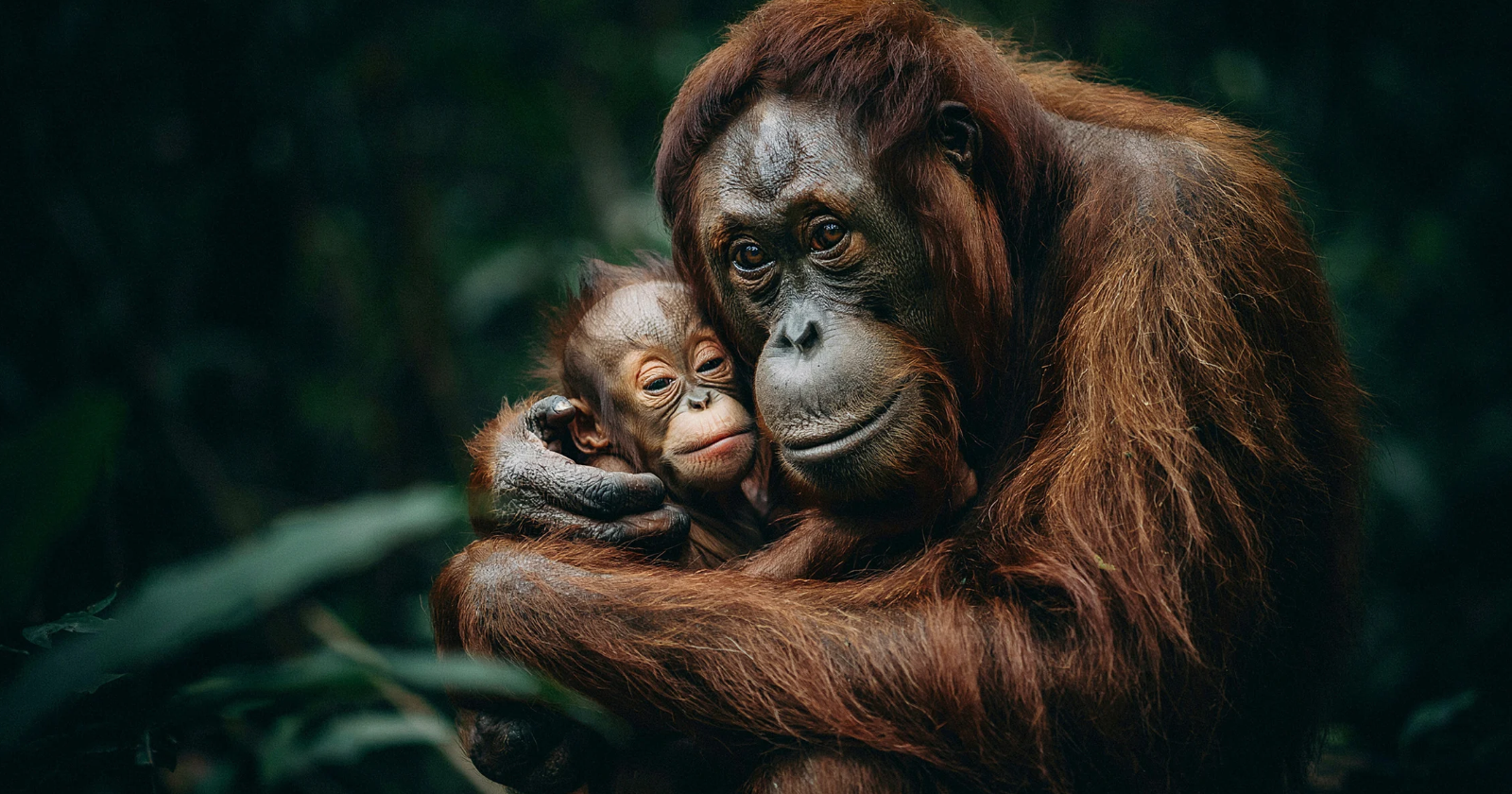
When I was a child, I visited Monkey World, the ape rescue centre in Dorset, and I’ve never forgotten one particular moment.
I was standing at the glass of the orangutan enclosure when one of them came right up to the window. She was watching me just as intensely as I was watching her. But what struck me was the warmth in her eyes – honey-coloured, curious, and almost knowing. I’ll never forget the expression on her face.
Monkey World was set up in 1987 to take in primates that had nowhere else to go – chimpanzees used as props by holiday photographers on Spanish beaches, monkeys from laboratories, and animals from the illegal pet trade. Several of its orangutans were smuggled out of Borneo as babies and kept as pets in Taiwan – one was found living in a cage in someone’s kitchen, another confiscated from an amusement arcade.
Even as a child, I felt sad seeing them behind glass, even knowing it was a far better life than the one they’d come from. Because somewhere in the back of my mind, I knew this wasn’t where they were supposed to be.
So when I read about a new study on how wild orangutan mothers raise their young in the forests of Borneo, I was hooked. Because it turns out those mothers go to remarkable lengths for something we’d never have guessed – making sure their babies have friends to play with.
“It just looked like a really long, hard day”
Orangutans are the most solitary of the great apes. A mother usually spends her days alone in the canopy with a single infant, and she’ll care for that one baby for years. Which is lovely for the bond – but not great if you’re a youngster who wants someone your own age to wrestle with.
Maria van Noordwijk, a Fellow at the Max Planck Institute of Animal Behavior and senior author of the new study, has spent more than two decades watching these families at the Tuanan research station in Indonesian Borneo. I asked her what first made her suspect that the days these mothers met up weren’t just chance encounters.
Part of it, she told me, is simply how much she knows about a mother’s normal routine:
“Most of the time mothers are alone with their offspring, so we have a lot of data on their ‘normal’ activity pattern. When two mothers are together they often just sit and watch while their offspring play and are ready to interfere, especially when their infants are still very young.”
And that’s what puzzled her team. Unlike most primates, orangutan mothers don’t groom each other or seem to get anything out of each other’s company:
“So we wondered why they would even stay and travel together (sometimes hours or even more than a day) once they encounter and their offspring started playing. One may expect feeding less means resting more, but instead they traveled more, thus expending more energy while having a lower intake.”
She also noticed that mothers met some neighbours far more often than others – and that this could change when one of them had a new baby. “Thus mothers do not come together with ‘friends’ or for their own benefits,” she said. They come together for the kids.
Looking back at those early observations in the Max Planck press release, she summed up what these meet-ups looked like from the mothers’ side: “It just looked like a really long, hard day for them.” The infants, meanwhile, were having a ball – orangutan kids, she says, have a “play button” that only mum can switch off when she decides it’s time to move on.
So how do you prove an ape planned it?
You can’t exactly ask an orangutan whether she meant to bump into her neighbour, so the team, led by first author Odd Jacobson, went to the data – and there’s a lot of it.
Over 15 years, researchers at Tuanan followed 31 mother-infant pairs from the nest they woke up in to the nest they built that night, racking up around 32,000 hours of observation along with GPS tracks of where they went.
When they mapped it all out, the first thing that stood out was that neighbours with babies of a similar age shared a lot more space than you’d expect – even after accounting for whether the mothers were related, or how much fruit was around. But they didn’t move house to do it. Instead of shifting or stretching their home ranges, they simply spent more time in the patches of forest they already shared with that particular neighbour. And when the team looked at the days around each play session, they found mothers heading towards their play partner’s core area beforehand, then heading back home again afterwards.
I asked van Noordwijk how confident she was that this was deliberate, rather than two hungry mothers ending up at the same tree. Her answer came down to the forest itself:
“In some other study sites females may be attracted to the same big fruiting tree and thus can rely on ‘chance’ to expose their offspring to playmates. However, in the peat swamp forest of Tuanan there are hardly any trees big or conspicuous enough to attract multiple orangutans at the same time.”
The analysis also showed the meet-ups weren’t happening at rich food sources. And once they’d found each other, she said, the mothers might travel together for a while, “visiting multiple feeding locations while their offspring play on and off.”
Her conclusion was clear: “We conclude the encounters are deliberate because of the directed travel before/toward and after/away from overlap areas, in addition to the selectivity of which neighbouring mother-offspring dyads are encountered.”
How would a solitary ape even know where to go? As Jacobson put it in the press release, orangutans “might spend most of their day alone, but they are still embedded in a social network. They know exactly who their mostly life-long neighbors are, and they know who had a baby when.”
The price of a play date
What really got me is that these meet-ups cost mothers something – and they get nothing back.
On days their infants played, mothers travelled further and spent a smaller share of their time feeding. They kept travelling more the day after, too. For an animal living in a peat swamp where food is patchy and energy is precious, that’s a genuine sacrifice.
The researchers suspect two reasons: mothers keep a watchful eye while their babies play (which distracts them from eating), and finding and staying near the right playmate means extra travel.
And that’s what makes orangutans unusual. In many animals that live in loose groups, young ones end up playing as a side-effect of their mothers gathering for food or company. Orangutan mothers, by contrast, don’t seem to get any direct benefit at all. They travel further, eat less, and change how they use their space – all, as far as the researchers can tell, for their babies’ development.
As van Noordwijk put it in the press release: “On top of providing food and safety for their young, orangutan mothers are tasked with supplying social resources too.”
I couldn’t read that without thinking about how many parents juggle exactly this – driving across town for a birthday party, arranging the school-gate play date, rearranging their week so their kids get time with their friends. Study co-author Meg Crofoot, director of the Max Planck Institute of Animal Behavior, made the same connection: “We evolved to raise children in large groups, but modern life is increasingly pushing us into a solitary lifestyle. Orangutans remind us of what we lose when we isolate ourselves.”
What the study doesn’t tell us (yet)
“Play dates” is a lovely way to put it, and the pattern is convincing. But it’s worth knowing a few things the headline version skips:
- They’re rare and short. Play happened on just 6% of the days a mother and infant were followed – roughly once every 20 days – and only for around 20 minutes in total on those days.
- It’s a pattern, not an experiment. The evidence comes from where mothers moved, not from testing their intentions. The authors themselves say future work needs to separate movement aimed at finding company from ordinary foraging more directly.
- Not every part of the trail is equally strong. The heading-towards-a-partner pattern on the day before play held up, but the extra travel on that day didn’t quite meet the researchers’ own bar for confidence. The extra travel on play days and the day after did.
- Family still matters. Infants whose mothers had no known relatives nearby were rarely seen playing at all – so it seems kin familiarity comes first, and the “planning” builds on top of it.
- We don’t know if it pays off. Nobody has yet shown that these play dates help infants survive or thrive later in life. That’s the next big question.
- It’s one population. All of this comes from Bornean orangutans at a single site.
None of that takes away from what the team found. It just means “mothers arrange play dates” is shorthand for something more precise: mothers seem to adjust where they travel to make play with suitable peers possible, and they pay for it.
The forest where it all happens is on fire
After our interview, van Noordwijk sent me a follow-up email. It wasn’t about the study. It was about the forest.
“This month, peat forest fires have reached the Tuanan study area in Central Kalimantan. So far about a third of the study area is severely affected by fires that are still ongoing.”
The long-term studies needed to understand how orangutans organise their lives, she explained, are being severely challenged by forest fires, especially in El Niño years. And this is an El Niño year.
According to CORE Borneo, the nonprofit that runs the Tuanan station with Universitas Nasional and Rutgers University, the fires have now reached camp, burning just 500 metres from the research station. Peat fires are especially hard to fight because they smoulder underground and can flare up again without warning. It isn’t the first time – fires in 2015 and 2019 burned more than 160 hectares, around 15% of the study area.
This is the forest where every one of those 32,000 hours of observations was made. It’s home to the critically endangered Bornean orangutans in this study, and to the mothers and infants who might one day help answer whether these play dates really pay off. As study co-author Sri Suci Utami Atmoko said in the press release, “only long-term studies like these can possibly unlock the answer.”
CORE Borneo has launched an emergency appeal to fund firefighting equipment, safety gear, and support for local fire crews. Co-author Prof Erin Vogel is currently at the field station and can be contacted for updates through the CORE Borneo website.
Back to the window
I keep coming back to that orangutan at the window. Many of the orangutans at Monkey World never had a mother to raise them in the wild – some were snatched as babies for the pet trade, others were rejected by their mothers in zoos. They never got the years in the canopy, the long, hard days of travelling, and the mother who’d walk an extra mile so they could find a friend.
So no, we can’t say these mothers sit and plan it the way we would. We don’t know yet whether all that effort pays off for their babies later in life, and we can’t assume every orangutan population does the same. But over 15 years in one Bornean forest, mothers with similar-aged babies kept drifting into each other’s patch, heading over before play and back home afterwards, and paying for it in miles travelled and meals missed. It’s a kind of mothering we’d barely noticed – giving their babies not just food and safety, but friendship.
And it’s all happening in a forest we’re only just beginning to understand. Right now, the place where these mothers make their quiet sacrifices is burning.
The orangutan I met as a child was safe, but she was behind glass. The ones at Tuanan are free, in the place they’re meant to be. I hope it’s still standing when the next generation of infants goes looking for someone to play with.