

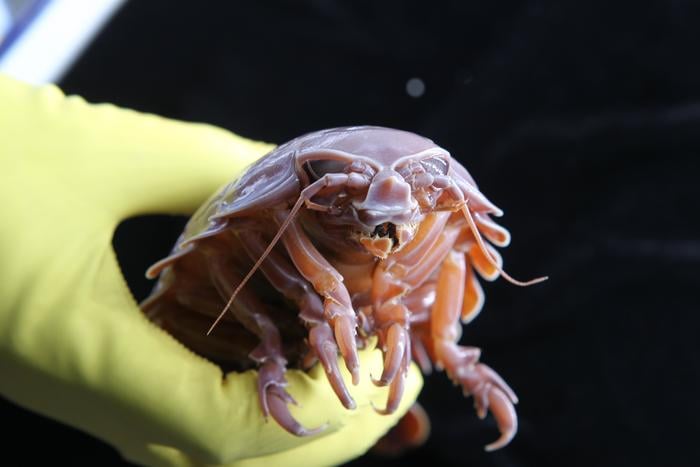
Cut open a supergiant isopod hauled up from nearly a kilometre down, and the first thing you notice is the stomach. It fills roughly two-thirds of the body cavity, packed tight with a finely ground, mud-like paste of whatever the animal last managed to scavenge from the seabed. Everything else, the legs, the armoured plates, the rest of the viscera, seems almost an afterthought arranged around that vast holding tank. For an animal that can go more than five years without a meal, the priorities make a certain grim sense.
The supergiant bathynomid, a deep-sea relative of the woodlouse you might find under a flowerpot, holds the animal kingdom’s record for starvation tolerance. Half a decade, no food, no obvious distress. The puzzle is that it manages this while also being enormous.
Big bodies are expensive. Every gram of tissue demands energy to build and maintain, and the deep sea is one of the most food-starved places on the planet, a realm where the occasional sinking fish carcass counts as a banquet. So how does a creature that can reach half a metre long sustain that bulk on almost nothing? A team led by researchers at the Institute of Oceanology of the Chinese Academy of Sciences set out to crack this energy paradox, and the answer they found in the journal Cell turns out to involve a gene the isopods appear to have stolen from bacteria.
They compared two species. Bathynomus jamesi, the true supergiant, lives at around 898 metres and averages 232 millimetres in length. Its smaller cousin B. doederleini sits at about 300 metres and tops out near 93 millimetres. (For scale, the team also looked at a shore-dwelling relative barely two centimetres long.) The deeper animal was bigger, with a far larger stomach and a metabolism turned right down.
Spend less, store more
That last point matters. Animals living below about 800 metres run their basal metabolism up to fifteen times slower than their shallow-water relatives, a sort of permanent idling that suits the cold, dark, food-poor conditions down there. The supergiant takes this to an extreme, with sluggish mitochondria and chemistry dialled down across the board. Combine a very low burn rate with a stomach the size of a small balloon and you get an animal built to gorge once, rarely, then coast for years on the proceeds.
The microbes inside that stomach tell the same story from another angle. The shallower doederleini hosts a community rich in the kinds of bacteria that help break food down quickly, the hallmark of a frequent feeder. The supergiant, by contrast, is unusually short on those digestive specialists and instead carries a surprising load of Chlamydiae, a bacterial group better known for causing disease, here apparently moonlighting in fat storage. Slow digestion, it seems, is not a bug but a feature: the longer the food sits, the longer it lasts.
None of which fully explained the metabolic conjuring trick at the heart of the paradox. For that, the researchers had to look at the genome, where they found something odd: a short gene, just 88 amino acids, called ND1. It bore no resemblance to the isopod’s own genetic machinery and every resemblance to a fragment of bacterial energy metabolism, specifically a piece of Complex I, one of the molecular pumps that drive respiration inside mitochondria. At some point in the deep past, before the two Bathynomus species split around 16 million years ago, an ancestor seems to have absorbed this gene from a symbiotic microbe and kept it. Horizontal gene transfer, biologists call it, the lateral handing-around of DNA between unrelated organisms that is common enough in bacteria but rather more startling in an animal.
A borrowed switch
What the isopods did next is the genuinely strange part. Most horizontally acquired genes sit quietly, if they survive at all, because high expression tends to sabotage the transfer in the first place. ND1 broke both rules. It duplicated itself after arriving, and then ramped up to extraordinary levels. In the supergiant, one copy is the single most active gene out of more than 23,000, outpacing the animal’s own equivalent genes more than twentyfold. The mechanism keeping it switched on so hard is epigenetic, a chemical tag called histone acetylation parked precisely on its control region.
To work out what the gene actually does, the team dropped it into zebrafish, nematodes and human cells in a dish, then starved them. At ordinary temperatures the result looked like a disaster: the engineered zebrafish burned through their reserves faster and died sooner, with mortality up by nearly a quarter. But chill the water to mimic the deep sea and the picture flipped entirely. Under cold, low-metabolism conditions, the fish carrying ND1 outlasted their unmodified counterparts by 37 per cent.
That reversal is the whole trick. ND1 behaves not as a simple accelerator or brake but as a fine-tuning dial on metabolic depression, pushing the system harder toward shutdown precisely when the temperature is already low. It lets the animal reconcile two demands that ought to be irreconcilable: the heavy upkeep of a giant body and the brutal economy required to endure years of famine. “Our work not only deciphers the mystery of ultra-long starvation tolerance in deep-sea isopods,” said Yuan Jianbo of the Institute of Oceanology, first author of the study, “but also provides an important paradigm for understanding how life balances growth and survival in extreme environments.”
There are caveats worth keeping in view. The isopods themselves cannot be reared in a lab, so the deep-sea specimens were flash-frozen and studied through their molecules rather than watched alive, and zebrafish in cool water are a long way from an animal under nearly a hundred atmospheres of pressure in perpetual dark. The deeper mechanism, why the gene’s control switch evolved the way it did, remains open.
Still, the broad shape of the thing is hard to ignore. An animal solved one of the deep ocean’s hardest problems not by inventing a new piece of biology but by quietly co-opting one from the microbes living inside it, then tuning it with an epigenetic switch. If borrowing genes from your gut bacteria is a route to surviving the unsurvivable, it is worth wondering what else, in the dark and the cold and the hunger of the deep sea, has been getting by on the same kind of theft.
Frequently Asked Questions
How can any animal go five years without eating?
It comes down to spending almost nothing while hoarding what little it gets. The supergiant isopod runs its metabolism extraordinarily slowly, up to fifteen times slower than shallow-water relatives, and stores a single large meal in a stomach that fills two-thirds of its body. A borrowed bacterial gene appears to fine-tune just how far it can throttle its energy use, stretching one feeding into years.
Is it really true that the isopod stole a gene from bacteria?
That is the most surprising claim in the study. A gene called ND1, which closely matches a piece of bacterial energy machinery rather than anything in the animal’s own lineage, sits embedded in the isopod genome and is wildly overactive. The researchers trace its arrival to an ancient transfer from a symbiotic microbe, more than 16 million years ago.
Why does a borrowed gene help in the cold but hurt in the warm?
The same gene that speeds up metabolism at normal temperatures becomes a tool for deeper shutdown when things turn cold. In warm-water experiments it made animals burn out and die faster during starvation; in cold water it extended their survival by more than a third. The deep sea is permanently cold, so for the isopod the gene is pure advantage.
Could this tell us anything useful beyond deep-sea biology?
Possibly. Understanding how an animal safely powers down its metabolism to near-dormancy speaks to long-standing questions about hibernation, ageing and how cells survive extreme stress. Whether any of it translates to human medicine is far from clear, but the mechanism is a striking proof that nature has already solved problems we are still puzzling over.
Source: Yuan, J. et al. “Deep-sea megafauna co-opts microbial energy metabolism genes to withstand ultra-long starvation.” Cell (2026). https://doi.org/10.1016/j.cell.2026.05.012