At one end of the family sits the tsetse fly, a strong flier with big eyes that picks out a buffalo or a person from across an African clearing. At the other end live the bat flies, eyeless or nearly so, scuttling through fur in the dark and almost never leaving their host. Two ways of making a living, about as far apart as vision gets. And then there is the deer ked, which somehow does both, in a single lifetime.
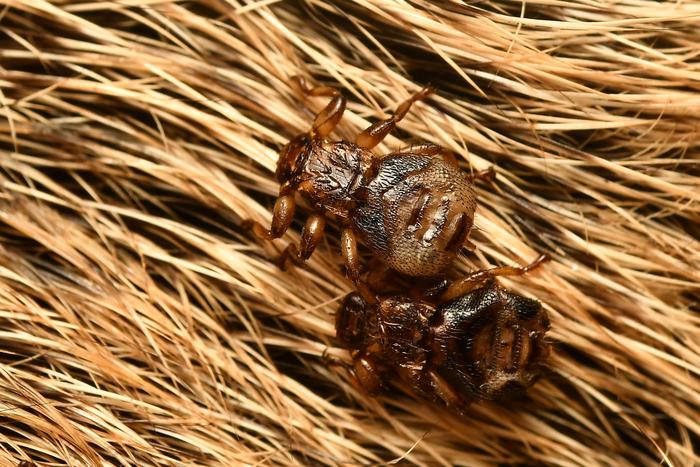
A ked starts out winged. It flies, it hunts, it uses its eyes to find a deer (or, now and then, a hapless human), and the moment it lands on something suitable it snaps off its own wings and never flies again. The rest of its life is spent crawling through hair, drinking blood.
So what happens to the eyes of an animal that gives up flight forever? That is the question Roger Santer and his colleagues set out to answer, and the answer, published in the Journal of Experimental Biology, is oddly specific: the fly turns its vision down, but it doesn’t switch it off. “Vision plays a vital role in animal behaviour, but it is also energetically expensive. Evolution favours sensory systems that are efficiently matched to an animal’s way of life,” says Santer, of the Department of Life Sciences at Aberystwyth University. Eyes are pricey to run. A blowfly’s retina alone can eat up roughly a tenth of the insect’s entire oxygen budget, which is a lot to spend on a sense you’ve largely stopped using.
The team worked with Lipoptena andaluciensis, a deer ked sampled in the Tuscan Apennines. Winged adults were caught in late summer while out searching for hosts; wingless ones were collected the following spring from the carcasses of red deer brought down by hunters.
Here’s the wrinkle that makes deer keds such a neat natural experiment. When the ked drops its wings and becomes a permanent parasite, it doesn’t moult. No moult means the hard outer structure of the eye, the facets, the lenses, all of it, simply can’t be rebuilt. Whatever changes, has to change on the inside. So Santer’s team went looking at the level of the genes that build the light-catching pigments, the opsins.
What they found in flying keds was, near enough, a tsetse’s visual kit. Five opsin types: a workhorse pigment for motion and brightness in most of the photoreceptors, a trio handling ultraviolet, blue and green for colour vision, and one more reserved for the simple eyes on top of the head that help stabilise flight. The full calyptrate fly toolkit, in other words, the same hardware that lets tsetse spot a host from a distance.
Then the wings come off, and the readout changes. Across the board, opsin gene activity in the wingless keds fell to roughly half of what it had been. Not a clean shutdown of one system or another, not the loss of colour vision or anything so tidy, but a fairly even dimming of the whole lot. “We found that a flying deer ked’s visual system is much like that of a tsetse fly, which famously hunt out mammal hosts in Africa,” says Santer. “However, after a deer ked loses its wings and becomes an ectoparasite, activity of its opsin genes reduces to around half the previous level… We think the fly might be sacrificing sight to conserve energy for functions such as digestion and reproduction.” Less light-catching machinery means less sensitivity. The fly can still see, probably; it just sees less keenly, and pays less for the privilege.
The genes it kept
It’s worth dwelling on what the keds didn’t do, because that’s arguably the more interesting bit. A close relative, the sheep ked, went down the flightless route long ago and ditched whole opsins from its genome along the way. The deer ked has kept every one of its pigment genes. It’s just quietened them.
Why hang on to the full set? Maybe colour vision still earns its keep on the host, or matters in the unhappy event that a ked gets knocked off and has to find a new deer on foot. Or maybe, Santer’s team suggests, the fly simply can’t dial expression all the way down within a single adult lifetime, and is stuck running visual equipment it barely uses.
If that’s the case, foregoing flight could carry a quiet, ongoing tax: the cost of keeping eyes you’ve mostly retired. The researchers reckon that may be part of why so few flies in this group ever commit to the wingless, ride-the-host lifestyle in the first place. There are some caveats worth flagging, mind. The winged and wingless keds were gathered in different seasons and handled a little differently, so things like light exposure could have nudged the numbers, and the team is upfront that they can’t rule that out entirely.
What a half-blind parasite teaches us
Beyond the deer ked itself, there’s a practical thread here. Biting flies find us and our livestock largely by sight, drawn to dark and blue shapes, and pinning down exactly which pigments do the work feeds straight into better traps and monitoring tools. A fly that flips between hunting and hiding, all in one body, turns out to be a rather good place to study how a sense gets switched on, and then turned down.
DOI / Source: 10.1242/jeb.251571
Frequently Asked Questions
Why would an animal deliberately reduce its own eyesight?
Eyes are extraordinarily expensive to run. In some flies the retina alone consumes around a tenth of the insect’s total oxygen, so a parasite that no longer needs to chase down hosts can save a meaningful amount of energy by investing less in vision. The deer ked appears to redirect those resources toward digestion and reproduction once it settles in for life on a deer.
Does the deer ked actually go blind after it loses its wings?
No, and that’s the surprising part. Its light-sensing genes drop to roughly half their previous activity rather than switching off, so the fly almost certainly still sees, just less sharply. It also holds on to every one of its visual pigment genes, unlike some relatives that have abandoned theirs entirely.
How can a fly change its vision without growing a new pair of eyes?
Because deer keds shed their wings without moulting, the external structure of the eye can’t be rebuilt, so any adaptation has to happen internally. The flies adjust how strongly they express the genes for opsins, the pigments that capture light inside their photoreceptors. Dialing that expression down reduces sensitivity without altering the eye’s outward anatomy.
Could studying these flies help control biting insects?
Potentially, yes. Many blood-feeding flies locate hosts by sight, gravitating toward dark and blue objects, so knowing precisely which visual pigments drive that behaviour helps in designing more effective traps and monitoring devices. The deer ked is a useful model because its hunting and parasitic phases are cleanly separated within a single insect.
Discover more from Wild Science
Subscribe to get the latest posts sent to your email.