The bird bones at Changma come in clusters, broken and crushed into tight little pellets, the kind of thing a modern owl coughs up after a meal. Hundreds of prehistoric birds, scattered through a fossil bed in northwestern China, some of them mangled in a way that screamed predator. For years nobody could say what had done the crushing. The site had given up more than a hundred bird skeletons and not one other dinosaur to pin the killings on. A whodunit with a body count and no suspect.
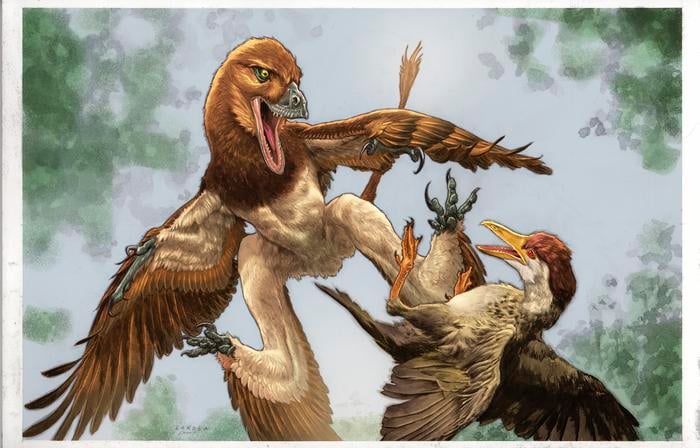
Now there is a suspect. Its name is Jian changmaensis, and it is a cousin of Velociraptor that probably glided on four feathered wings.
The fossil itself is modest: an articulated left shoulder and forelimb, the scapula and coracoid fused together, plus the humerus, radius and ulna. No hand, no skull, no tail. But shoulder bones can be surprisingly chatty. From this single arm, a team led by Jingmai O’Connor of the Field Museum in Chicago and Matt Lamanna of the Carnegie Museum of Natural History worked out that they were looking at something new, and something that did not belong to the avian crowd that dominates this place. “It’s the only dinosaur found at this site that wasn’t a bird, it was a carnivore, and it was much bigger than everything else that we’ve found there,” says O’Connor.
Which makes it the obvious person of interest. “Scientists have found these weird, broken-up clusters of bird bones at this site, and we didn’t know what made them. This new microraptor dinosaur, Jian changmaensis, is our best guess,” she says.
A raptor the size of a barn owl
Microraptors were the small fry of the dromaeosaur family, the group that includes the famous (and, in real life, considerably fluffier) Velociraptors. The best known microraptor was roughly crow-sized. Jian was a giant by those standards. “Jian is one of the biggest microraptor specimens that has ever been found,” says O’Connor. “The piece of its upper arm bone that we have is about 4 inches long, so the entire dinosaur probably had something like a four-foot wingspan, around the size of a barn owl.”
That owl comparison is doing some quiet work. Microraptors are thought to have carried long feathers not just on their arms but on their legs too, giving them the look of a creature with four wings rather than two. Whether they could properly fly is another matter. The current best guess is that they couldn’t, not in the powered, flapping sense. “Jian and the other microraptors probably weren’t capable of true, powered flight, but they could probably glide like a flying squirrel,” says O’Connor. So: something launching from a branch above a lake, dropping onto a bird below. Then the pellets.
The bones came out of the Xiagou Formation, lacustrine mudstone laid down around 120 to 124 million years ago, in the early part of the Cretaceous. This was a lake setting, seasonally warm and rather arid, with a mean annual temperature that one isotope study pinned at about 20°C. The slab preserves the forelimb in three dimensions, slightly crushed (lake-bottom fossils nearly always are), and the researchers ran it through a laminography scanner to pull out the fine detail. Among the features that mark Jian as its own species: an unusually long coracoid, condyles sitting oddly far forward on the arm bone in a way that looks a touch bird-like, and a small foramen, a little hole, on the radius that has never been seen in any other dromaeosaur. Tiny things. But that is how you name a dinosaur from one arm.
The bird graveyard and its twin
Changma is strange for a Cretaceous fossil bed. Most sites of this age in China, the celebrated Jehol localities of the northeast, are crowded with archaic birds called enantiornithines and their stem relatives. Changma is the opposite. It is overwhelmingly dominated by one bird, the duck-like ornithuromorph Gansus yumenensis, an early member of the lineage that eventually led to everything in your garden. Ornithuromorph fossils here outnumber the others roughly ten to one. For a long time that lopsidedness looked like it might mark a moment in deep time, the changing of the avian guard, with modern-style birds elbowing out the old guard.
Jian complicates that tidy story, and not by itself. The researchers point to a second site, Sihedang in Liaoning, that looks eerily like Changma: same dominance of derived ornithuromorphs, same turtles, same enantiornithines, and, tellingly, the same kind of microraptorine raptors. Two bird graveyards with matching casts of characters. The team suspects this isn’t really about time at all. More likely both places preserve a particular sort of habitat, some specific lakeside environment, that the rest of the Jehol world rarely captured. The weird bird mix would then reflect where these animals lived, not when.
“Jian changmaensis reveals that non-avian dinosaurs lived in what is now the Changma Basin, an area famous for its fossil birds,” says Lamanna. “Our team has recovered more than a hundred bird fossils at Changma, but only this single non-avian dinosaur specimen. Jian provides critical new insight into the biological history of the Changma region and the ecological context of the ancestors of today’s birds.”
There is a longer arc here, the one O’Connor keeps coming back to. Birds are the only dinosaurs that made it through the asteroid 66 million years ago, and they have since become arguably the most successful land vertebrates on the planet. Working out what the survivors were doing while they still shared the world with their toothier relatives, and what was hunting them, is part of understanding why they, and not the others, are still here. “You cannot understand life on the planet today without looking at its origins,” she says. For now the case against Jian rests on a single shoulder and a heap of crushed bird bones. More of the dinosaur, should Changma ever give it up, would help. So would catching it, so to speak, in the act.
Source: Annals of Carnegie Museum / Field Museum
Frequently Asked Questions
How can scientists name a whole new dinosaur from just one arm?
Shoulder and forelimb bones carry a lot of diagnostic detail. In Jian‘s case, three features stood out as unique among its relatives, including a small hole in the radius bone never seen in any other dromaeosaur, plus an unusually elongated coracoid. Those distinctions, combined with body proportions intermediate between known microraptors, were enough to mark it as a new species.
Did Jian actually fly, or just glide?
Probably just glide. Microraptors are thought to have had long feathers on both their arms and legs, giving them four wing-like surfaces, but most researchers doubt they could manage true flapping flight. The likeliest picture is something closer to a flying squirrel, launching from a height and steering its way down.
Why does one dinosaur matter at a site with a hundred birds?
Because it is the only non-bird dinosaur found there, and it appears to solve a standing mystery: the crushed clusters of bird bones, resembling owl pellets, that hinted at an unseen predator. Jian was a carnivore and much larger than the birds around it, making it the prime candidate for whatever was eating them.
What does Jian tell us about the rise of modern birds?
The Changma fossil bed is dominated by an early modern-type bird rather than the archaic birds typical elsewhere. Jian, along with a strikingly similar site called Sihedang, suggests this odd mix reflects a particular habitat rather than a moment when modern birds took over. That shifts how palaeontologists read one chapter of the dinosaur-to-bird transition.
Discover more from Wild Science
Subscribe to get the latest posts sent to your email.