
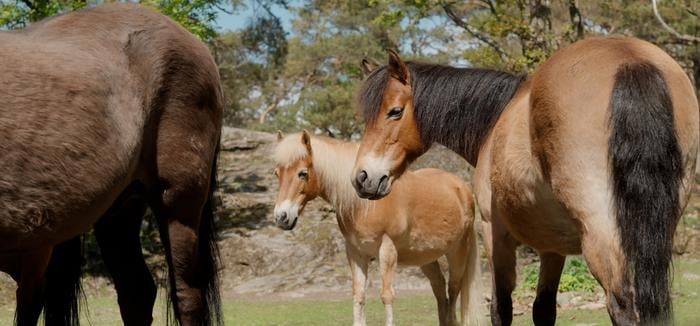
The children kept coming, small hands reaching over the fence to pat a pony’s neck while it pulled hay from a rack and chewed, unbothered. Around the eight Gotland russ horses at Slottsskogen park in Gothenburg, the spring afternoon was all noise and motion: infants squealing, adults leaning in, the general low chaos of a children’s zoo on a weekend. And strapped around each horse’s chest, under that famously thick winter coat, a heart rate monitor logged the truth of how they felt about it. Which turned out to be: not much at all.
That, more or less, is the finding from a study just published in Zoo Biology by researchers at the University of Gothenburg. The horses, it seems, take human attention in their stride.
The logic behind the work is simple enough. Heart rate tracks stress, in animals as in us. When something rattles you, the rate climbs; when you settle, it drops. So Isidora Dundjerovic and her colleague Lynne Sneddon fitted Polar belts (the same sort of kit a runner straps on, only sized for a pony) to eight horses and recorded what their hearts did across three very different afternoons. Resting in the stable. Out walking the park with a keeper. And penned beside the playground, where the public could come close and pet them over the rail.
Behaviour only tells you so much. A horse standing still and chewing might be perfectly content, or it might be quietly miserable in a way it has learned not to show.
So the team needed numbers. At rest, the horses averaged roughly 42.5 beats per minute, a baseline that, reassuringly, matched a fifty-year-old study of ponies almost exactly. Out on the walks, hearts climbed to about 85 bpm, which is no surprise: walking briskly for an hour demands oxygen, and the heart obliges. The real test was the playground.
“Although a great deal can be gleaned from the animals’ behaviour, there is still some uncertainty about how they feel in the company of humans,” says Dundjerovic, the study’s lead author. “They actually don’t seem to mind all that much.”
The Number That Mattered
At the playground, surrounded by children and hands and the whole petting-zoo circus, the horses’ hearts averaged 51 bpm. Barely above resting. Nowhere near the exertion of a walk. Whatever was going on in those enclosures, panic was not part of it, and the slight bump above baseline may have had more to do with the hay laid out for them, or simply the novelty of a new spot, than with any unease about the crowds. The horses appeared, by every measure the researchers had, to be having an entirely ordinary day.
What makes this more than a feel-good result is the contrast that turned up, unplanned, mid-study. Because on one occasion the horses were not calm. Not calm at all.
An excavator fired up next to the playground enclosure. The two horses wearing belts that day reacted at once: heart rates shot up, and they shoved to the far side of the pen. When the machine fell quiet, they drifted back to the fence and the grass. Then it started again, and kept going, and this time the avoidance turned to something closer to flight, the animals moving faster and faster around a space too small to escape from, with episodes of outright running. One defecated, which in a horse is often a tell of real stress. The researchers kept the data in rather than tidying it away, on the grounds that it was a genuine response to a genuine stressor, and arguably the most revealing thing they recorded.
“At one point, an excavator started up next to the paddock and the horses’ heart rates shot up significantly and they quickly moved away from the machine,” says Dundjerovic. The petting, the children, the hands: fine. The growl of heavy machinery: not fine.
What a Thousand Years of Company Buys You
And it was not only the excavator that left the horses unmoved by everything that wasn’t it. On their walks they passed barking dogs, more than once, and trotted by a dog park where the barking was more or less constant. Cars went by. None of it registered, not in their behaviour and not in their hearts. There is something almost touching in that selective composure, a sense of an animal that has, over a very long association with us, sorted the genuinely alarming from the merely loud. Dogs bark; horses, apparently, have heard it all before. Dundjerovic frames it in terms of deep history. “Horses, as animals, have been accustomed to coexisting with the people who care for them for thousands of years,” she says. We have known, in a rough way, that domesticated animals tolerate us. Putting a monitor on the heart and watching the line stay flat is a rather more convincing kind of knowing.
It matters for places like Slottsskogen, which run on visitor contact and need to be sure that contact isn’t quietly costing the animals something. Zoos and city parks justify themselves partly through public engagement, the petting and the questions and the close encounters, and it would be awkward, to put it mildly, if the encounters that draw the crowds were the very thing wearing the animals down. The work also flags a practical lesson that has nothing to do with petting: keep the construction equipment well away. A barking dog is background. An excavator, it turns out, is a predator-shaped problem.
The caveats are real, mind you. Eight horses is a small herd to draw conclusions from, this was winter (when the park is quieter and the coats are thicker), and ponies may simply be a more phlegmatic breed than most. The team already wants to repeat it in summer, when the visitors arrive in force, and to look at other animals and other breeds. Pony riding, by the same method, has reportedly already been put to the test. For now, though, there is a small and pleasing certainty to bank: the children can keep on patting, and the ponies, bless them, will go on chewing their hay.
Frequently Asked Questions
Does being petted at a zoo stress horses out?
In this study, no. The Gotland russ horses at Slottsskogen averaged 51 beats per minute while children petted them over a fence, barely above their resting rate of about 42.5 bpm and far below the 85 bpm they hit out on a walk. By the measures the researchers used, a busy petting session looked like an ordinary day to them.
If petting didn’t bother them, what did?
An excavator. When one started up beside the playground enclosure, the horses’ heart rates spiked and they fled to the far side of the pen, and when it ran for longer they began running in circles, with one defecating, a known stress response. Loud machinery, it seems, reads as a real threat in a way that barking dogs and passing cars simply did not.
Why use a heart rate monitor instead of just watching the animals?
Because behaviour can hide what an animal is actually feeling. A horse may stand calmly while quietly stressed, so the researchers strapped on Polar belts to read the heart directly. Heart rate climbs with stress, which makes it a non-invasive window into welfare that observation alone can miss.
Can the results be trusted from just eight horses?
It’s a small sample, and the researchers say so plainly. The work was also done in winter, when the park is quieter, and ponies may be calmer by nature than other breeds. The team plans to repeat the study in summer and with other animals, so treat this as a promising first look rather than the final word.
Discover more from Wild Science
Subscribe to get the latest posts sent to your email.