
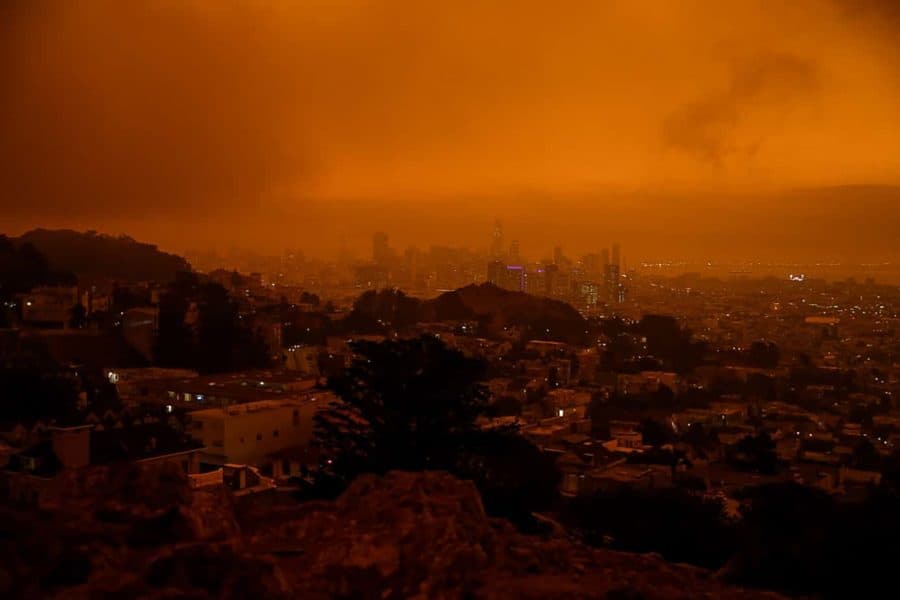
For a century, the strategy was simple. See a fire, put it out. It worked, in a way, right up until it didn’t. All that diligent suppression let dead wood and brush and spindly young trees pile up across forests that had evolved to burn every few years anyway, and now those forests go up not in gentle ground fires but in the kind of towering, smoke-belching infernos that turn the sky orange over cities hundreds of miles away.
So here’s an idea that sounds slightly mad: to get less smoke, light more fires. A study published on 11 June in Science puts hard numbers on that bargain for the first time, and the numbers, roughly speaking, hold up.
The researchers behind it, Iván Higuera-Mendieta and Marshall Burke of Stanford’s Doerr School of Sustainability, were chasing a question that had nagged at fire policy for years. Everyone more or less agreed that prescribed burns, deliberate low-intensity fires set under careful conditions, could tame future wildfires. The trouble is they make smoke too. So you are being asked to pollute today on the promise of cleaner air later, and nobody had worked out whether that trade actually pays.
“Part of our wildfire problem, and the air quality problem it generates, is ironically the fact that we’ve been putting out fires for a long time,” says Burke, the study’s senior author.
A Paradox With a Price Tag
The snag was data, or rather the lack of it. The American West barely does prescribed burning at scale, averaging about 44,000 acres a year against more than 866,000 acres of wildfire. You cannot study something that has hardly happened. So the team reached for a clever stand-in: patches inside real wildfires that happened to burn at low severity, which look an awful lot like what a prescribed burn does to the land.
“It’s a chicken and egg thing,” says Higuera-Mendieta, the PhD student who led the work. “How do we study prescribed burning at scale? Well, what is it trying to replicate? It’s trying to replicate low-severity fire.”
From there it was a matter of grinding through two decades of satellite imagery, building severity maps for nearly 99% of every wildfire California reported between 2000 and 2021, more than a thousand fires in all, including the monstrous 2020 Creek Fire, then matching each scorched square kilometre against a statistically similar patch that hadn’t burned. The point was to ask a counterfactual question: what would have happened to this land if the fire had never touched it?
Benefits That Drift Downwind
The answer, in conifer forests at least, was striking. A single dose of low-severity fire cut the odds of a very severe wildfire returning to that spot by 92 percent, and the protection lingered for more than ten years. Even stranger, the benefit leaked outward. Land within two kilometres of a treated patch saw its own fire risk drop by something like 43%, with faint but real effects measurable as far as five kilometres away.
“You get large benefits in the place that you treated,” Higuera-Mendieta says. “You get benefits that are maybe half as big but pretty meaningful in the nearby places that you didn’t burn. And so those are sort of ‘for free’ from an air quality perspective, because you didn’t have to burn them.”
Plug all that into a simulation of California burning 500,000 acres of conifers a year, and the smoke ledger eventually tips. In the early going, when wildfires happen to be quiet, all that deliberate burning would have bumped smoke pollution up by roughly 50%. Not a great look. But the books balance by about year four, and over a full decade cumulative smoke falls by around 10 percent, with the biggest payoffs landing in catastrophic years like 2020 and 2021. Treat the land and weigh future smoke saved against smoke spent, and the benefits beat the costs by more than five to one.
Not every landscape plays along, mind you. In shrubland, the chaparral that covers much of southern California, the protective effect faded inside four years and never clearly stopped the worst fires. There, the researchers suggest, simply keeping fire out altogether might serve communities better than courting it.
There are caveats, and the authors are upfront about them. The study doesn’t tally the asthma attacks or heart problems or early deaths that shifting smoke around might prevent, though that work is now underway. It assumes a unit of prescribed smoke harms lungs exactly as much as a unit of wildfire smoke, which nobody has really proven. And it leaves out the plain financial cost of treatment, about $170 an acre, give or take, depending on terrain. The simulations also assume managers burn more or less blindly, scattering treatments across all 20 million acres of California conifer rather than targeting the spots most likely to ignite. Burke reckons smarter aim could only improve the math.
“On average, we estimate that each individual acre you treat has an impressive benefit-cost ratio, with the largest benefits in the worst wildfire years,” Burke says. The catch, he adds, is one of sheer scale: you have to treat an enormous amount of land to move the needle at all. California’s existing goal is already roughly 500,000 acres a year, four times what currently gets done. Whether the state can light that many fires on purpose, year after year, without one escaping into the next Creek Fire, is the question the spreadsheets can’t answer.
Frequently Asked Questions
How can lighting more fires possibly mean less smoke overall?
A controlled low-severity burn clears out the dead wood and brush that would otherwise feed a catastrophic blaze. That treated land then burns far less severely, or not at all, when a real wildfire arrives, and severe fires are what produce the truly enormous smoke plumes. You pay a small smoke cost now to dodge a much larger one later. In conifer forests the study found that trade pays off within about four years.
Does the benefit really reach land that was never burned?
Yes, and that was one of the more surprising findings. Fire risk dropped by roughly 43% in unburned areas within two kilometres of a treated patch, with weaker effects out to five kilometres. Past burns seem to act as temporary fuel breaks that slow the spread of later fires, so neighbouring land gets protection without anyone setting it alight.
Would this work everywhere in California?
No. The dramatic effects showed up in conifer forests, which blanket the Sierra Nevada and much of northern California. In shrubland and chaparral the protective effect faded within four years and didn’t reliably prevent severe fires, so the researchers suggest keeping fire out of those systems may be the wiser course.
What’s the biggest obstacle to actually doing this?
Scale, mostly. The benefit per acre is large, but California would need to treat around 500,000 acres a year, about four times the current rate, to meaningfully reduce statewide smoke. There’s also the financial cost, roughly $170 an acre, and the ever-present risk that a prescribed fire escapes its bounds, as happened with the 2022 Hermits Peak Fire in New Mexico.
The full study is available in Science: The air pollution benefits of low-severity fire.
ScienceBlog.com has no paywalls, no sponsored content, and no agenda beyond getting the science right. Every story here is written to inform, not to impress an advertiser or push a point of view.
Good science journalism takes time — reading the papers, checking the claims, finding researchers who can put findings in context. We do that work because we think it matters.
If you find this site useful, consider supporting it with a donation. Even a few dollars a month helps keep the coverage independent and free for everyone.