
The most extreme objects in the universe might not exist. Black holes, those monsters of collapsed matter that anchor whole galaxies and bend light around themselves, have a problem at their core, quite literally: a point of infinite density where the laws of physics simply give up. Now two theoretical physicists in Frankfurt have worked out a way for nature to dodge that embarrassment entirely. Their answer involves something rather startling, a second Big Bang igniting inside a dying star.
The idea sounds like science fiction. The mathematics, published this week in Physical Review D, says otherwise.
Start with what happens when a very massive star runs out of fuel. For billions of years, the energy from nuclear fusion pushes outward, holding the star up against its own crushing gravity. When the fuel is gone, that support vanishes and the star collapses inward. According to the standard picture, nothing can stop the fall. The matter compresses past the point of no return, an event horizon snaps shut around it, and everything funnels down to a singularity, a point where spacetime is curved infinitely and roughly ten billion solar masses (in the most extreme cases) can sit on something smaller than an atom.
Physicists have never been entirely comfortable with this. Infinities in equations usually signal that a theory has been pushed past its limits, not that nature actually behaves that way.
The Star That Hides in Plain Sight
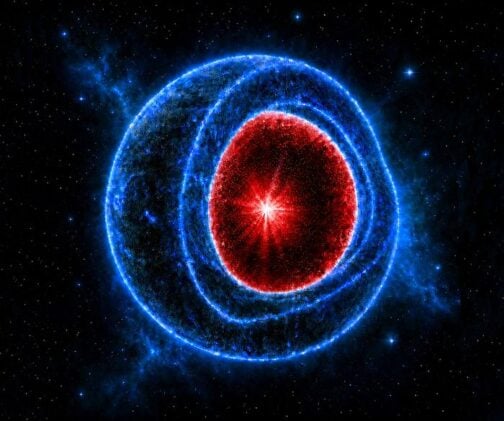
Enter the gravastar, a hypothetical alternative first proposed around 25 years ago. From the outside, a gravastar would look almost exactly like a black hole: nearly as compact, nearly as massive, dark because light struggles to escape its ferocious gravity. Inside, though, things are very different. There is no singularity and no event horizon. Instead, the object is filled with dark energy, the same mysterious stuff thought to be accelerating the expansion of our universe, which pushes outward and props the star up against collapse. A shell of ordinary matter wraps around the outside. Tidy, in a way. No infinities required.
The catch, and it has been a serious one, is that nobody could explain how such a thing would actually form. A quarter century of debate produced no convincing mechanism.
Daniel Jampolski and Luciano Rezzolla at Goethe University Frankfurt have now found one, and it emerged not from some exotic modification of gravity but from Einstein’s general relativity, the same 110-year-old theory that predicts black holes in the first place. Jampolski discovered the solution while working on his master’s thesis under Rezzolla’s supervision. The pair modeled the collapse of a sphere of matter, the classic textbook scenario physicists have studied since 1939, and found that under finely tuned conditions something remarkable happens at the center. A tiny bubble of expanding spacetime, what cosmologists call a de Sitter region, nucleates from zero size right in the middle of the infalling matter. It then grows, driven by dark energy, in a manner not so different from the Big Bang that birthed our own universe some 13.8 billion years ago.
An Expansion That Knows When to Quit
Here is the genuinely elegant bit. The expansion of this mini universe does not run away. It slows naturally as it approaches the Schwarzschild radius, the boundary where an event horizon would otherwise form, and there it meets the collapsing surface of the star coming the other way. The two forces balance. Expansion pushing out, gravity pulling in, and the result is a static equilibrium: a stable gravastar, frozen at the brink of becoming a black hole but never tipping over.
“The Big Bang of the emerging universe can unfold once the star has already collapsed almost to the point of becoming a black hole,” Jampolski explains. The extreme compression is the point, he reckons, because that is precisely where known physics gets shaky. “It is easier to imagine that the Big Bang occurs only at a very late stage, when matter has already been compressed to an extreme degree, thereby giving rise to new effects.”
There are limits, though. The team found that a collapsing star can only take this exit route if its initial compactness stays below a sharp mathematical threshold, a value of exactly 3/8. Squeeze the starting configuration any tighter and the collapse to a black hole becomes unavoidable, mini Big Bang or not. And the conditions need to be fine-tuned, which may mean such objects are vanishingly rare, perhaps nonexistent, in the real universe.
Rezzolla, professor of theoretical astrophysics at Goethe University, is careful not to oversell. “Looking for alternatives to black holes should not suggest a skepticism towards black holes, which still represent the most natural and simplest solution to the fate of gravitational collapse,” he says. But he argues the exotic deserves a fair hearing alongside the orthodox. “History teaches us that it is not unusual for the latter to become the former.”
Universes All the Way Down
If gravastars do exist, the implications are strange to sit with. Every dark, ultracompact object astronomers have cataloged, the thing at the center of the Milky Way included, could in principle be hiding a small expanding cosmos behind its gravitational veil. It also invites an uncomfortable question in the other direction: if a universe can be born inside a collapsing star, what does that say about the origins of ours?
Telling a gravastar from a black hole observationally would be fiendishly hard, since both swallow light with near-total efficiency, but not necessarily impossible; the absence of a true event horizon could, some physicists suspect, leave subtle fingerprints in gravitational wave signals. The next generation of detectors may get to ask the question. For now, the monsters keep their secrets.
Frequently Asked Questions
What exactly is a gravastar?
A gravastar is a hypothetical ultracompact star that looks almost identical to a black hole from the outside but has no singularity and no event horizon. Its interior is filled with dark energy, which pushes outward and prevents total collapse, while a shell of ordinary matter forms its outer layers.
How would a gravastar form, according to the new study?
The Frankfurt physicists showed that when a massive star collapses, a tiny region of expanding spacetime can nucleate at its center, similar to a miniature Big Bang driven by dark energy. This expansion slows near the would-be event horizon, meets the infalling matter, and the two balance into a stable object.
Does this mean black holes don’t exist?
No. The researchers themselves stress that black holes remain the simplest and most natural outcome of gravitational collapse. The gravastar solution requires fine-tuned conditions and only works below a specific compactness threshold, so it is an alternative worth exploring rather than a replacement.
Could we ever tell a gravastar apart from a black hole?
It would be extremely difficult, since both are dark and compact. However, because a gravastar lacks a true event horizon, it might leave subtle signatures in gravitational wave observations that future detectors could potentially pick up.
The research is published in Physical Review D.
ScienceBlog.com has no paywalls, no sponsored content, and no agenda beyond getting the science right. Every story here is written to inform, not to impress an advertiser or push a point of view.
Good science journalism takes time — reading the papers, checking the claims, finding researchers who can put findings in context. We do that work because we think it matters.
If you find this site useful, consider supporting it with a donation. Even a few dollars a month helps keep the coverage independent and free for everyone.