
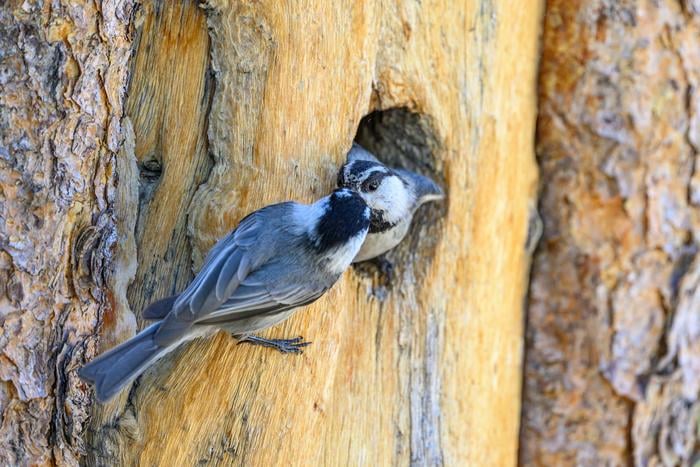
High in the Sierra Nevada, a mountain chickadee drops onto an aluminum frame strung with eight identical feeders, hesitates, hops to the wrong one, then the wrong one again, before finally finding the single door that yields a sunflower seed. The bird flits off to cache it. Every visit, every fumble, every clean hit is logged by a radio tag on its leg. And from that mundane stream of data, a rather startling picture has emerged: the females in this population appear to be shopping around for brains.
That, at least, is the upshot of a three-year study of wild chickadees published in eLife, which its editors call an important piece of work backed by compelling evidence. Females paired up and nesting with one male, it turns out, are routinely slipping off to mate with neighbouring males who are better at remembering where they hid their food.
Why would that matter to a bird? For mountain chickadees, spatial memory is not some abstract talent. These are non-migratory, food-caching birds that survive brutal montane winters by relocating thousands of seeds they have stashed across their territory. Get good at that and you live longer; get bad at it and you tend to die in your first winter. The ability is heritable, tied to genes that build the hippocampus, and it has already been linked in this same population to survival and longevity. So a female who pairs her offspring with a sharper-remembering father is, in effect, handing them a better shot at making it through the cold.
The trouble is that chickadees form their social pairs in the autumn, well before breeding, when most males are already spoken for. Not much room for choosing there.
Which may be where the cheating comes in. To measure who was sneaking off with whom, the team, led by Carrie Branch at Western University in Ontario, genotyped parents and chicks across three breeding seasons and worked out the real fathers. Roughly a third of the sampled chicks (222 of 732, if you want the exact tally) had been sired by a male other than the female’s social partner, and about 70 per cent of nests held at least one such extra-pair chick.
“When it comes to selecting a mate, females tend to be the ‘choosier’ sex due to their inherent investment. Females seek ‘high-quality’ males to increase the likelihood of successful reproduction, good parental care, and the chance that their offspring inherit ‘good’ genes,” says Branch. Spatial memory, she notes, can be inherited and shaped by natural selection, yet there has been scant evidence that females actually pick males for their cognitive chops.
Caught Out by Their Own Caches
Here is the part that makes the case. When the researchers lined up each extra-pair father against the social male he had cuckolded, on the same patch, in the same season, the interloper was, on average, the better performer on the memory task. Not by a landslide in every case, but consistently: in roughly two-thirds of the head-to-head comparisons the extra-pair male had made fewer errors finding his rewarding feeder. Males with the sharpest performance might father six or seven extra-pair chicks in a single year, while the duffers managed one or two. And age had nothing to do with it, the cheaters weren’t simply older, wilier birds. They were just better at the spatial game.
What is rather neat, and a little brutal, is that being a clever male offered no protection from being cheated on. A male’s own memory score did not predict whether his mate would stray. A good male, in other words, could still lose paternity to an even better one. The thing that did seem to nudge a female toward straying was her own forgetfulness: females who fared worse on the task tended to have more extra-pair chicks in the nest, hinting that they might be compensating for their own cognitive shortfalls by seeking out a sharper sire.
And the cheating males paid no obvious price at home. Their own nests held just as many chicks, just as heavy, as those of faithful males. No trade-off showed up at all. (Males with better spatial memory also raised heftier young in their own nests, the kind of chicks more likely to survive and recruit into the breeding population.)
A few caveats are worth keeping in view. The team did not witness the copulations themselves, so the case for active female choice is built on the paternity data and on decades of work showing that female chickadees, and their close tit relatives, leave their territories to seek out neighbouring males, and that forced copulation simply isn’t a thing in these birds. It is also conceivable that some unmeasured trait travels alongside spatial memory, though previous work in this system has knocked down the obvious suspects: sharper birds aren’t more aggressive, more dominant, or more exploratory.
“Our results show that female choice contributes to the evolution of spatial cognitive abilities in a species that stores and recovers thousands of food items and relies on spatial cognition for survival,” says senior author Vladimir Pravosudov at the University of Nevada, Reno. Better-remembering males, he adds, sire more young and fledge heavier chicks, the sort more likely to survive into the next generation of breeders.
The lingering puzzle is how a female judges a male’s memory in the first place. Nobody yet knows. Maybe there’s a tell in the plumage (recent work on black-capped chickadees hints that cognitive performance shows up in feather brightness), or maybe she simply watches who finds their caches through the long winter the pair spends together in a flock, and remembers. If memory is what’s being chosen, then the choosing may itself depend on memory. Which is a fittingly chickadee sort of riddle to be left with.
DOI / Source: https://doi.org/10.7554/eLife.110905.1
Frequently Asked Questions
Why would a female bird mate outside her pair at all?
In many socially monogamous birds, females mate with extra males to gain genetic benefits for their chicks, not help with parenting. For mountain chickadees, pairs form in autumn when choice is limited, so straying during the breeding season may be the main way a female can secure better genes than her social partner offers.
How do researchers even measure a chickadee’s memory in the wild?
They use ‘smart’ feeder arrays: eight feeders on a frame, each bird assigned a single one that will release a seed. Birds wear radio tags, so every visit is recorded, and the number of wrong feeders a bird tries before finding its own becomes a running score of spatial learning and memory.
Is it true that smarter males never get cheated on?
No, and that’s one of the more striking findings. A male’s own memory score didn’t predict whether his mate would stray. Even a high-performing male could lose paternity to a male who scored even higher, because what mattered was the relative difference between the two.
Why does spatial memory matter so much for these birds specifically?
Mountain chickadees stash thousands of food items and must relocate them to survive harsh mountain winters. Birds with better spatial memory are more likely to survive and live longer, and because the trait is heritable, a chick that inherits it inherits a real survival edge.
Discover more from Wild Science
Subscribe to get the latest posts sent to your email.