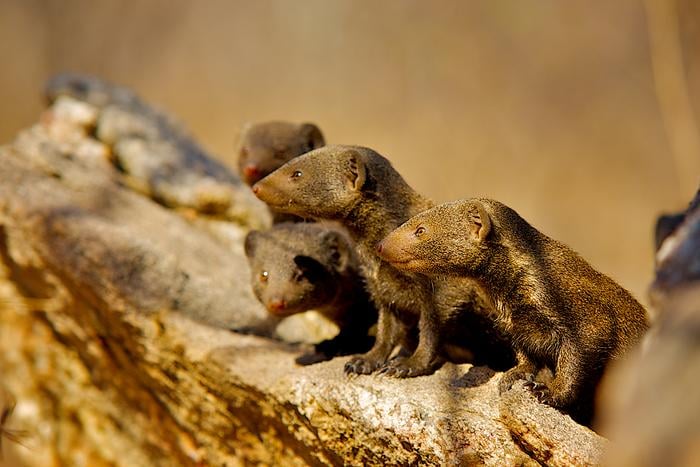
On a termite mound somewhere in the Limpopo bush, a dwarf mongoose hauls itself up onto its hind legs, scans the scrub, and starts to sing. It is a small, chirruping watchman’s song, the sound of a sentinel telling the rest of its group that someone is on guard. But whether it bothers to announce itself at all, it turns out, depends on a calculation the animal made long before any rival came into view: how big are the neighbours around here, and how badly could this go?
That is the surprising message from a decade of fieldwork on Africa’s smallest carnivore, published today in Nature Ecology & Evolution. Dwarf mongooses, it seems, do not simply react when an enemy group turns up. They prepare.
Dwarf mongooses (Helogale parvula) live in tight cooperative bands of anywhere from five to thirty animals, each defending a patch of territory against the neighbours. When two groups meet, things can get ugly fast: nearly half of these encounters escalate into physical fights, and a fight can mean injury or death. So the stakes of bumping into the wrong crowd are real. What the Bristol team wanted to know was whether mongooses treat the spaces between fights as dangerous too, the way a prey animal treats open ground where a predator might lurk.
They borrowed a phrase for it. Ecologists have long talked about a “landscape of fear,” the way grazing animals tiptoe around places where lions might be waiting. The mongooses, the researchers argue, navigate something more like a landscape of conflict.
To map that landscape, the team leaned on a frankly enormous pile of data: ten years of GPS tracks and behavioural observations from twelve wild groups, all so used to human observers that scientists could sit a few metres away and watch daily life unfold. We’re talking more than 1600 daily movement tracks, some 16,000 sentinel watches, and around 2000 evenings spent noting which burrow each group chose to sleep in. Most of it, crucially, came from ordinary days. Days when no rival was anywhere in sight.
“Not only are the mongooses keeping track of where their enemies might be, but they’re factoring in the relative size of different groups,” says lead author Josh Arbon. “They can then tailor their pre-emptive behaviour accordingly.”
Reading the neighbourhood
That tailoring shows up in oddly specific ways. The researchers mapped out what they call neighbour zones, the overlapping bits of range where a rival group had recently been, and found that more than three-quarters of all hostile encounters happened in exactly those areas. So a mongoose group venturing into one is, in a sense, walking into a rough part of town. And when they did, their behaviour shifted according to who lived there. Faced with a much larger, more dangerous rival, sentinels became more talkative: for every doubling in the relative size of the neighbouring group, a guard was about 8 per cent more likely to call out and announce its watch, keeping the rest of the group informed even at the cost of being easier to hear. Against rivals of roughly their own size, though, the calculation flipped. Well-matched groups are the ones you can get into a long, costly brawl with, the kind nobody clearly wins, and here the mongooses played it cannier still, lingering in contested ground by day but slipping away to sleep somewhere safer come evening.
Why such fuss over bedtime? Burrows are precious, and roughly a quarter of all intergroup scraps kick off at them, often at a cramped entrance with only one way in or out. Not a place you want to be ambushed.
“We know that battles between groups can be very dangerous for participants,” says senior author Andy Radford. “What we’ve shown now is that there are constant behavioural changes to mitigate these risks and enhance the likelihood of future contest success.”
What the map can’t tell you
Here’s the wrinkle, though. The team had expected the edges of a group’s territory, out near the borders, to be where caution ramped up, since that is presumably where you are most likely to run into trouble. Mongooses did move faster and cover more ground at the fringes. But their guarding behaviour did not neatly follow suit, and some of it pointed the opposite way. Spatial position alone, it seems, is a clumsy proxy for danger; the real signal is who your neighbours are, not just where the line on the map happens to fall. Quite how the animals gather that intelligence without a rival in sight remains a bit of a puzzle, though scent marks left at shared latrines and plain old memory of past run-ins are the leading suspects.
The project itself has deep roots. It grew out of the long-running Dwarf Mongoose Research Project, pioneered by co-authors Julie Kern and Amy Morris-Drake, who spent years getting close enough to read the small dramas of mongoose life. “The dwarf mongooses are an ideal model species,” says Kern, “both because their lives are strongly affected by intergroup conflict and because we could observe them so closely in natural conditions.”
What makes the finding land, in a way, is how familiar it feels. Humans do this constantly: we post extra lookouts in contested territory, go quiet slipping through enemy ground, weigh up whether a rival is worth the fight before we ever face them. To find a creature the size of a teacup running similar arithmetic, day in and day out, is a reminder that the machinery of conflict was switched on long before we came along. “This work provides insight into how smaller groups are able to survive, and even thrive, amongst more powerful enemies,” Arbon says, by moving cleverly through space and sharing what they know.
And if mongooses are doing it, plenty of other animals probably are too. “Conflict between groups is rife throughout the natural world,” says Morris-Drake. “We have shown that animals are continuously making decisions in a landscape of conflict, not just when they actually encounter rivals.” Which leaves a rather haunting thought: across the bush, the forest, perhaps your own back garden, countless small animals may be planning for fights that have not happened yet, and might never come.
Frequently Asked Questions
How can a mongoose prepare for a fight when there’s no enemy in sight?
The mongooses appear to rely on indirect clues rather than a rival’s actual presence. Scent marks deposited at shared latrine sites give a rough sense of who has been about, and the animals seem to draw on memories of past encounters, which stay reliable because mongoose group sizes and territories tend to be stable over weeks. Together that lets a group judge the threat in an area before anyone shows up.
Why would a guard make itself louder when the danger is greater?
It sounds backwards, but calling out keeps the whole group informed and coordinated, which matters most when a large, dangerous rival is nearby. The trade-off is that announcing your watch can also make you easier for enemies, or predators, to locate. The researchers found mongooses accept that risk specifically when the neighbouring group is bigger and the cost of being caught off guard is highest.
Is it true that mongooses choose where to sleep based on their rivals?
Yes, and the pattern is surprisingly precise. Groups were least likely to bed down in contested ground when their nearby rivals were a close match in size, the situation most likely to spark a drawn-out, costly fight. Since around a quarter of all clashes happen at burrows, retreating to a safer spot for the night is a sensible hedge.
Why does this matter beyond mongooses?
Intergroup conflict has shaped social life across the animal kingdom, from ants to apes to us. Showing that animals constantly adjust their everyday behaviour in anticipation of conflict, not just during it, suggests this hidden layer of decision-making may be widespread and has simply been overlooked. It also offers a clue to how small or weak groups manage to hold their own against stronger neighbours.
Source: Arbon, J. J., Morris-Drake, A., Kern, J. M. & Radford, A. N. “Dwarf mongooses pre-emptively alter their behaviour relative to the threat posed by different rival groups,” Nature Ecology & Evolution (2026). https://doi.org/10.1038/s41559-026-03104-3