
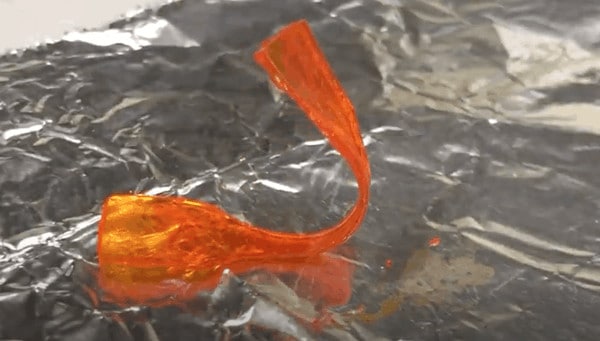
Engineers at Caltech have developed a process for generating three-dimensional architected polymers with heat-dependent “shape memory” properties: that is, when heated, the material folds and unfolds itself into a new preordained shape. In this video, Caltech graduate student Luizetta Elliott explains how these shape memory polymers could one day be used to perform complex tasks inside the human body, such as unclogging a blocked artery or pulling out a blood clot. Elliott worked on micro-architected shape polymers in the lab of Julia R. Greer, the Ruben F. and Donna Mettler Professor of Materials Science, Mechanics and Medical Engineering, who is a pioneer of “nano-architected materials.” Their paper, co-authored with alumna Erika Salzman (BS ’20) is titled “Stimuli Responsive Shape Memory Microarchitectures” and was published in the journal Advanced Functional Materials on December 8. This research was supported by the Chen Neuroscience Institute and the U.S. Department of Defense.
ScienceBlog.com has no paywalls, no sponsored content, and no agenda beyond getting the science right. Every story here is written to inform, not to impress an advertiser or push a point of view.
Good science journalism takes time — reading the papers, checking the claims, finding researchers who can put findings in context. We do that work because we think it matters.
If you find this site useful, consider supporting it with a donation. Even a few dollars a month helps keep the coverage independent and free for everyone.