
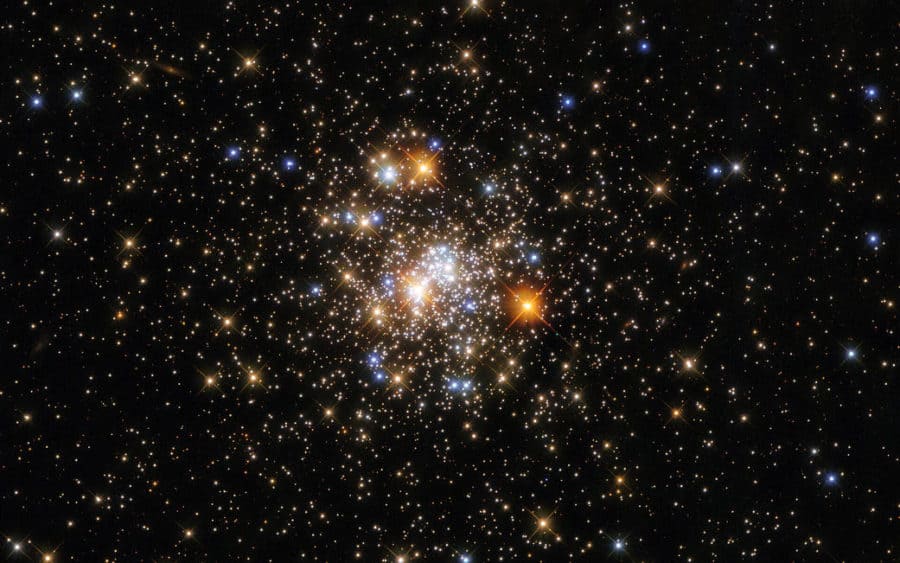
This star-studded image from the NASA/ESA Hubble Space Telescope depicts NGC 6717, which lies more than 20,000 light-years from Earth in the constellation Sagittarius. NGC 6717 is a globular cluster, a roughly spherical collection of stars tightly bound together by gravity. Globular clusters contain more stars in their centers than their outer fringes, as this image aptly demonstrates; the sparsely populated edges of NGC 6717 are in stark contrast to the sparkling collection of stars at its center.
The center of the image also contains some interlopers from closer to home. These bright foreground stars reside between Earth and the cluster. They are easily spotted by the crisscross diffraction spikes that form when their light interacts with the structures supporting Hubble’s secondary mirror.
The constellation Sagittarius is in the same area of the night sky as the center of the Milky Way, which is filled with light-absorbing gas and dust. This absorption of light – which astronomers call “extinction” – makes studying globular clusters near the galactic center challenging. To determine the properties of NGC 6717, astronomers relied on a combination of Hubble’s Wide Field Camera 3 and the Advanced Camera for Surveys.
ScienceBlog.com has no paywalls, no sponsored content, and no agenda beyond getting the science right. Every story here is written to inform, not to impress an advertiser or push a point of view.
Good science journalism takes time — reading the papers, checking the claims, finding researchers who can put findings in context. We do that work because we think it matters.
If you find this site useful, consider supporting it with a donation. Even a few dollars a month helps keep the coverage independent and free for everyone.