
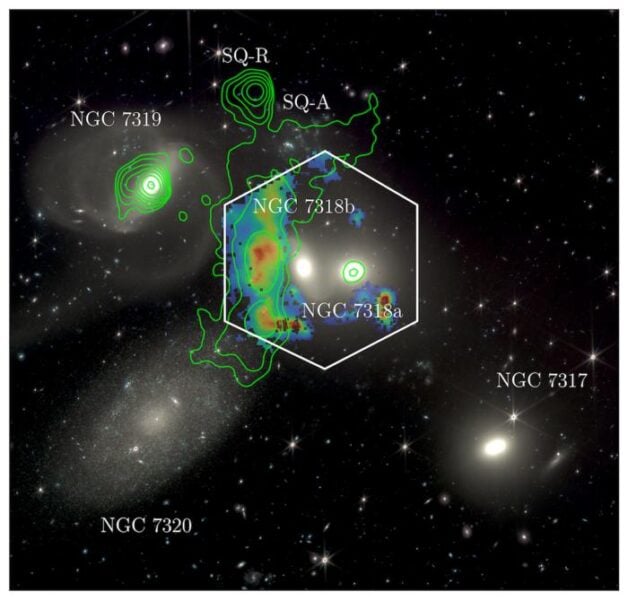
In a dramatic cosmic spectacle, astronomers have captured unprecedented details of a galaxy hurtling through space at an astonishing 2 million miles per hour, triggering a massive collision that creates shock waves comparable to a fighter jet’s sonic boom.
Glossary
- Shock Front
- A boundary where matter undergoes abrupt changes in properties due to supersonic collision impacts.
- Spectroscopy
- The study of how matter interacts with electromagnetic radiation, revealing its composition through light analysis.
- Intergalactic Medium
- The space between galaxies, containing various forms of matter and energy.
Test Your Understanding
How fast is the colliding galaxy NGC 7318b moving?
The galaxy is moving at an incredible speed of 2 million miles per hour (3.2 million kilometers per hour).
What happens when the shock wave encounters cold gas?
It travels at hypersonic speeds and strips electrons from atoms, creating a glowing trail of charged gas.
How does the shock wave behave differently in hot gas?
Instead of causing significant disruption, it becomes weaker and compresses the hot gas, generating radio waves detectable by radio telescopes.
What makes this observation particularly significant?
It’s the first time scientists have observed this dual nature of shock fronts in galaxy collisions, using the new WEAVE telescope alongside other cutting-edge instruments.
Enjoy this story? Subscribe to our newsletter at scienceblog.substack.com
ScienceBlog.com has no paywalls, no sponsored content, and no agenda beyond getting the science right. Every story here is written to inform, not to impress an advertiser or push a point of view.
Good science journalism takes time — reading the papers, checking the claims, finding researchers who can put findings in context. We do that work because we think it matters.
If you find this site useful, consider supporting it with a donation. Even a few dollars a month helps keep the coverage independent and free for everyone.