
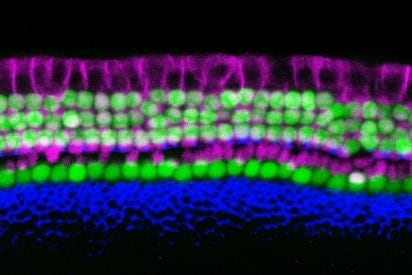
Non-mammals such as birds can recover from deafness as quickly as humans can recover from a cut or bruise. In contrast, when humans and other mammals sustain damage to the inner ear’s sensory cells, the resulting hearing loss is permanent.
In two studies published in the journal Development, researchers from the USC Stem Cell laboratory of Neil Segil examined how a key gene, called Atoh1, underpins the development and potential regeneration of the inner ear’s sensory cells, which are known as hair cells.
In the first study, researchers Zlatka Stojanova, Tao Kwan and Segil explored how Atoh1 is either “turned on” or “turned off” through a process called epigenetic regulation.
By studying the mouse inner ear, the team documented the precise epigenetic signals that turn on or “upregulate” Atoh1 in the progenitor cells that become hair cells during embryonic development, and the epigenetic signals that turn off or “downregulate” Atoh1 during the first week after birth — when the newborn mouse loses its potential to regenerate hair cells and recover from hearing loss.
In the second study, researchers Yassan Abdolazimi, Stojanova and Segil showed that a group of genes called Hes/Hey directly interact with and repress Atoh1 to sculpt the developing structure in the inner ear called the organ of Corti into a complex mosaic of different cell types that ultimately enables hearing.
“These two studies advance our understanding of both the genetic and epigenetic signals that regulate Atoh1, a critical factor in the development of hair cells and the entire sensory structure,” said Segil, professor of research in the Department of Stem Cell Biology and Regenerative Medicine, and the USC Tina and Rick Caruso Department of Otolaryngology – Head and Neck Surgery. “In the future, we hope to find drugs that target these genetic and epigenetic regulators of Atoh1, and that might provide new therapies to stimulate hair cell regeneration in individuals with hearing loss or deafness.”
Both studies were supported by grants from the National Institutes of Health (DC004189), the Hearing Health Foundation and the Sidgmore Family Foundation.
ScienceBlog.com has no paywalls, no sponsored content, and no agenda beyond getting the science right. Every story here is written to inform, not to impress an advertiser or push a point of view.
Good science journalism takes time — reading the papers, checking the claims, finding researchers who can put findings in context. We do that work because we think it matters.
If you find this site useful, consider supporting it with a donation. Even a few dollars a month helps keep the coverage independent and free for everyone.