
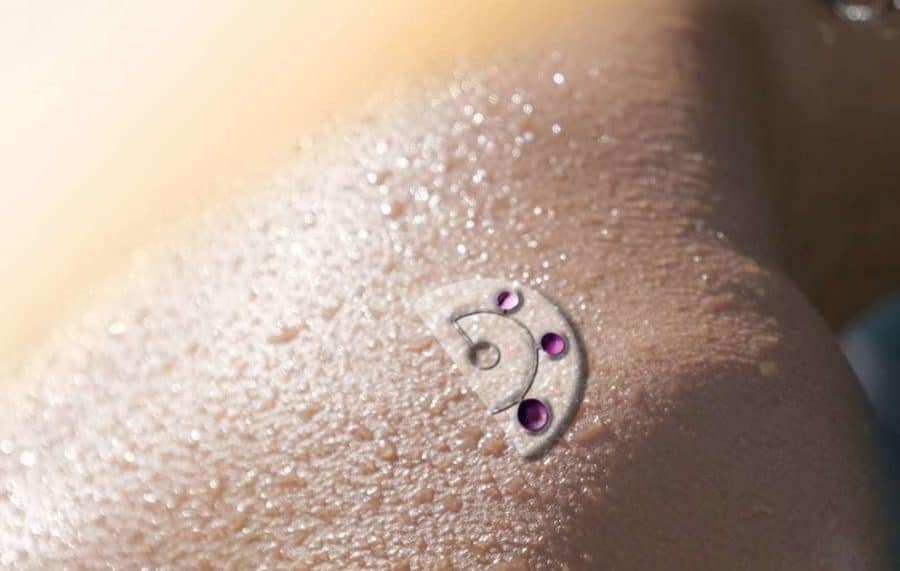
A device that monitors health conditions in the body using a person’s sweat has been developed by Penn State and Xiangtan University researchers, according to Huanyu “Larry” Cheng, assistant professor of engineering science and mechanics, Penn State.
“We want to be able to analyze the sweat from daily exercise or from the heat of the sun because in sweat we have a lot of biomarkers like pH and glucose that will be a really nice indicator for disease progression or diagnostics,” Cheng said.
The device will be on a patch applied to the skin near sweat glands. It consists of a small vial containing multiple chambers that has a hydrophobic — water repelling — valve near the opening made of silicone rubber. The channel has a hydrophilic — water attracting — coating for easy collection of the sweat. Unlike other devices that require two openings, the single opening reduces the amount of evaporation, leading to longer storage time for later analysis.
On-the-spot analysis can be done using a colorimetric approach in which a color-coded analyte is preplaced in the various chambers. This sensitive chemical responds to the pH or glucose level and can be read by the naked eye or a photo taken with a smartphone. Also, the researchers can analyze the sweat at different time points using different chambers — called chrono-sampling.
“The two-valve device is more complicated and requires using a clean-room technique called photolithography. Our simpler one-valve device can be made without expensive equipment utilizing micromachining,” Cheng said.
The device will be of interest to the healthcare industry, and particularly in athletics, where it can be used to monitor overheating or to adjust exercise levels for optimum performance. The researchers are also collaborating with a researcher at Penn State Hershey Medical School on disease monitoring. The device can have one chamber color-coded for pH, a second for glucose and a third for sodium, all of which are disease markers.
Their results appear online in the journal Lab on a Chip in an article titled “Skin-interfaced microfluidic devices with one-opening chambers and hydrophilic valves for sweat collection and analysis.” Lead authors are Yingxue Zhang, co-advised by Cheng and Xiufeng Wang, Xiangtan University, China, and Wang’s student Yao Chen.
The National Natural Science Foundation of China, the Natural Science Foundation of Hunan Province, and Penn State supported this work.
ScienceBlog.com has no paywalls, no sponsored content, and no agenda beyond getting the science right. Every story here is written to inform, not to impress an advertiser or push a point of view.
Good science journalism takes time — reading the papers, checking the claims, finding researchers who can put findings in context. We do that work because we think it matters.
If you find this site useful, consider supporting it with a donation. Even a few dollars a month helps keep the coverage independent and free for everyone.