
Deep in the Bolivian highlands, archaeologists have uncovered a massive temple complex that served as a crucial gateway for one of South America’s most powerful ancient civilizations.
The Palaspata temple, spanning roughly the size of a city block, offers fresh insights into how the Tiwanaku state controlled trade routes connecting highland Bolivia with fertile eastern valleys over a thousand years ago.
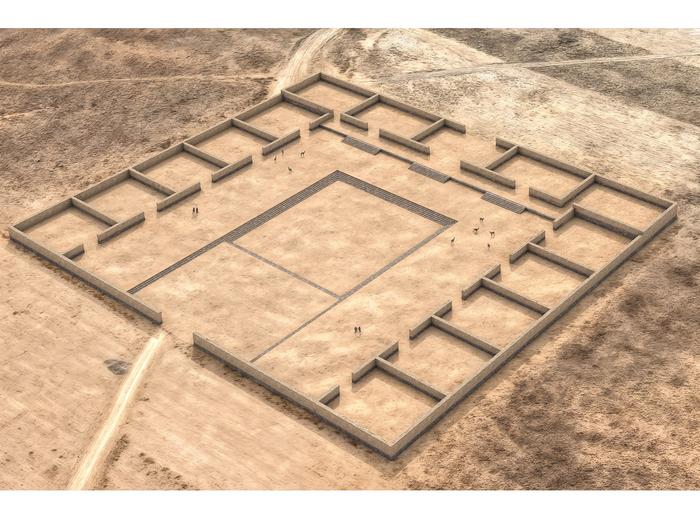
The discovery, published today in the journal Antiquity, reveals a sophisticated 125-by-145-meter ceremonial complex positioned at the intersection of three major trade routes. Located 130 miles southeast of the main Tiwanaku site near Lake Titicaca, this temple demonstrates the empire’s strategic approach to expansion and economic control.
Strategic Location Controlled Ancient Commerce
“Their society collapsed sometime around 1000 CE and was a ruin by the time the Incas conquered the Andes in the 15th century,” explained José Capriles, Penn State associate professor of anthropology and lead author of the study. “At its peak, it boasted a highly organized societal structure, leaving behind remnants of architectural monuments like pyramids, terraced temples and monoliths.”
The temple’s position was no accident. It sat at a crossroads connecting the productive Lake Titicaca highlands to the north, llama-herding territories in the west, and the agriculturally rich Cochabamba valleys to the east. This strategic placement allowed the Tiwanaku to monitor and potentially tax goods flowing between vastly different ecosystems.
Advanced Detection Methods Reveal Hidden Architecture
Despite being known to local farmers, the site’s archaeological significance remained hidden until researchers combined satellite imagery with drone photography. The temple’s features were so subtle that advanced photogrammetry—a technique using overlapping photos to create detailed 3D models—was required to map the structure accurately.
The temple complex contains 15 rectangular enclosures arranged around a central courtyard, with its main entrance facing west in alignment with the solar equinox. Key discoveries include:
- Fragments of ornate keru drinking cups used for consuming chicha, a traditional maize beer
- Ceremonial pottery showing connections to distant regions
- Turquoise stones and Pacific Ocean shells indicating far-reaching trade networks
- Evidence of astronomical alignments for ritual purposes
Maize Beer Points to Religious Trade Control
The abundance of keru cup fragments proves particularly significant. These vessels were essential for drinking chicha during agricultural celebrations, yet the maize needed to brew this beer couldn’t grow at the temple’s high altitude. Instead, it had to be imported from the Cochabamba valleys—exactly the type of trade the temple was positioned to oversee.
“Most economic and political transactions had to be mediated through divinity, because that would be a common language that would facilitate various individuals cooperating,” Capriles noted, explaining how religion often served as neutral ground connecting different groups.
Radiocarbon dating of charcoal samples from the associated settlement reveals the site was most intensively occupied between approximately 630 and 950 CE, corresponding precisely with Tiwanaku’s expansion period. This timing wasn’t revealed in the original press release but appears in the detailed study data.
Local Community Embraces Archaeological Heritage
The discovery surprised even local inhabitants, according to Justo Ventura Guarayo, mayor of Caracollo municipality. “The archaeological findings at Palaspata are significant because they highlight a crucial aspect of our local heritage that had been completely overlooked,” he remarked. The municipality is now working with authorities to protect and potentially develop the site for tourism.
This temple represents only the second known Tiwanaku ceremonial complex found outside the Lake Titicaca heartland, making it crucial for understanding how this ancient state projected power across hundreds of miles of rugged terrain. While the Tiwanaku civilization mysteriously collapsed around 1000 CE, sites like Palaspata continue revealing the sophisticated political and economic strategies that sustained their empire for centuries.
ScienceBlog.com has no paywalls, no sponsored content, and no agenda beyond getting the science right. Every story here is written to inform, not to impress an advertiser or push a point of view.
Good science journalism takes time — reading the papers, checking the claims, finding researchers who can put findings in context. We do that work because we think it matters.
If you find this site useful, consider supporting it with a donation. Even a few dollars a month helps keep the coverage independent and free for everyone.