

The Arctic Ocean never froze solid under a massive ice shelf during the coldest periods of Earth’s recent ice ages, according to new research that challenges a long-standing scientific debate.
Instead, the region maintained seasonal sea ice and patches of open water that supported marine life even when glaciers covered much of the Northern Hemisphere.
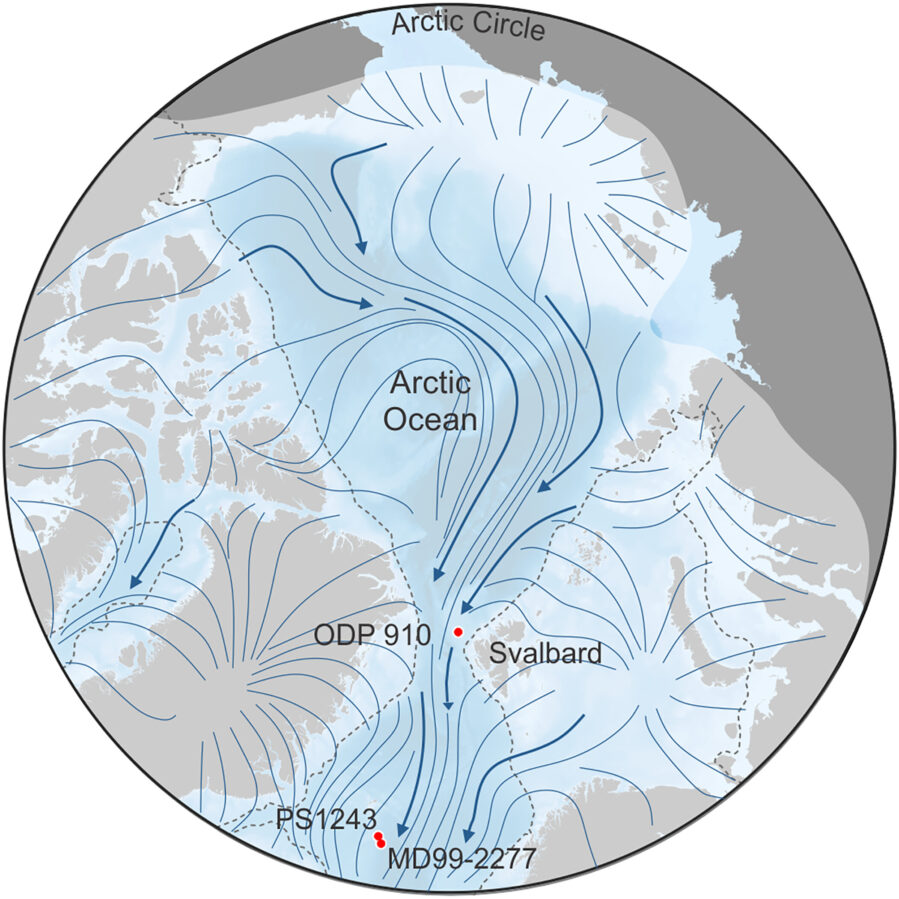
Scientists from Norway, the UK, and Germany analyzed 750,000 years of ancient seafloor sediments from two key Arctic locations. Their findings, published in Science Advances, contradict theories that a kilometer-thick ice shelf once blanketed the entire Arctic Ocean during extreme glacial periods.
Tiny Fossils Tell an Ancient Story
The research team studied microscopic chemical signatures left by algae in sediment cores from the seafloor north of Svalbard and in the central Nordic Seas. These algae act like ancient weather reporters—some species only grow in open water, while others thrive under seasonal sea ice that forms and melts each year.
“Our sediment cores show that marine life was active even during the coldest times,” said Jochen Knies, lead author from UiT The Arctic University of Norway. “That tells us there must have been light and open water at the surface. You wouldn’t see that if the entire Arctic was locked under a kilometre-thick slab of ice.”
One crucial clue came from a molecule called IP25, produced exclusively by algae living in seasonal sea ice. Its consistent presence throughout the sediment record indicates that sea ice came and went with the seasons rather than forming a permanent frozen barrier.
Computer Models Support the Evidence
The team used advanced climate modeling to test their geological findings. Computer simulations of two especially harsh periods—the Last Glacial Maximum 21,000 years ago and an even deeper freeze 140,000 years ago—confirmed what the sediments suggested.
“The models support what we found in the sediments,” Knies explained. “Even during these extreme glaciations, warm Atlantic water still flowed into the Arctic gateway. This helped keep some parts of the ocean from freezing over completely.”
The simulations revealed that ice wasn’t static during glacial periods. Instead, it shifted seasonally, creating openings where sunlight could penetrate and marine life could flourish.
Key Research Findings
- Continuous biological activity: Marine algae and plankton survived throughout all glacial periods studied
- Seasonal ice patterns: Sea ice formed and melted annually rather than persisting year-round
- Atlantic influence: Warm ocean currents continued flowing into Arctic waters during ice ages
- Limited ice shelf evidence: Only one brief period around 650,000 years ago showed potential ice shelf conditions
Rethinking Arctic Ice History
Some scientists have argued that massive underwater ridges and seafloor scars indicate a giant ice shelf once scraped across the Arctic Ocean floor. But this study offers an alternative explanation: these features likely came from enormous icebergs that broke off from ice sheets around the Arctic’s edges and drifted across the ocean.
These floating mountains of ice, with underwater portions extending more than 800 meters deep, could have gouged the seafloor while remaining mobile rather than forming a solid, continent-spanning ice shelf.
The research team did find evidence for one possible exception around 650,000 years ago, when biological activity dropped sharply. But even this event appears temporary rather than the long-lasting ice shelf some models predicted.
Climate Insights for Today’s World
Understanding how the Arctic behaved under extreme past conditions helps scientists predict its future as global temperatures rise. Co-author Gerrit Lohmann from the Alfred Wegener Institute noted that the study “helps us understand what’s possible—and what’s not—when it comes to ice cover and ocean dynamics.”
The findings suggest the Arctic Ocean maintained its fundamental circulation patterns even during the planet’s coldest periods. This resilience offers insights into how the region might respond to today’s rapid warming, though in reverse—transitioning from seasonal ice to increasingly ice-free conditions.
The research represents part of the European Research Council’s “Into the Blue” project, which aims to understand how polar oceans have changed over geological time. As Knies put it, “We need to know how the Arctic behaves under stress—and what tipping points to watch for—as the Arctic responds to a warming world.”