

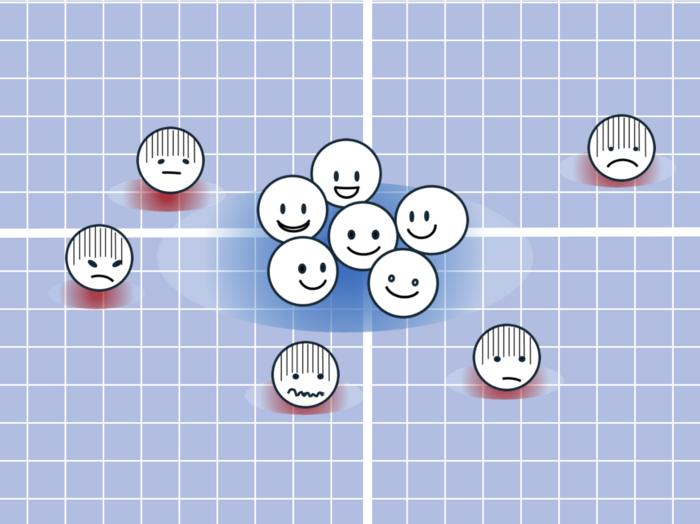
Using functional MRI (fMRI) to monitor 87 participants as they imagined a range of future events, psychologist Kuniaki Yanagisawa and colleagues found that neural activity in the medial prefrontal cortex—a region associated with self-referential and future-oriented thinking—was more convergent among those with high optimism scores.
In contrast, less optimistic individuals exhibited more idiosyncratic patterns of brain activity.
“What was most dramatic about this study is that the abstract notion of ‘thinking alike’ was literally made visible in the form of patterns of brain activity,” said Yanagisawa.
Inspired by the opening line of Tolstoy’s Anna Karenina, the team summarized their results: “Optimistic individuals are all alike, but each less optimistic individual imagines the future in their own way.”
In two fMRI experiments, participants were asked to vividly imagine episodic scenarios—some positive, some negative, some neutral—either involving themselves or their romantic partners. The researchers then used intersubject representational similarity analysis (IS-RSA) and multidimensional scaling (INDSCAL) to compare neural patterns across individuals.
Crucially, only pairs of optimistic individuals showed consistently similar neural representations in the medial prefrontal cortex, supporting the researchers’ “Anna Karenina model.” Pairs that included at least one pessimist exhibited more neural dissimilarity.
The study also revealed that optimists made a stronger mental distinction between positive and negative events. This separation wasn’t due to reinterpreting negative events positively, but rather to processing them in a more abstract and emotionally distant way. In contrast, positive scenarios were imagined more vividly and concretely.
Yanagisawa believes these shared cognitive structures may partly explain why optimists tend to be more socially connected. “The everyday feeling of ‘being on the same wavelength’ is not just a metaphor,” he said. “The brains of optimists may in a very physical sense share a common concept of the future.”
The researchers now aim to explore whether this shared neural convergence is innate or developed through experience and communication. They hope that understanding how these mental frameworks emerge may eventually help address loneliness and improve social connectedness.
Journal: Proceedings of the National Academy of Sciences
DOI: 10.1073/pnas.2511101122