

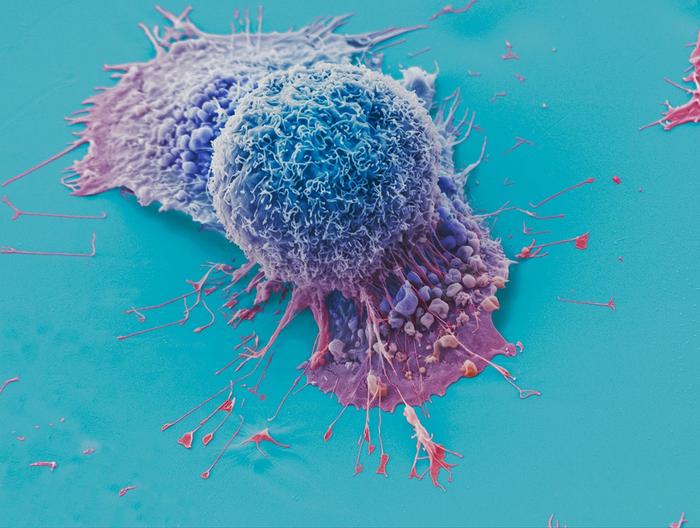
What if we could simulate cancer like we simulate storms?
Researchers at the University of Maryland School of Medicine (UMSOM) have developed new software that does just that—predicting how cancer cells grow, spread, and interact by merging real patient genomics data with mathematical modeling. The program uses a plain-English “grammar” to describe cell behavior, making it easier for scientists across disciplines to build virtual tissues and forecast disease progression. This could lay the groundwork for digital twins of cancer patients and entirely virtual clinical trials.
A Language for Simulating Life
The study, published July 25 in Cell, introduces a novel approach that translates biological processes into readable code using what researchers call a “hypothesis grammar.” Scientists can now write models of cancer using ordinary language statements that the software converts into cell behaviors. It’s a bit like scripting a simulation, but for living tissue.
“As much as this new ‘grammar’ enables communication between biology and code, it also enables communication between scientists from different disciplines to leverage this modeling paradigm in their research,” said Daniel Bergman, PhD, of UMSOM’s Institute for Genome Sciences (IGS), a co-leading author on the study.
From Snapshot to Simulation
Traditional genomic tools offer only a static snapshot of a cell. But cancer is a dynamic, evolving system. The new software models how cancer arises from complex cellular communication and how it may respond over time to treatment.
“Cancer is controlled or enabled by the immune system, which is highly individualized; this complexity makes it difficult to make predictions from human cancer data to a specific patient,” said Jeanette Johnson, PhD, co-first author and postdoctoral fellow at IGS. “This framework gives us a sandbox to freely investigate our hypotheses… without extra costs or risk to patients.”
What the Models Reveal
To test their system, the team combined their modeling language with spatial transcriptomics data from real human tissues. They simulated:
- Immune system failure to control breast tumor invasion
- Pancreatic cancer response to immunotherapy using untreated patient tissue samples
- Communication between fibroblasts and tumor cells in pancreatic tumors
Each digital patient in the simulation responded differently to treatment, underscoring how diverse and complex the tumor microenvironment can be. These “virtual patients” may one day help tailor treatment plans without having to test them on the actual patient first.
From Cancer to the Brain
To demonstrate the grammar’s broader value, researchers at Johns Hopkins used the software to model the development of brain layers in a neuroscience experiment. This flexibility suggests that the approach could be applied across many areas of biomedical research.
“We have a new framework for biological research since researchers can now create computerized simulations of their bench experiments and clinical trials,” said Mark T. Gladwin, MD, dean of UMSOM. “This has important applications to enable digital twins and virtual clinical trials in cancer and beyond.”
Powered by Collaboration and Open Source Tools
The open-source nature of the grammar and modeling system is key. “By making this tool accessible to the scientific community, we are providing a path forward to standardize such models and make them generally accepted,” said Dr. Bergman.
The work was a “tapestry of team science,” said senior author Elana J. Fertig, PhD, who once trained in weather prediction and now directs IGS. She sees parallels between forecasting weather systems and forecasting biological systems. “Adapting this approach to genomics technologies gives us a virtual cell laboratory in which we can conduct experiments… entirely in silico.”
The project received funding from the National Foundation for Cancer Research and multiple grants from the National Cancer Institute, among others.
Journal Reference
Journal: Cell
Publication Date: July 25, 2025
Title: Human interpretable grammar encodes multicellular systems biology models to democratize virtual cell laboratories