

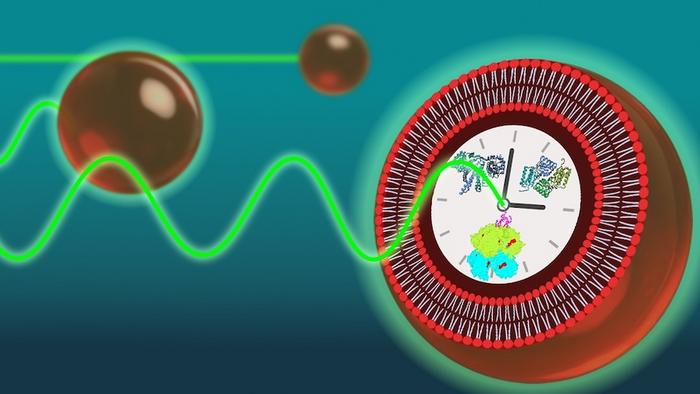
Tiny synthetic cells can keep time with surprising accuracy, according to new research from the University of California, Merced.
Using simplified, cell-like structures loaded with core clock proteins, scientists were able to mimic the natural circadian rhythms that govern everything from sleep cycles to metabolism. The study, published in Nature Communications, offers new insight into how biological clocks remain so reliable—even in microscopic environments prone to molecular noise.
How a Minimal System Recreated a 24-Hour Rhythm
The research team, led by bioengineer Anand Bala Subramaniam and biochemist Andy LiWang, engineered artificial cells known as vesicles to house the key proteins behind the cyanobacterial circadian clock: KaiA, KaiB, and KaiC. By tagging one of the proteins with a fluorescent marker, they were able to track oscillations in glowing intensity every 24 hours.
“This study shows that we can dissect and understand the core principles of biological timekeeping using simplified, synthetic systems,” Subramaniam said.
The glow lasted four days. But when either the protein concentration or vesicle size dropped below a threshold, the rhythm broke. The failure followed a predictable pattern, which suggested deeper rules at play.
Modeling Clock Fidelity Across Thousands of Tiny Cells
To explain what they saw, the team built a mathematical model that simulated clock behavior in thousands of vesicles with slightly different protein concentrations. The model revealed several key findings:
- High concentrations of clock proteins are essential for reliable oscillations
- Smaller vesicles are less likely to maintain rhythmic behavior
- Membrane binding by proteins like KaiB reduces the number of proteins available to run the clock
- A separate gene-switching loop helps synchronize the clocks across a population but is not needed for each cell’s rhythm
According to Subramaniam and LiWang’s results, natural cyanobacteria likely overcome internal noise by keeping clock protein levels high and by using auxiliary proteins like SasA and CikA to stabilize performance. Their simulation showed that without these helper proteins, only about 86 percent of simulated cells could keep accurate time. With them, that number rose to 99.6 percent.
What This Means for Biology—and Beyond
These findings go beyond bacteria. As Ohio State microbiologist Mingxu Fang noted, “This powerful tool enables direct testing of how and why organisms with different cell sizes may adopt distinct timing strategies.” The study’s combination of reconstituted biological parts and adjustable synthetic containers offers a general method for studying complex biological behaviors in controlled settings.
Interestingly, the team also showed how clocks lose synchronization over time unless the gene expression feedback loop is active—much like a conductor keeping an orchestra in time. This suggests why even genetically identical cells can lose rhythm if their molecular tuning is off.
Looking Ahead: Synthetic Timekeeping and Systems Biology
The UC Merced researchers hope that their approach can eventually be extended to build synthetic cells that not only keep time, but also control gene expression in a circadian fashion. That could open the door to more sophisticated bioengineered systems, or even new treatments for circadian-related disorders.
For now, the study underscores a simple truth: even the tiniest artificial cells can tick like clockwork, if you give them the right parts and enough room to move.
Journal: Nature Communications
DOI: 10.1038/s41467-025-61844-5