

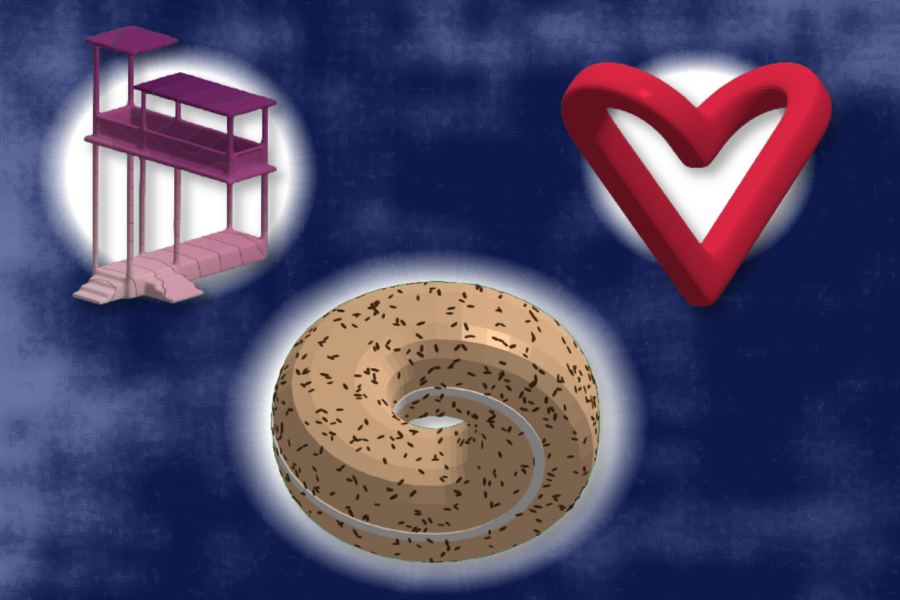
At MIT, researchers have built a new computer graphics tool that allows users to visualize, edit, and even simulate the physics of “impossible objects,” those brain-bending shapes that defy 3D space, like the Penrose triangle or Escher’s never-ending stairs.
The system, called Meschers, transforms drawings and models into 2.5D representations that preserve the illusion of impossibility while enabling real calculations. With this advance, artists can sculpt fantasy objects that seem to break the laws of physics, and scientists can study their geometry as if they were real.
Turning Perception Into Computation
Impossible objects often look believable in pieces, but fall apart as a whole. A Penrose triangle, for example, is built from three L-shaped corners that each look fine individually. But put together, they defy consistent depth perception. This tension between local plausibility and global contradiction is exactly what Meschers exploits.
Rather than embedding impossible shapes into full 3D, Meschers represents them in 2.5 dimensions. It uses image coordinates for position and relative depth values between edges—what a viewer would perceive from a fixed vantage point. This allows the tool to capture local consistency without enforcing global realism. The result: shapes that look impossible but can still be manipulated, shaded, and measured.
“Using Meschers, we’ve unlocked a new class of shapes for artists to work with on the computer,” said lead author Ana Dodik, a PhD student at MIT CSAIL. “They could also help perception scientists understand the point at which an object truly becomes impossible.”
What Meschers Can Do
Meschers isn’t just a visual gimmick. It opens up powerful geometry processing functions usually reserved for real 3D models. Here’s what it can handle:
- Rendering and relighting: Artists can change lighting to suit a mood—sunrise, sunset, or surreal neon—without breaking the illusion
- Subdivision and smoothing: Rough edges and blocky shapes can be refined into smooth, flowing surfaces
- Geodesic calculations: The tool can find the shortest path between two points on an impossible object, like how an ant might crawl across a twisted bagel
- Heat diffusion: Simulations of how heat might spread across an impossible surface, useful for physics experiments or creative animation
- Inverse rendering: It can even reverse-engineer 2D drawings into consistent 2.5D models
One demo included an “impossibagel”—a shaded torus with contradictory lighting. Using Meschers, researchers were able to compute distances and simulate how heat would flow over its surface. In another case, they relit a scene featuring a dog on a skateboard under different virtual lighting, all while maintaining the visual illusion.
Why 2.5D Works
Much of human vision is local. The brain assembles partial cues from edges, shading, and perspective into a full picture, often filling in the gaps with assumptions. Meschers mirrors this perceptual trick. It focuses on storing relative depth changes between neighboring parts of a mesh, while keeping overall coordinates in flat image space.
This approach draws from discrete exterior calculus (DEC), a framework for doing geometry without full 3D embedding. The mesh keeps track of screen position and per-edge depth shifts, enough to define shading and geometric flows without needing to resolve physical impossibilities. As long as local depth cues add up around small loops (like triangle faces), the object can support calculations—even if the larger structure can’t be globally reconciled.
“Meschers demonstrates how computer graphics tools don’t have to be constrained by the rules of physical reality,” said senior author Justin Solomon, who leads the Geometric Data Processing Group at CSAIL.
Beyond Escher
While Meschers grew out of artistic curiosity and perceptual science, it could soon power more practical applications. Vision researchers might use it to probe how humans process optical illusions. Game designers could build surreal, non-Euclidean levels without breaking their engines. Even path-planning in robotics might borrow tricks from navigating visually inconsistent terrain.
The researchers are now developing an interface to make the tool easier to use, and collaborating with perception scientists to expand its impact. They also note that Meschers generalizes prior methods: it avoids the pitfalls of “cut” models that destroy geometry at seams, and “bent” models that distort faces to force compatibility.
Ultimately, Meschers lets us explore what lies beyond physical realism—a space where perception trumps possibility, and the impossible becomes interactive.
Publication Details
“Meschers: Geometry Processing of Impossible Objects”
Ana Dodik, Isabella Yu, Kartik Chandra, Jonathan Ragan-Kelley, Joshua Tenenbaum, Vincent Sitzmann, Justin Solomon
ACM Transactions on Graphics, Volume 44, Issue 4, August 2025
DOI: 10.1145/3731422
