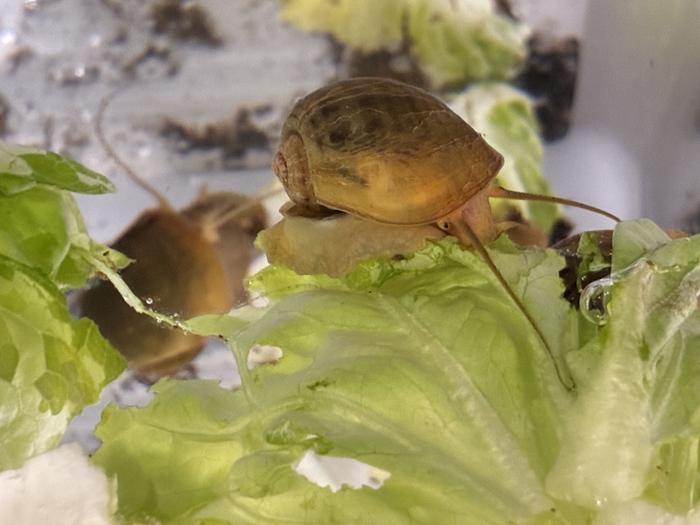
Imagine losing an eye … and growing it back, complete with retina, lens, and optic nerve.
While this may sound like science fiction, it’s routine for the golden apple snail. In a new study published August 6 in Nature Communications, researchers show that this South American freshwater snail can fully regenerate complex, camera-type eyes that share striking anatomical and genetic similarities with those in humans. By turning the apple snail into a lab-ready genetic model, scientists now have a new system to explore how full eye regeneration might one day be possible for people.
A Snail with Human-Like Eyes
The golden apple snail (Pomacea canaliculata) doesn’t just have any old eyes—it has camera-type eyes with a cornea, lens, and retina, much like ours. “Apple snails are an extraordinary organism,” said Alice Accorsi, assistant professor of molecular and cellular biology at UC Davis and lead author of the study. “They provide a unique opportunity to study regeneration of complex sensory organs.”
Using microscopy, dissection, and gene analysis, the researchers confirmed that the snail’s eyes aren’t just similar in structure—they’re also built using many of the same genes found in vertebrate eye development.
Regrowth in Four Stages
After surgically removing the snail’s eye, the team tracked its regeneration through four key phases over 28 days:
- Day 1: Wound closure and healing
- Days 3–6: Formation of a blastema, a mass of undifferentiated cells
- Days 9–15: Development of eye structures including retina and lens
- Days 21–28: Maturation of all components, including the optic nerve
By the end of the month, the new eye looks nearly identical to the original. Though behavioral tests are still in development, the anatomy suggests that regenerated eyes may be capable of vision.
The Gene Behind the Eye
To understand what controls this regenerative process, the team turned to CRISPR-Cas9 gene editing. They focused on pax6, a gene known to orchestrate eye development in animals ranging from fruit flies to humans. When both copies of pax6 were knocked out in snail embryos, the snails developed without eyes, confirming that the gene is essential for eye formation.
“We showed for the first time that apple snails not only have pax6 but also that this gene is critical for their eyes to develop,” said Accorsi. Her team is now testing whether pax6 also controls the ability to regrow eyes in adults.
A New Model for Sight Restoration
Apple snails may not look like much, but they’re fast breeders and easy to raise in the lab. These traits, plus their ability to regenerate a complex sensory organ, make them a powerful new model for studying regeneration. The research also marks one of the first times stable CRISPR mutant lines have been created in mollusks.
“We now have a tractable system for investigating which genes are responsible for camera-type eye regeneration,” said Alejandro Sánchez Alvarado, senior author and president of the Stowers Institute for Medical Research.
Could This Lead to Human Therapies?
It’s still a long road from snail biology to human eye regeneration, but the work is laying the foundation. Thousands of genes change activity during the regeneration process. Some of those genes, including pax6, are shared with vertebrates. If scientists can identify which genes control regrowth and activate them in human cells, it may one day be possible to repair or regenerate damaged eye tissue in people with macular degeneration or traumatic injuries.
“With a little bit of effort, a little bit of ingenuity, and a great deal of persistence, biology that seemed inaccessible is no longer a pipe dream,” said Sánchez Alvarado. “Our work with the apple snails is proof positive.”
Journal and Funding Information
Journal: Nature Communications
DOI: 10.1038/s41467-025-61681-6
Authors: Alice Accorsi et al.
Funding: Howard Hughes Medical Institute, Society for Developmental Biology, American Association for Anatomy, Stowers Institute for Medical Research