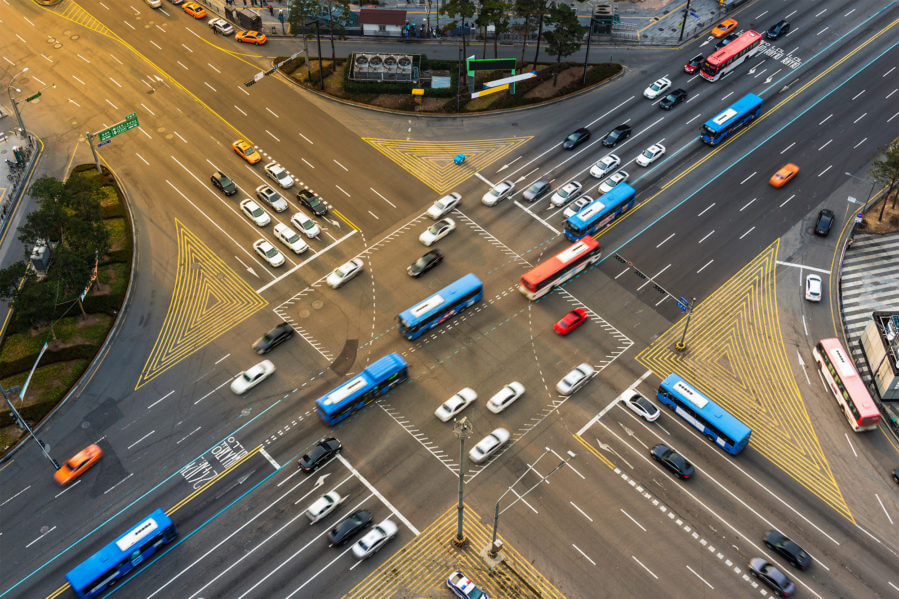
A new study suggests that programming semi-autonomous vehicles to smooth their driving near traffic lights could cut carbon emissions from city intersections by as much as 22 percent.
Using one of the largest traffic simulations ever attempted, researchers modeled one million scenarios across 6,011 intersections in Atlanta, Los Angeles, and San Francisco. They found that even modest adoption of this so-called dynamic eco-driving—optimizing speed and acceleration to avoid unnecessary stops—can deliver a large share of the benefits without slowing traffic or compromising safety.
Reinforcing the Case for Intersection-Level Emissions Cuts
Transportation is among the hardest sectors to decarbonize, and intersections are a hidden hotspot for wasted fuel. Unnecessary idling and rapid acceleration at signalized crossings may account for up to 14.6 percent of U.S. land transport emissions, comparable to half of airline sector emissions. The study’s authors saw a chance to tackle this by using vehicle-to-infrastructure communication and reinforcement learning to time vehicle approaches more efficiently.
The results show that:
- Eco-driving reduced intersection carbon emissions by 11–22 percent across the three cities.
- Just 10 percent adoption captured 25–50 percent of the maximum possible benefits.
- About 70 percent of the gains came from only 20 percent of intersections.
- Throughput was maintained or improved, and safety metrics matched human-driven traffic.
Pinpointing Where Eco-Driving Works Best
Not all intersections are equal. High-benefit sites tend to have longer approaches, higher speed limits, and moderate traffic inflows, creating room for speed adjustments that avoid red-light stops. Yet the list of top-performing intersections changes as adoption grows, meaning that early infrastructure investments in roadside units for communication may need reevaluation over time.
This finding complicates planning. The researchers emphasize that a strategic, phased rollout—targeting intersections with the biggest immediate gains—could yield substantial early returns while keeping costs down.
How the Study Was Done
The team used an agent-based traffic simulator, realistic intersection layouts, and a multi-task deep reinforcement learning approach. Rather than model every possible variation, they worked with a curated set of representative scenarios reflecting 33 key factors, from road grade and lane length to weather and vehicle type. Eco-driving strategies were optimized for each intersection, then tested under “zero-shot” transfer to other scenarios.
Safety was evaluated using measures like time to collision and deceleration rate, and results suggested that smoother acceleration profiles did not introduce new hazards. In fact, the behavior could feel counterintuitive to some human drivers—something the authors say warrants further human factors research.
Working Alongside Electrification
Even as electric and hybrid vehicles become more common, eco-driving remains relevant because the grid is not yet carbon-free. When the researchers factored in projected EV and hybrid adoption through 2050, eco-driving still added meaningful emission reductions on top of these other decarbonization strategies.
Implications for Climate Policy
The authors argue that intersection-level eco-driving is a near-term, high-impact climate solution that could be deployed before full vehicle electrification. Its benefits extend across seasons and weather conditions, and it could work in tandem with broader transportation reforms. But success will require careful selection of deployment sites, ongoing adjustment as adoption rises, and alignment with other city planning priorities.
Journal reference: Transportation Research Part C: Emerging Technologies (2025), DOI: 10.1016/j.trc.2025.105146