

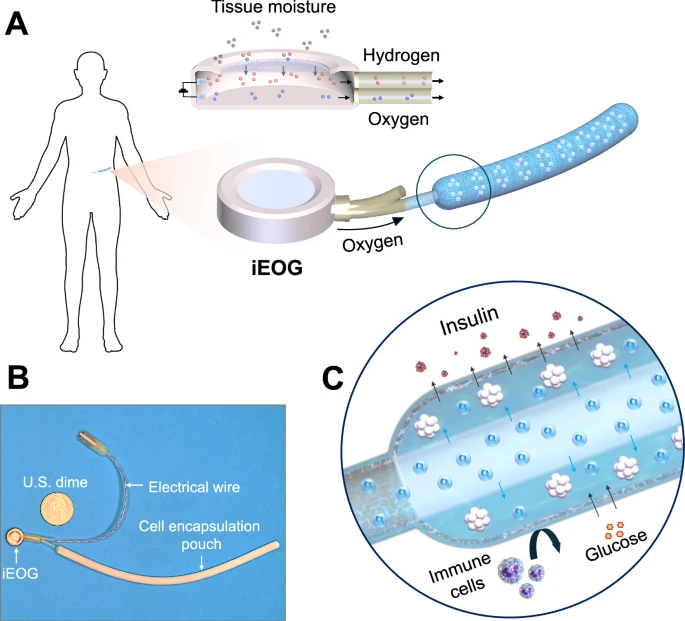
In a major step toward a functional cure for Type 1 diabetes, Cornell University researchers have built a small implant that keeps transplanted insulin-producing cells alive by feeding them oxygen. The device, described Aug. 11 in Nature Communications, could control blood sugar without the immune-suppressing drugs that make current cell therapies risky.
By combining immune shielding with a miniature electrochemical oxygen generator, the system maintained dense clusters of insulin-secreting cells in animal models for months, offering new hope for the 2 million Americans living with the disease.
Overcoming the Oxygen Problem in Cell Therapy
Type 1 diabetes occurs when the immune system destroys pancreatic islet cells, cutting off the body’s insulin supply. Replacing those cells has long been a goal, but transplants typically require lifelong immunosuppression and often fail when the cells suffocate inside protective capsules.
“One of the major challenges is the implant itself often dies due to the lack of oxygen after implantation,” said co-first author Lora (Phuong) Tran. The problem becomes even more severe when scaling up to the higher cell doses needed for human therapy.
The Cornell team’s solution, developed with Giner Inc., places the transplanted cells in a ring-shaped capsule shielded from the immune system, with a dime-sized oxygen generator at its core. The generator splits water molecules from surrounding tissue into hydrogen and oxygen, sending the oxygen directly to the cells through a permeable membrane.
Proof of Concept in Animals
In tests with diabetic rats, implants connected to the oxygen generator restored normal blood sugar within three days. All animals with oxygenated devices stayed in the healthy range for up to 88 days, while those without oxygen support remained hyperglycemic.
“It’s the proof of concept. We really proved that oxygenation is important, and oxygenation will support high cell-density capsules,” said Linda Tempelman, co-author and CEO of Persista Bio Inc.
Lab experiments also showed that under low-oxygen conditions, both rat insulinoma cells and human pancreatic islets stayed alive and functional for days when oxygenated, but quickly died without it.
Key Advantages of the New System
- Immune protection without immunosuppressive drugs
- Continuous, controllable oxygen supply for densely packed cells
- Compact, scalable design for minimally invasive implantation
- Potential adaptability to other chronic diseases requiring cell therapy
Beyond Diabetes
The researchers envision using the technology for other conditions where the body lacks a key molecule, from endorphins for pain to enzymes for rare metabolic disorders. “We see an age where people will be getting implants with allogeneic cells from other human beings, from stem cell lines, and using it long term to treat things that your body is missing,” Tempelman said.
Next Steps
The team plans to test the device in pigs and with human stem cell–derived islets. A fully implantable human version would include a rechargeable power supply, charged wirelessly through the skin, and mechanisms to safely dissipate the hydrogen produced alongside the oxygen.
If successful, this approach could allow people with Type 1 diabetes to eat, exercise, and live without insulin injections or pumps, something no treatment has yet achieved.
Journal: Nature Communications
DOI: 10.1038/s41467-025-62271-2
