

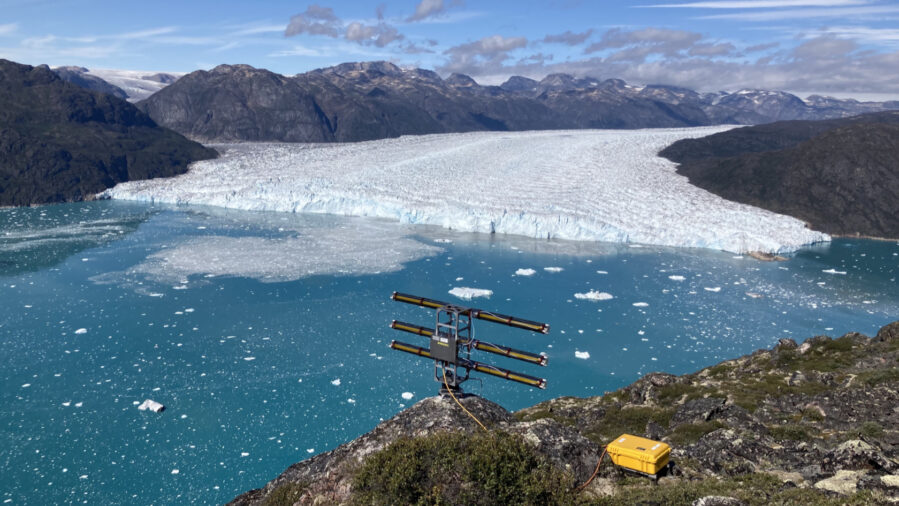
When chunks of glacier ice in Greenland crash into the sea, they do more than make noise. They kick off huge underwater waves that keep the fjord churning, hauling warm water up against the ice wall and speeding the melt.
A new Nature study from the University of Zurich and the University of Washington shows the chain reaction in sharp detail. The team stretched a ten kilometer fiber optic cable along the seafloor in South Greenland and listened as icebergs fell and drifted. Long after the splash faded, the cable picked up steady mixing that helps explain why these glaciers are retreating, and what that means for sea level and ocean circulation.
Why this matters now
Greenland’s ocean facing glaciers are pulling back fast. Warm Atlantic water sneaks into the fjords at depth and undercuts the ice. That much was known. What was missing was the stir. The study ties calving to slow, deep waves that travel between layers of water. Those waves keep warm water moving toward the ice face, while cold meltwater sinks. Think of stirring a drink so the ice melts quicker. Here, the fjord does the stirring for hours after a big splash.
How they caught the hidden waves
At Eqalorutsit Kangilliit Sermiat in South Greenland, the team laid a fiber optic cable on the fjord floor a few hundred meters from a three kilometer wide ice front. Using distributed acoustic sensing, they tracked tiny strains in the cable caused by waves, drifting ice, crevasse cracks, and temperature shifts. Over three weeks, they recorded the whole show, from surface tsunamis right after calving to the deep, unseen internal waves that rolled on long after. Satellites cannot see under the water. The fiber could. For background on the setup, see the UW Fiber Lab project page.
What the fjord revealed
Each big calving event sent surface waves racing down the fjord. Then came the quiet work. Internal waves, sometimes as tall as buildings, kept the water column mixing. Warm, salty water rose and met the ice. The ice melted faster. Icebergs on the move added more internal waves. Some of those bergs were the size of a football stadium and moved at 15 to 20 miles per hour. More mixing, more melt, more calving. A simple loop, but a powerful one.
Key numbers and context
- The glacier studied dumps about 3.6 cubic kilometers of ice into the sea each year, close to three times the volume of Switzerland’s Rhône Glacier at the Furka Pass.
- Warm subsurface water has been linked to retreat of many Greenland glaciers since the late 1990s, through undercutting and loss of support at depth.
- Greenland’s ice sheet holds enough water to raise sea level by several meters, so small shifts in melt rates matter for coasts worldwide.
- Fiber sensing offers a safer, continuous way to measure underwater processes that satellites and shore based tools miss.
- For a clear primer on Greenland’s glacier recession, visit AntarcticGlaciers.org.
In their words
“We took the fiber to a glacier, and we measured this crazy calving multiplier effect that we never could have seen with simpler technology.” — Brad Lipovsky, a University of Washington assistant professor in Earth and space sciences.
Method and publication details
The team placed the cable along deep sections of the fjord floor, near 300 meters, and used shore based gear to read acoustic and temperature signals for 21 days. The record captured rapid surface action and the slower, sustained internal waves that do most of the mixing. The paper, Calving driven fjord dynamics resolved by seafloor fibre sensing, was published on August 13, 2025 in Nature. You can also read summaries from the University of Zurich and the University of Washington.
What comes next
What will another decade of warming bring, if calving keeps stirring warm water toward the ice? The team plans to repeat these measurements in other fjords and seasons, and fold the results into models. Better process data should sharpen forecasts, improve coastal planning, and support safety in fjords where ships and small communities share water with falling ice. Small changes under the surface can tip big ice cliffs toward failure. Now we can hear those changes, in real time.