
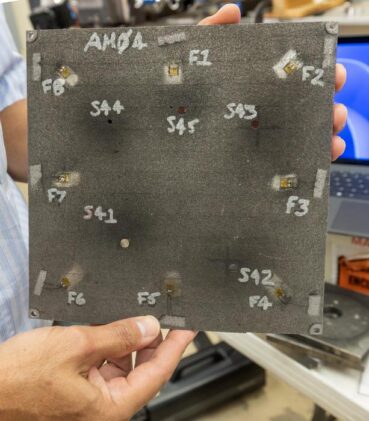
In a San Antonio lab, tiny bullets fly like shrapnel from a silent war in orbit. Using a light gas gun, Southwest Research Institute (SwRI) researchers simulate hypervelocity debris strikes to test a new micrometeoroid and orbital debris (MMOD) detection system.
The results, published in the Proceedings of the 17th Hypervelocity Impact Symposium, reveal how spacecraft could soon detect and record even the smallest collisions in real time. What if satellites could serve as both survivors and sentinels in Earth’s growing debris battlefield?
A Growing Orbital Threat
Earth’s orbit is filling with wreckage from old satellites, rocket stages, and anti-satellite missile tests. According to the European Space Agency, more than 36,000 fragments larger than 10 cm are tracked, but millions of smaller pieces remain invisible. Even a paint fleck can pierce a spacecraft wall when moving at 25,000 kilometers per hour.
In 2009, the Iridium 33 and Cosmos 2251 satellites collided, generating over 2,000 new trackable debris pieces. Such incidents underscore why debris awareness and characterization tools are vital for protecting current and future missions.
Inside the SwRI Impact Sensor
The SwRI MMOD system is built around a deceptively simple idea: two aluminum plates separated by a few millimeters, each embedded with strain gauges. When struck, the plates vibrate with distinctive strain waves that reveal the impact’s properties. From these signals, researchers can calculate:
- Impact location with about 3% error
- Velocity estimates within 5–23% accuracy
- Size and density of particles as small as 0.1 mm
As the authors explain, the goal is to “help in identifying the location, size, impact velocity, impact angle, and nature of an impact by recording and analyzing the strain waves generated during the penetration process”:contentReference[oaicite:0]{index=0}.
Simulating the Dangers of Orbit
SwRI fired aluminum and steel spheres at test panels using its two-stage light gas gun, reaching speeds up to 6 km/s. Sensors recorded the resulting strain waves, while CTH computer simulations replicated each impact. Together, the tests and models showed how spacecraft can detect both direct hits and oblique strikes, while distinguishing noise from real damage.
“Most spacecraft survive minor impacts without systems breaking or operators on Earth knowing. Our device is designed to send data back to Earth with important insights before any damage is apparent.” — Dr. Sidney Chocron, SwRI
Toward a Debris Map of Earth
If widely deployed, satellites equipped with this system could serve as distributed observatories, building a dynamic map of the micrometeoroid and orbital debris environment. Unlike ground-based tracking, this method can capture sub-centimeter fragments, the most common but least visible hazard. Over time, such data could guide spacecraft design and even allow real-time alerts to other satellites in nearby orbits.
Next Steps
With full-scale validation complete, SwRI is seeking support to develop a flight-ready version of the MMOD system. The vision is not only to harden spacecraft against orbital shrapnel but also to transform them into frontline scouts. Just as weather satellites monitor storms on Earth, tomorrow’s spacecraft may monitor the storms of debris that threaten their survival in orbit.
Journal: Proceedings of the 17th Hypervelocity Impact Symposium (HVIS2024). DOI: 10.1115/HVIS2024-011
ScienceBlog.com has no paywalls, no sponsored content, and no agenda beyond getting the science right. Every story here is written to inform, not to impress an advertiser or push a point of view.
Good science journalism takes time — reading the papers, checking the claims, finding researchers who can put findings in context. We do that work because we think it matters.
If you find this site useful, consider supporting it with a donation. Even a few dollars a month helps keep the coverage independent and free for everyone.