

The universe’s ghost particles may finally make sense. A new study using the Dark Energy Spectroscopic Instrument (DESI) shows that treating black holes as bubbles of dark energy helps reconcile cosmological data with the measured masses of neutrinos. The work, published in Physical Review Letters by an international collaboration led from the University of Michigan, suggests that matter converted into dark energy through stellar collapse aligns cosmology with ground-based neutrino experiments. This cosmologically coupled black hole (CCBH) model not only recovers positive neutrino masses but also reduces tension in other longstanding puzzles, including the Hubble constant.
From Mysterious Expansion to a New Hypothesis
Dark energy has long been thought to be constant, a uniform background driving the universe’s accelerating expansion. But mounting evidence from DESI’s three-year galaxy survey shows that its density evolves over time. That shift led physicists Kevin Croker (Arizona State University) and Duncan Farrah (University of Hawaii) to propose that black holes may act as reservoirs of dark energy. When stars die and collapse, part of their mass could convert into energized vacuum rather than classical singularities.
The idea was radical but testable. When researchers compared DESI’s detailed maps of galaxy clustering with this CCBH framework, they found the model not only fit the data but also solved a glaring problem: neutrino mass estimates that had previously appeared negative or inconsistent with laboratory results.
“This paper is fitting the data to a particular physical model for the first time and it works well,” said Gregory Tarlé, University of Michigan physicist and DESI collaboration member.
Making Neutrinos Physical Again
Neutrinos are elusive particles that pass through matter nearly undetected. Oscillation experiments on Earth show they have mass, but cosmological surveys often yield results that imply zero or even negative mass. By including matter-to-dark-energy conversion, the CCBH model naturally reduces the baryon count over time, freeing space in the universe’s matter budget for neutrinos to take on realistic positive values.
Rogier Windhorst, Regents’ Professor at Arizona State University and co-author, explained that under ΛCDM, “the data would suggest that the neutrino mass is negative and that, of course, is likely unphysical.” With CCBH, the tension disappears, yielding summed neutrino masses around 0.05–0.10 electronvolts, consistent with experimental lower bounds.
Additional Payoffs of the CCBH Model
The CCBH interpretation brings several benefits beyond neutrino physics:
- It links cosmic acceleration to stellar evolution, since dark energy production tracks the star formation rate.
- It raises the present-day Hubble rate, reducing the gap between cosmological and supernova-based measurements.
- It provides a natural explanation for the observed quantity of dark energy: none before stars, then growth alongside star production.
Gustavo Niz of the University of Guanajuato noted that while promising, “it will take more data, rigorous analysis and broader scrutiny to determine whether it can become a new paradigm for explaining our universe.”
Key Findings
- Sample size: DESI Data Release 2, including over 14 million galaxy and quasar spectra.
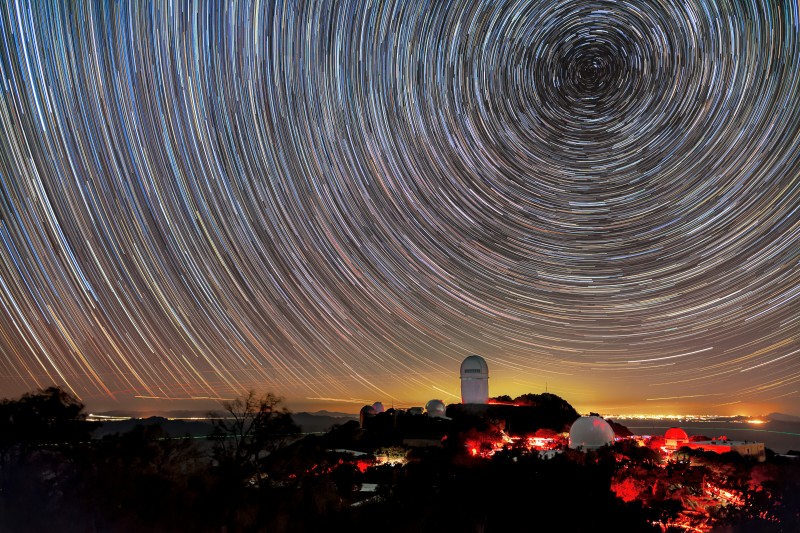
- Duration: Three years of observations from the Mayall Telescope at Kitt Peak National Observatory, Arizona.
- Model: Cosmologically coupled black holes (CCBH), where collapsing stars convert matter into dark energy.
- Neutrino mass: Positive summed masses, ∑mν = 0.106+0.050−0.069 eV (Madau SFRD) and ∑mν < 0.149 eV (Trinca SFRD) at 95% confidence.
- Location: DESI collaboration led by Lawrence Berkeley National Laboratory, with key contributions from University of Michigan, Arizona State University, and University of Hawaii.
- Safety: Observational and theoretical study, no human or environmental risks.
Takeaway
The DESI survey combined with a bold new interpretation of black holes as dark energy bubbles resolves a critical inconsistency in cosmology: neutrino masses that had seemed unphysical now align with laboratory results. The findings also ease the Hubble tension and offer a framework where cosmic acceleration is tied to stellar history. Whether CCBH will become a new paradigm depends on future data and scrutiny, but for now it offers a strikingly coherent picture.
Journal: Physical Review Letters
DOI: https://doi.org/10.1103/yb2k-kn7h
