
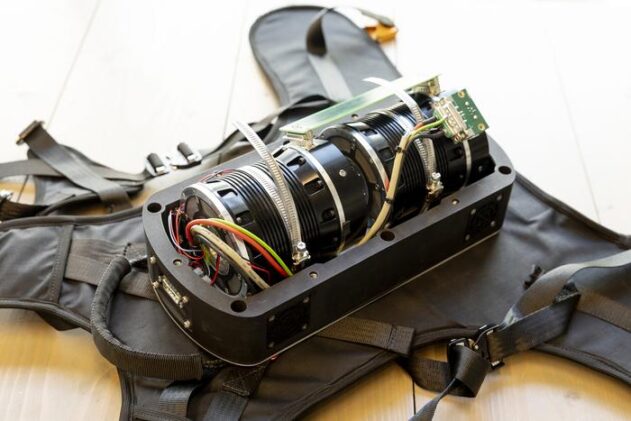
It looks like science fiction, but it is real. A backpack built with aerospace gyroscopes can help patients with ataxia stand and walk more steadily, according to new research from Radboud University Medical Center, Delft University of Technology, and Erasmus MC.
The device, called the Gyropack, reduced trunk wobbling and improved straight-line walking in a sham-controlled trial of 14 people living with degenerative ataxia. The study, published in Nature npj Robotics, offers early evidence that wearable robotics might replace or supplement walkers in daily life.
A Disorder of Balance
Ataxia is caused by cerebellar dysfunction. Patients struggle with coordination, stagger when they walk, and are at constant risk of falls. Mobility aids like walkers are common, but they are bulky and stigmatizing, especially for younger patients. “Some people with ataxia, often young individuals, depend on a walker. These devices can be heavy and cumbersome, and many patients find them stigmatizing,” said study lead Dr. Jorik Nonnekes, a rehabilitation specialist at Radboudumc.
Borrowed From Space Stations
The Gyropack contains spinning wheels that resist torso rotation, stabilizing posture in the same way satellites use gyros to orient in orbit. Developed in Heike Vallery’s group at TU Delft, the device weighs about six kilograms. Even that weight alone helped some patients hold steadier, but the active gyros produced the strongest effects. “Patients were visibly more stable and could, for example, walk in a straight line much more effectively,” Nonnekes explained.
“Patients were visibly more stable and could, for example, walk in a straight line much more effectively,” said Jorik Nonnekes of Radboudumc.
Testing the Gyropack
Fourteen individuals with moderate to advanced ataxia participated in a cross-over experiment. They performed five tasks, including standing still, treadmill walking, and turning, under three conditions: no device, sham backpack, and fully active gyroscopic support. Researchers used motion capture to measure trunk angular velocity, center of mass shifts, and stance times. The results were telling:
- Standing time increased from 16 to 19 seconds with active support.
- Trunk angular velocity variability dropped from 5.37 to 4.54 units with active gyros (p = 0.001).
- Extrapolated center of mass sway decreased significantly compared to baseline.
- No major improvements were seen in perturbation recovery or turning tasks.
Even the sham condition gave some benefits, likely from the added torso weight. The authors note that “torso weighting” has been shown before to reduce sway in balance disorders, raising the possibility of a placebo or weight effect alongside the true gyro assistance.
Limits and Next Steps
The backpack is not yet ready for everyday use. Noise levels reached 86 decibels during trials, and the six-kilogram load is still too heavy for long-term wear. “It’s not yet suitable for daily use, but in the future, it could help people with ataxia participate more freely in daily life,” Nonnekes said. Making the device lighter and quieter is now a design priority.
“It’s not yet suitable for daily use, but in the future, it could help people with ataxia participate more freely in daily life,” said Jorik Nonnekes.
Key Findings
- Study of 14 patients with degenerative ataxia tested a gyroscopic backpack for balance support.
- Active gyros reduced trunk wobble and improved straight walking compared to baseline and sham.
- Device remains noisy (86 dB) and heavy (6 kg), limiting daily usability.
Takeaway
A gyroscopic backpack adapted from aerospace technology improved gait stability in people with degenerative ataxia. While bulky and noisy today, it points toward a new class of robotic wearables that could eventually let patients walk without walkers and reclaim more independence.
Journal: Nature npj Robotics
DOI: 10.1038/s44182-025-00041-4
ScienceBlog.com has no paywalls, no sponsored content, and no agenda beyond getting the science right. Every story here is written to inform, not to impress an advertiser or push a point of view.
Good science journalism takes time — reading the papers, checking the claims, finding researchers who can put findings in context. We do that work because we think it matters.
If you find this site useful, consider supporting it with a donation. Even a few dollars a month helps keep the coverage independent and free for everyone.