

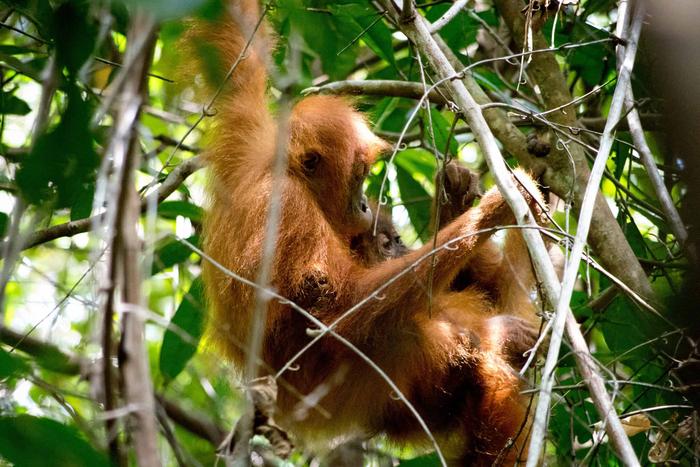
Orangutans learn by watching. That’s the simple, almost tender finding from a 17-year study of wild Sumatran orangutans, showing that young apes master the complex craft of nest building by closely observing their mothers and other role models before practicing it themselves. The research, led by University of Warwick primatologists in collaboration with the Max Planck Institute, appears in Communications Biology and underscores how survival-critical skills in great apes depend on observational social learning.
Peering In The Canopy
Every night, orangutans climb high into the canopy to weave elaborate nests, sleeping platforms that keep them safe, warm, and even help fend off mosquitoes. These are not crude piles of branches. Night nests often include roofs, lining, pillows made from Y-shaped twigs, and leafy blankets. Building one takes judgment, dexterity, and years of practice. And as this study shows, years of watching too.
“Nest-building is critical to survival in orangutans but is surprisingly not the focus of a lot of research,” said Ani Permana of Warwick, lead author.
Researchers documented 44 orangutans at the Suaq Balimbing monitoring station in Sumatra, recording nest-building behavior, practice sessions, and instances of “peering,” attentive watching of another’s construction work. The data, spanning 17 years, revealed that youngsters who actively peered were far more likely to practice afterwards. Merely sitting nearby didn’t cut it. It was the watching that mattered.
Know-How And Know-What
The team distinguishes between “know-how” (the sequence of actions required to weave a strong frame or add comfort elements) and “know-what” (which tree species provide the right wood and leaves). Both forms of knowledge, they argue, are transmitted socially. Infants largely copy their mothers, selecting the same tree species she does. As they grow more independent, adolescents widen their gaze to other orangutans, diversifying their skills. But in adulthood, many circle back to their mothers’ preferences, suggesting an enduring cultural baseline.
In practice, that means an orangutan raised by a mother who favors certain trees often carries that tradition into her own adult nesting. It’s culture in the canopy, fragile and passed hand to hand, or rather, branch to branch.
Watching The Tricky Parts
Not all peering is equal. The data showed juveniles pay closest attention when nests involve multi-step construction: night nests, multitree nests spanning different trunks, or the addition of pillows and blankets. These moments prompted the most staring, and then the most practicing. The implication is clear: orangutans know which parts are tricky, and they watch accordingly.
“Just like human teenagers finding their own path, maturing orangutans increasingly peer at the nest-building of others and begin experimenting with the tree species those individuals use,” said senior author Caroline Schuppli of the Max Planck Institute of Animal Behavior.
Schuppli and colleagues argue this is more than individual trial and error. It’s a form of social transmission with cultural weight, akin to how chimpanzees learn termite fishing or humans learn carpentry. The difference is that orangutan nests are built anew each night, a constant cycle of skill in action.
Why It Matters
Why should we care about ape beds? Because nests are essential to survival. A poorly built one can collapse, exposing an ape to predators or cold. And since orangutans are critically endangered, with shrinking habitat and fragmented populations, any behavior that is socially transmitted, any culture, can vanish if the local community does. Conservation here isn’t just about preserving animals, but preserving traditions that have been in the forest canopy for millions of years.
The repetition matters. Orangutans watch. Orangutans practice. Orangutans remember. Without the next generation, the knowledge goes silent in the trees.
Communications Biology, DOI: 10.1038/s42003-025-08217-2
Kicker
In the end, these great apes remind us that even the simple act of making a bed can be cultural, can be taught, can be lost. The forest holds its own schools. The students just happen to be orange and arboreal.