

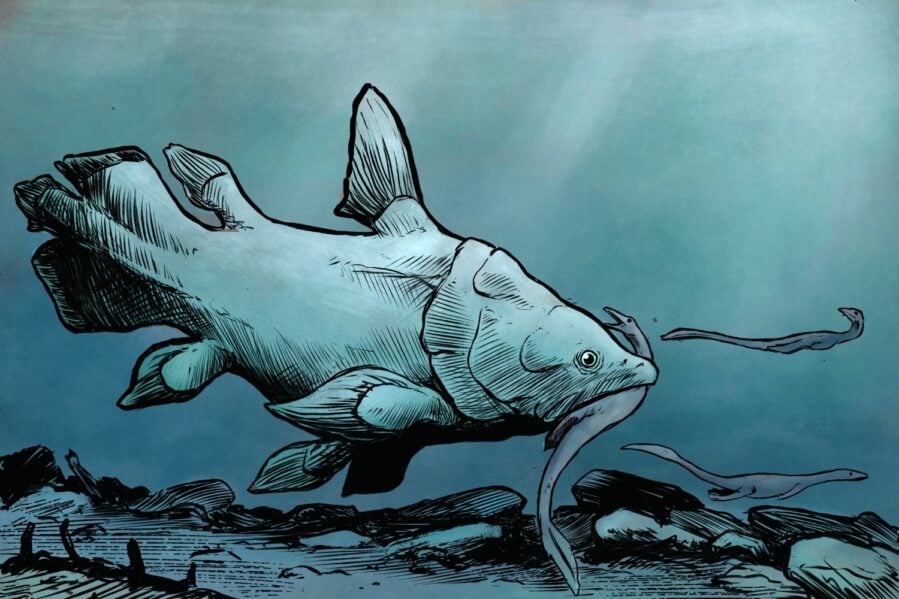
The collar bone was the giveaway. A thick, twisted sliver of armor, more Mawsonia than mystery reptile.
In new work from the University of Bristol, researchers combed through British Rhaetian bonebeds and museum drawers to reveal an overlooked cast of coelacanths in the latest Triassic. The team reidentified dozens of isolated bones that had long been filed under reptiles like Pachystropheus or left as indeterminate fragments. It turns out those drawers were humming with lobe-finned fish. And not small ones.
The paper, published September 7 in the Journal of Vertebrate Paleontology, documents at least 50 coelacanth elements from the Westbury Formation and nearby fissure deposits. Many belong to Mawsoniidae, a clade better known from brackish, nearshore settings. A single right clavicle, 142 millimeters long, matches the outline and helical twist of Mawsonia gigas. Body length estimates for comparable material hover around 1.4 to 1.5 meters. Not a guppy.
“Coelacanth fishes are well represented in the fossil record, ranging in age from the Early Devonian to the present day, though now represented by only two species of the genus Latimeria.”
Why were so many bones mislabeled for so long? Blame the Triassic habit of breaking things. The British Rhaetian preserves fragments churned by storms on a shallow continental shelf. Coelacanth skulls were weakly sutured, their cartilage caps often gone by the time the mud turned to rock. Put that next to fragmentary marine reptiles and you get case files that, frankly, fooled smart people for a century.
The researchers used CT scans to trace nerve canals in a basisphenoid, documented multiple morphotypes in jaw and skull roof bones, and matched distinctive ornament on opercular plates. One basisphenoid shows a narrow U-shaped pituitary notch and paired sphenoid condyles, classic Mawsoniid traits. Another basisphenoid fits Latimeriid proportions. The mix hints at a more complex fish community than the drawers suggested. Shallow water again, but not simple.
“We highlight taxonomic misidentifications to show that coelacanth specimens from the British Rhaetian have been confused as far back as the late 1800s.”
Ecologically, the pieces line up with a Bristol Archipelago of variable shorelines, anoxic muds, and pulses of organic matter. Mawsoniids favor nearshore and brackish water. Latimeriids skew deeper. The Westbury Formation toggles between both, which might explain why their bones sleep side by side. The authors also report frequent co-occurrence with Pachystropheus at Westbury Garden Cliff. Maybe the coelacanths hunted small reptiles. Maybe they just shared a buffet of benthic invertebrates. Either way, shallow water is the refrain.
There is a pragmatic angle here. Reexamining historical collections is cheaper than new digs and often faster. Drawer audits do not require bulldozers, just time, access, and someone willing to squint at a rugose surface and say, that is not a reptile. Museums everywhere take note. The opportunity cost of misfiled bones is real, both for science and for the stories we can tell with them.
The real surprise came when the clavicle from Britain mirrored the giant from South America. Geography drifted, ecosystems shifted, yet the shoulder girdle kept its language. Stable form across unstable worlds. That is a coelacanth kind of poetry, and it lives in the details.
Journal: Journal of Vertebrate Paleontology