

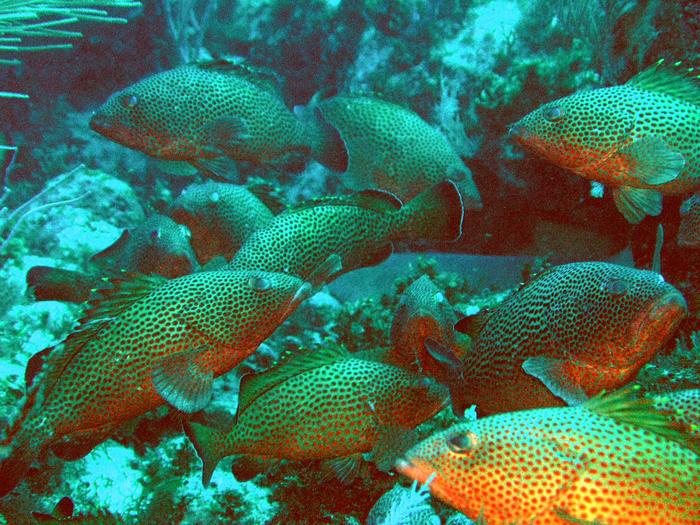
A dozen years of underwater eavesdropping has revealed something unexpected about red hind groupers: their love songs are changing, and scientists think it might signal major shifts in how these commercially important Caribbean fish reproduce.
Researchers at Florida Atlantic University’s Harbor Branch Oceanographic Institute analyzed more than 2,000 hours of grouper grunts recorded at a single spawning site off Puerto Rico’s west coast. What they discovered challenges assumptions about how fish populations adapt to environmental pressures.
Red hind groupers are peculiar creatures. They start life as females, then transform into males as they mature. Each winter, they travel over 30 kilometers to offshore sites where hundreds gather under the full moon to spawn in what marine biologists call fish spawning aggregations. Males produce rhythmic, low-frequency sounds to court females and defend territory from rivals.
The Sound of Romance Underwater
The study, published in ICES Journal of Marine Science, focused on two distinct types of calls. Researchers discovered that between 2011 and 2017, courtship calls dominated during peak spawning periods. But starting in 2018, something shifted dramatically.
“This shift could indicate changes in the population, such as an increase in the number of older or more dominant males, changes in sex ratios, or even a shift in the core spawning area,” said Laurent Chérubin, lead author and research professor at FAU Harbor Branch.
Territorial and competitive calls became dominant, nearly tripling over the study period. The researchers also observed spawning spread across more days in each lunar cycle than in previous years, suggesting fundamental changes in reproductive behavior.
The analysis was made possible by FADAR, an advanced machine-learning tool that can detect and distinguish between different types of mating calls with extraordinary speed and accuracy. Without this technology, processing 12 years of acoustic data would have taken years rather than weeks.
Early Warning System for Fish Populations
The implications extend beyond academic curiosity. Red hind groupers are especially vulnerable to overfishing during spawning season because of their predictable gathering patterns. Traditional survey methods require boats, divers, and favorable weather conditions. Passive acoustic monitoring can operate continuously in remote locations without disturbing the animals.
“What’s remarkable is that even a single underwater microphone can reveal so much about fish populations,” said Chérubin. “With consistent long-term monitoring, we can pick up early warning signs – like shifts in spawning behavior or population stress – and give resource managers the information they need to adapt conservation strategies before it’s too late.”
The timing of spawning aggregations follows a predictable pattern tied to lunar cycles and water temperature. When seawater reaches between 25°C and 27.5°C during winter months, and currents slow around the full moon, the groupers gather to reproduce. This predictability makes them valuable to fishermen but also vulnerable to overexploitation.
The research team combined acoustic monitoring with underwater visual surveys to confirm that increases in calls corresponded with increases in fish density. However, peak density didn’t always align with peak calling activity, suggesting complex social dynamics within the spawning aggregations.
The shift in call types could indicate several scenarios. An increase in older, more dominant males might explain the rise in territorial calls. Alternatively, the core spawning area might be shifting away from the monitoring location, with competitive calls traveling farther than courtship sounds.
Environmental factors may also play a role. The researchers noted that reproductive phenology is sensitive to climate change, with modeling studies suggesting potential delays in spawning seasons over decadal timescales. Changes in ocean circulation patterns could force fish to seek new spawning locations with more favorable current conditions.
The study demonstrates how advanced acoustic technology can transform understanding of marine ecosystems. By listening to underwater soundscapes, researchers can detect not just when and where fish spawn, but how those patterns change over time, offering vital insights into ecosystem health.
As passive acoustic monitoring becomes more sophisticated, it’s opening new possibilities for fisheries management. Rather than relying solely on catch data or periodic surveys, managers could potentially track reproductive behavior in real-time, adjusting conservation measures based on acoustic early warning signs.
For red hind groupers, the changing chorus of underwater calls tells a story still being deciphered. Whether the shift represents adaptation, stress, or simply the natural variability of marine populations remains an open question requiring continued monitoring and research.