
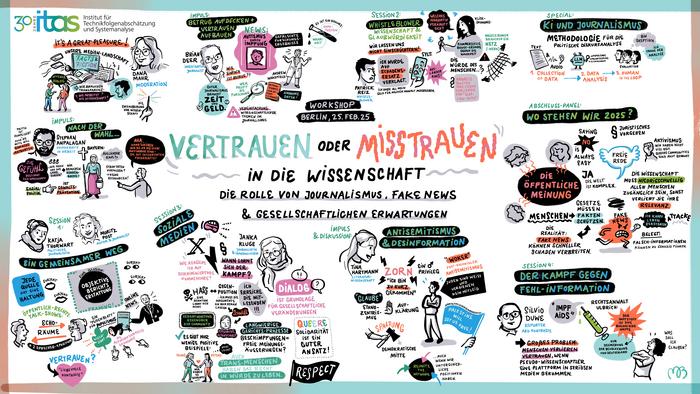
The common narrative suggests trust in science is collapsing across the globe. But according to science journalists working on the front lines of public communication, the reality is far more complex (and perhaps more hopeful) than the alarm bells suggest.
A new study published in the Journal of Science Communication reveals that journalists in Germany, Italy, and Lithuania describe themselves not just as information conduits, but as active “trust brokers” negotiating constantly with their audiences about the credibility of scientific claims. The research, conducted by the Institute for Technology Assessment and Systems Analysis at Germany’s Karlsruhe Institute of Technology, involved 87 media professionals across three distinctly different media ecosystems.
“According to the journalists involved in our study, trust in science is not collapsing. That was kind of a surprise for me, because in the media and in discussions among researchers there’s this idea of a collapse, while participants in our study see trust as being constantly negotiated.”
So says Nora Weinberger, one of the study’s researchers, whose findings challenge the prevailing doom-and-gloom narrative about public faith in scientific institutions.
Trust Depends on Context, Not Credentials
The journalists interviewed described a fragmented landscape where scientific expertise gets filtered through political and emotional lenses. In Germany, one participant observed that people no longer evaluate scientific facts independently. Instead, they accept or reject science based on whether it aligns with their political identity.
This shift represents a fundamental change in how authority operates in the digital age. Where scientific credentials once carried weight across social groups, trust now depends heavily on perceived ideological alignment and emotional resonance.
The COVID-19 pandemic served as a defining moment, according to the study. Initial public enthusiasm for expert guidance gave way to confusion and skepticism as scientific recommendations evolved. The public struggled to distinguish between normal scientific uncertainty and perceived inconsistency, creating fertile ground for mistrust.
In Italy, the situation appears even more precarious. Science journalism there operates as what one Italian participant called a “luxury” (getting attention during crises but otherwise ignored). This episodic coverage pattern undermines the consistent public engagement needed to build lasting trust relationships.
Lithuania faces different challenges entirely. With few full-time science specialists and a small media market shaped by its post-communist history, science coverage often falls to generalists or depends on collaborations with universities and research centers.
The Click Economy Shapes Coverage
Perhaps most concerning for long-term trust building is how online engagement metrics now determine editorial decisions. The same article gets published in print and online, researchers found, but if it generates no clicks online, the topic disappears from future editorial discussions.
“The journalists in our focus groups expressed the idea that basically you cannot do journalism on climate change because the public is overladen with information. Basically they are tired of the topic of climate change.”
This dynamic creates a vicious cycle. Important but less sensational scientific topics (from vaccine research to incremental climate findings) get sidelined in favor of content that attracts immediate attention. The resulting gaps in coverage create space for what the researchers diplomatically term “alternative information” driven by specific political agendas rather than evidence.
The algorithmic logic of digital platforms compounds these problems. Journalists described feeling trapped between their professional obligation to provide nuanced, accurate reporting and the platform dynamics that reward emotionally charged or polarizing content.
Despite these constraints, the journalists in the study expressed a strong sense of responsibility for building public trust in science: a role that extends well beyond their formal job descriptions. They’re experimenting with new formats: interactive podcasts, Q&A sessions, and community engagement initiatives designed to foster dialogue rather than one-way information transmission.
This represents a significant shift in journalistic identity. Rather than maintaining traditional objectivity and distance, many science journalists now see themselves as active mediators working to strengthen the social contract between science and society.
The strategies they’re developing include greater transparency about uncertainty, more collaborative relationships with audiences, and formats that allow for sustained engagement rather than hit-and-run coverage. Some are building relationships within digital communities, adapting content to platform affordances without compromising scientific accuracy.
Yet individual efforts can only go so far. The study’s authors emphasize that supporting quality science journalism requires structural changes: more stable funding models, dedicated science desks, investigative funds, fact-checking units, and ongoing professional training.
Germany’s relatively robust science journalism infrastructure serves as a model, with dedicated desks in public broadcasters and major outlets, strong professional networks, and established fact-checking practices. These institutional supports help buffer journalists from pure market pressures, enabling more sustained, contextualized coverage.
The research suggests that trust in science journalism (and by extension, trust in science itself) depends less on individual reporting skills than on the broader conditions that enable quality journalism to flourish. In an era of digital fragmentation and contested expertise, the messenger may be as important as the message.
For science communication, this means recognizing journalists not just as neutral transmitters of information, but as active participants in the ongoing negotiation of public trust. Their success in that role depends on having the institutional support, professional autonomy, and audience engagement necessary to build lasting relationships rather than chasing fleeting attention.
Journal of Science Communication: 10.22323/2.23050208
ScienceBlog.com has no paywalls, no sponsored content, and no agenda beyond getting the science right. Every story here is written to inform, not to impress an advertiser or push a point of view.
Good science journalism takes time — reading the papers, checking the claims, finding researchers who can put findings in context. We do that work because we think it matters.
If you find this site useful, consider supporting it with a donation. Even a few dollars a month helps keep the coverage independent and free for everyone.