

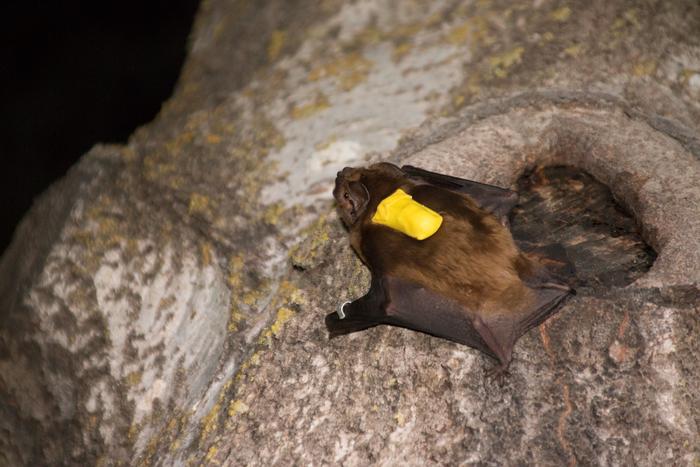
After a quarter century of speculation, scientists have finally proven how Europe’s largest bat, the greater noctule, pulls off its most audacious feat: catching and eating songbirds while flying more than a kilometer above the ground.
The discovery, published in Science, confirms that these elusive bats do not merely scavenge bird remains but actively hunt, strike, and devour migrating passerines during nocturnal flights. The research team, led by Aarhus University and the Leibniz Institute for Zoo and Wildlife Research, used advanced biologging technology to record the bats’ movements, altitude, and echolocation calls in real time.
Tracking the Hunter in the Night Sky
To uncover this mystery, researchers equipped greater noctule bats (Nyctalus lasiopterus) with miniature “backpacks” containing sensors and microphones. These biologgers tracked how the bats soared into the night sky, zeroed in on their targets, and executed high speed dives in pursuit of migrating birds. Some of these chases lasted nearly three minutes, ending in a mid air kill.
The team discovered that the bats’ low frequency echolocation calls allow them to detect birds that cannot hear ultrasound, giving the predators a significant advantage. Once within range, the bats attack, producing a rapid burst of short, intense calls.
Data from the devices revealed one bat diving for 30 seconds before aborting the chase, while another pursued a bird for 176 seconds, ultimately catching it near the ground. The microphone captured 21 distress calls from the unfortunate prey, followed by 23 minutes of chewing sounds as the bat ate its meal in flight.
“It is fascinating that bats are not only able to catch them, but also to kill and eat them while flying. A bird like that weighs about half as much as the bat itself. It would be like me catching and eating a 35 kilo animal while jogging,” said Assistant Professor Laura Stidsholt of Aarhus University.
By combining the audio data with DNA and X ray analyses of songbird remains found near the bats’ roosts, the researchers pieced together the full picture: the greater noctule kills its prey by biting through vital areas, removes the wings to reduce drag, and then uses the membrane between its hind legs like a pouch to eat the bird while airborne.
A 25 Year Scientific Pursuit
The breakthrough confirms a long standing hypothesis first proposed by Spanish biologist Carlos Ibanez more than two decades ago. Ibanez had discovered feathers in noctule bat droppings and suspected that they preyed on birds, but direct evidence proved elusive. Because the bats hunt at night, filming their behavior was nearly impossible. Over the years, his team at the Donana Biological Station in Seville tried everything from radar and high altitude microphones to GPS trackers, but none could fully capture the hunt in progress.
The lightweight biologgers developed by Aarhus University finally solved the technical challenge. The recordings not only documented a successful kill but also captured the chilling sequence of bird distress calls followed by silence, a moment the team described as both emotional and exhilarating.
“While it evokes empathy for the prey, it is part of nature. We knew we had documented something extraordinary. For the team, it confirmed what we had been seeking for so long,” said study co author Elena Tena.
The greater noctule remains one of Europe’s rarest and most endangered bats, its habitat shrinking as mature forests disappear. Scientists emphasize that its diet poses no threat to migratory bird populations; rather, the findings highlight the complex, often hidden relationships in nocturnal ecosystems.
For Ibanez, who has studied these bats for decades, the discovery is the culmination of years of persistence. With modern tools finally catching up to his early insights, the noctule’s secret hunting method, long doubted by many, has been definitively confirmed.
“It is a remarkable example of how persistence, patience, and technology can finally illuminate a behavior that has evaded science for generations,” said Stidsholt.