

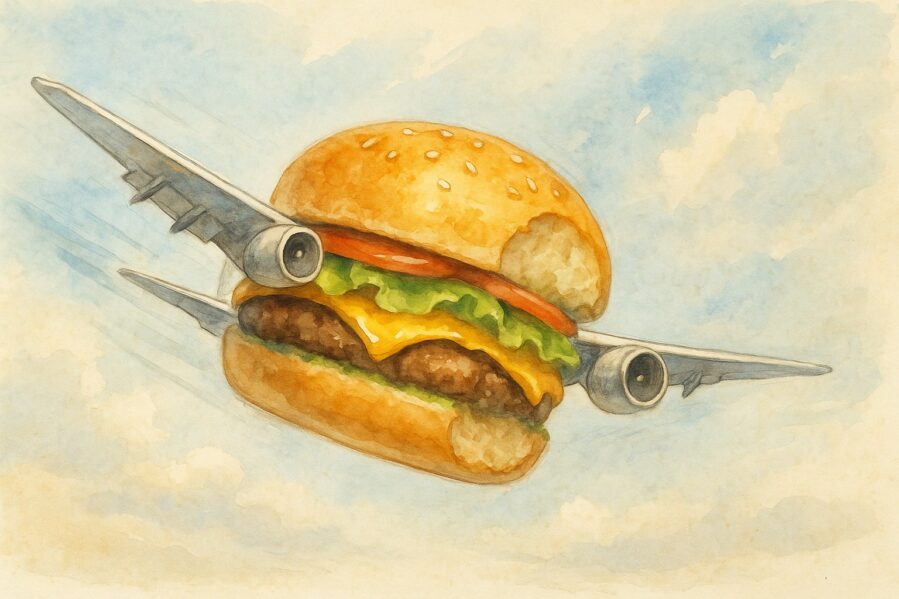
In a lab filled with stainless steel and the low hiss of gas lines, Illinois researchers watched cloudy biocrude turn bright and clear. The chemistry was not just elegant, it was aimed squarely at aviation’s emissions problem. A University of Illinois Urbana-Champaign team reports a way to turn food waste into sustainable aviation fuel that meets key industry screens without blending with fossil fuels, according to a new Nature Communications study published October 30, 2025.
The recipe begins with hydrothermal liquefaction, or HTL, which converts wet food waste into a dense biocrude. After pretreatment to pull out salts and ash, the team ran a single-stage catalytic hydrotreating step. They screened and optimized temperature, hydrogen, retention time, and catalyst loading, and identified a commercial cobalt molybdenum catalyst as the top performer. The result was a jet-range cut that passed Tier Alpha and Beta prescreening against ASTM benchmarks for conventional jet fuel without additives or fossil blending.
Lead author Sabrina Summers explains the basic physics and promise of the feedstock conversion.
“HTL basically mimics the natural formation of crude oil in the Earth. It uses high heat and pressure to convert wet biomass into a biocrude oil.”
That biocrude is messy at first. It carries oxygen, nitrogen, and sulfur that must be stripped for drop-in performance. The Illinois group reports complete oxygen and nitrogen removal in its best runs, with sulfur down to 10 ppm, under the ASTM limit of 15 ppm. Critically, the fuel’s density, kinematic viscosity, flash point, freeze point, and lower heating value all landed within specification ranges during prescreening. Specific energy was high, a reflection of the product’s abundant n-alkanes, while cycloalkanes and modest aromatics helped with handling and seal swell. The team notes that increasing lightly branched isoalkanes through an added isomerization step could further improve cold flow and raise yield, which, yes, is exactly the kind of practical knob industry will want to tune.
From Waste Streams To Wing Tanks
The study tackled more than lab performance. It asked whether such a pathway would meaningfully bend the aviation sector toward circularity. Using a Circularity Index framework, the authors estimate that routing U.S. food waste through HTL and hydrotreating could improve energy circularity by 31.1% and carbon circularity by 17.0% relative to conventional jet fuel. Those are system-level indicators, not certification stamps, but they point to gains if municipalities and biorefineries can capture today’s landfilled calories and redirect them into turbines.
The route also sidesteps a chronic constraint for existing SAF pathways that depend on clean lipid streams. Food waste is abundant, wet, and heterogeneous, which usually makes it a headache. HTL turns that wetness into an advantage by using water as the reaction medium, avoiding expensive drying. Then the hydrotreating step does the heavy lifting, cutting heteroatoms and shifting the boiling point distribution toward jet-range fractions. Temperature mattered most for average carbon number, the team found, with higher temperatures and tuned retention times driving the product closer to Jet-A’s C8 to C16 envelope.
Of course, nothing about scale-up is trivial. Polymerization at mild conditions can steal yield to char. Push severity too far and cracking and gasification nibble away at liquids. Catalyst deactivation is a constant risk when trace metals or nitrogenates sneak through pretreatment. The practical answer, suggested by the authors, is reaction engineering and catalyst development focused on isomerization, plus continuous-flow hydrotreaters to improve mass transfer and reduce coke.
Coauthor Yuanhui Zhang, who has developed a circular bioeconomy index used in the paper’s analysis, framed the stakes in refreshingly plain terms.
“In this project, we take the waste and recover the energy and materials to make a usable product.”
I will add one cautionary note. The prescreening success means the fuel behaved like jet fuel in critical properties under Tier Alpha and Beta, but full ASTM D4054 qualification is a longer road. Feedstock variability also looms. Even with careful pretreatment, the composition of food waste shifts with season and supplier, which can wobble density and freeze point toward their limits. The authors acknowledge that limited blending could still be prudent if those parameters drift.
Aviation’s Bigger Decarbonization Puzzle
Still, this study clears a key hurdle: it shows that wet, low-value waste can be pushed through a realistic, single-stage upgrade to make a neat jet fuel candidate. That matters because the United States SAF Grand Challenge calls for ramping to 100% of domestic jet demand with net-zero carbon by midcentury, and no single pathway will carry that load. Food waste will not either, but it could be a sturdy leg under the stool alongside municipal solid waste, forestry residues, and engineered lipids.
I kept thinking about the scene the paper sketches indirectly, a drum of brown biocrude easing toward clarity as hydrogen flows and the reactor hums. It is not glamorous. It is methodical and slightly stubborn, like much of decarbonization. Yet if airports one day fuel flights with energy recaptured from yesterday’s leftovers, the stubborn work in this lab will have helped make that mundane miracle possible.