

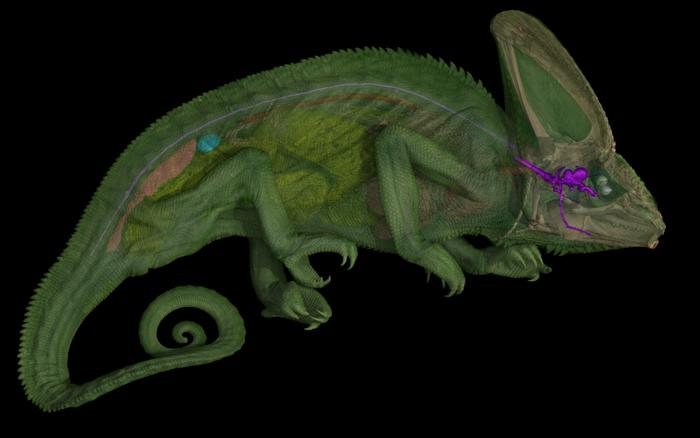
The chameleons two wandering eyes have teased natural philosophers for millennia. Now high resolution CT scans reveal the hidden hardware: telephone-cord-like optic nerves, coiled inside the skull to give each eye unusual slack.
Researchers from the Florida Museum of Natural History and collaborators describe a long, looping optic nerve in three chameleon species that is unlike the straighter, shorter pathways seen across other lizards. The unusual geometry appears to solve a mechanical problem posed by chameleon life on branches, where an ambush hunter must rotate each bulging eye widely while the head and neck stay mostly still.
The discovery did not come from a scalpel. It came from non destructive digital anatomy. In 2017, while reviewing CT data from a minute leaf chameleon, a visiting scientist noticed a strangely coiled tract running from the optic chiasm to the eye. That spiral reappeared in additional species once the team tapped open access oVert datasets and generated detailed 3D brain models. Side by side, the optic nerves in chameleons were consistently longer than the straight line distance they needed to cover, a telltale sign of built in slack.
Picture a telephone handset cord dangling beneath the eye socket, except this cord is tucked out of sight. When the eye pans or tilts, the extra length unspools smoothly rather than tugging on nerve tissue. The effect is subtle in life yet striking in the reconstructions, with multiple inflection points that let the nerve bend, twist, and reorient before it reaches the sclera.
A Puzzle That Outlived Aristotle And Newton
Human curiosity about chameleon vision stretches back at least two thousand years, but the anatomy proved slippery. Aristotle once suggested the eyes linked directly to the brain. In the 1600s, Domenico Panaroli argued the optic nerves did not cross, an idea later echoed by Isaac Newton in Optiks. A few observers drew the crossing correctly, but dissections tended to disturb or destroy the nerves in situ, obscuring any coils and keeping the most important clue off the page.
The new scans also track when the geometry arises. In veiled chameleon embryos, the optic nerves are straight early on, then elongate and loop before hatching. Hatchlings emerge with the adult pattern already in place, ready for two freely roaming eyes that can snap to binocular alignment the instant a cricket comes into range.
“Chameleon eyes are like security cameras, moving in all directions,” explained Juan Daza, associate professor at Sam Houston State University and author of a new study describing the trait.
Function follows form. Across vertebrates, large eyes demand a way to expand the field of view. Owls and lemurs swivel their necks because their eyes barely move. Primates and rodents rely on stretchy nerves or wavy fibers for limited give. Chameleons, with stiffened trunks and reduced neck mobility, appear to have evolved an alternative: a coiled nerve that provides slack for extreme rotations without strain.
The team quantified this by comparing the actual nerve length to the straight line distance from the optic chiasm to the eye. In chameleons, ratios routinely exceeded 1, sometimes by a wide margin, while most other lizards clustered near 1. Even among species known for active visual behaviors, the chameleon pattern stood out, suggesting that the telephone cord solution is not just rare, it may be unique within squamates.
Open Data, New Angles, And A Broader Hunt
The study leans heavily on oVert, a multi institution effort that is placing thousands of vertebrate scans online. That open pipeline turned a chance sighting into a comparative analysis, spanning dozens of lizards and snakes. It also shows why digital imaging has become a mainstay in museum science. With microCT and iodine staining, the scientists could inspect fragile cranial nerves without cracking skulls or tearing tissue.
“But if you physically dissect the animal, you lose information that can tell the full story.”
The authors now want to test whether other tree dwelling lizards converge on similar designs, and to model how coiling changes nerve strain during eye movements. On an evolutionary timeline, the feature likely emerged after chameleons split from their agamid relatives, along with grasping feet, prehensile tails, and ballistic tongues. Fossils offer few direct clues, but the functional logic is tantalizing. If your neck cannot help you scan, your eyes must do more, and your nerves need a safe way to follow.
It is a neat coda to centuries of fascination. Aristotle and Newton had pieces of the puzzle. CT, open data, and a second look at old assumptions supplied the twist. The eyes still roam like tiny periscopes. Now we know the cords are coiled.